
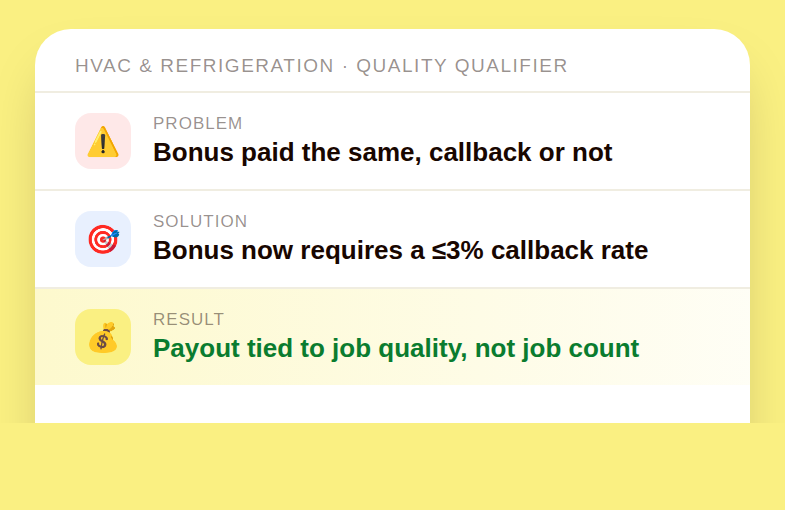
A mid-sized HVAC and refrigeration company was paying the same bonus whether a job held up or came right back as a callback. Tying the payout to a 3% callback rate fixed that, and gave techs a reason to slow down and do it right the first time.
The bonus that paid out no matter what
Most HVAC and refrigeration shops run some version of the same incentive plan: a tech closes a job, hits a revenue number or a job count, and a bonus shows up in the next paycheck. It is simple to explain and simple to run payroll on. It also has a blind spot that does not show up until the callbacks start piling up.
A mid-sized HVAC and refrigeration service company ran into exactly this. Their commission plan paid out on completed jobs, full stop. It did not matter if the compressor the tech installed lasted three years or three weeks. It did not matter if the customer called back the next morning because the unit was still short-cycling. The bonus check looked the same either way.
That is a reasonable way to build a plan when a company is small and every job gets eyeballed by an owner who knows every truck and every customer. It stops being reasonable once headcount grows and the person cutting checks is not the person hearing the complaints. By the time this owner sat down to look at the numbers, the pattern was hard to ignore: a handful of techs were closing jobs fast, getting paid fast, and generating a disproportionate share of the callback volume. Everyone else, the ones doing careful diagnostic work and slower, cleaner installs, were earning the same bonus for meaningfully better outcomes.
This is a common failure mode in HVAC incentive pay, and it is worth naming clearly: a bonus tied only to volume is not a quality incentive. It is a speed incentive wearing a quality incentive's clothes. Techs are smart, and they respond to whatever the plan actually measures, not to what the owner hoped it would measure. If callbacks do not cost anything, callbacks will happen more often, because rushing is faster and rushing pays exactly as well as care does.
The fix this company landed on was not complicated, but it required a mindset the industry sometimes resists: making the bonus conditional. Not on some vague quality score nobody can define, but on a single, plain number every tech already understands. Callback rate.
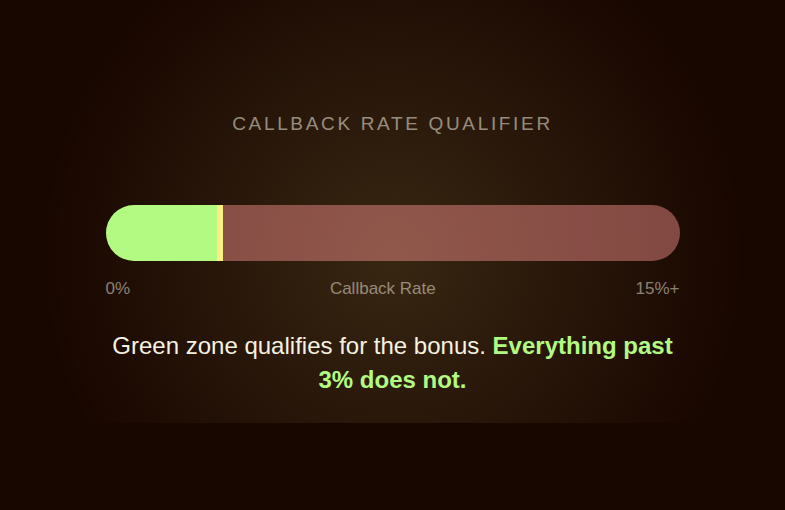
Here is the rule they put in place. If a tech's rolling callback rate sits at 3% or lower, the incentive pays out in full, exactly as it always did. If it climbs above that line, the bonus does not pay, regardless of how much revenue that tech closed that period. No partial credit, no sliding scale, no manager override for a good excuse. The threshold either holds or it does not, and everyone on the team can look up their own number and know exactly where they stand before payday arrives.
That last part matters more than it sounds. A lot of quality-linked pay plans fail not because the idea is wrong but because the math is invisible. Techs hear "we factor in quality" and have no way to check the work themselves, so it feels arbitrary, even when it is not. A callback rate is different. It is a number every dispatcher already tracks, it updates in something close to real time as jobs close, and a tech can watch it move week to week the same way they watch their truck's mileage. When the qualifier is legible, buy-in stops being a hard sell.
Why the threshold, and why 3%
The owner did not pull 3% out of thin air. It came from looking at what "acceptable" actually looked like across the team once the callback data was pulled together in one place instead of scattered across service tickets and a dispatcher's memory. A small amount of callback activity is unavoidable in this trade: parts fail, homeowners misuse equipment, weather does things no diagnostic checklist predicts. The threshold was set to absorb that normal noise while still catching the pattern that mattered, which was a cluster of technicians whose callback rate ran two, three, sometimes four times higher than their peers.
That is the piece worth borrowing even if your number is not 3%. The goal is not to punish every callback; it is to separate ordinary variance from a real quality gap, and then price that gap into the paycheck. A threshold set too tight turns into a plan nobody ever qualifies for, which kills morale faster than having no incentive at all. Set too loose, and it stops changing behavior because it never actually bites. Getting this right takes real job-level data, not a gut-feel number picked in a Monday meeting.
This is the part where a lot of shops get stuck, not because the concept is hard, but because the data lives in three different places. Callback tickets sit in the field service platform, commission math sits in a spreadsheet, and nobody has time to reconcile the two every pay period by hand. That reconciliation gap is exactly what ShareWillow's incentive pay platform exists to close: it pulls directly from the job data a shop already has in systems like Housecall Pro or ServiceTitan, calculates the callback rate per technician automatically, and applies the qualifier before a single check gets cut. Nobody is eyeballing a report at 11pm on payday trying to figure out who crossed the line.
There is a second, quieter benefit to automating this instead of running it by hand. When the qualifier is calculated the same way every period, techs stop suspecting favoritism. Nobody can argue that a manager fudged the number for a favorite tech or missed a callback for someone they liked. The rule applies identically to every technician on the plan, which turns a potentially uncomfortable conversation about pay into a straightforward one about performance. That shift alone, from "why didn't I get paid" to "how do I get my number under 3%," changed how techs on this team talked about callbacks in their own huddles, without anyone from management having to push it.
None of this required the company to invent a new pay structure from scratch. The base commission stayed the same. The only thing that changed was the gate in front of it, and that single change did more to shift daily behavior than the entire rest of the plan combined.
Profit sharing
made simple.
Give your team a stake in the company’s success. ShareWillow helps you create and manage profit-sharing programs that motivate employees and drive business results.
What changed, and what to watch for if you try this
The most immediate result was not a dollar figure; it was a behavior change. Techs started double-checking refrigerant charge and static pressure readings before calling a job complete, because for the first time, that extra five minutes had a visible connection to their paycheck. Diagnostic notes got more thorough, since a well-documented job is easier to defend if a callback does happen for reasons outside the tech's control, like a part failure. And the conversation between dispatch and the field changed too. Callback rate stopped being a number that only leadership saw in a monthly report and became something techs asked about proactively.
For the business, the payoff shows up in a few places that do not always make it into a bonus press release but matter just as much to the bottom line. Fewer callbacks means fewer unpaid or discounted return trips eating into a tech's day and the shop's fuel and labor cost. It means better online reviews, since a callback is often the moment a customer's trust in the whole company wavers. And it means a cleaner signal for who deserves to lead an install crew or train a new hire, because callback rate is a far more honest measure of technical skill than raw job count ever was.
If you are considering a version of this for your own team, a few things are worth thinking through before you flip the switch. First, pick a threshold using your own historical data, not an industry rule of thumb; what counts as normal variance in a commercial refrigeration shop will look different from a residential HVAC install team. Second, decide up front how you will handle edge cases, like a callback caused by a defective part rather than workmanship, so techs trust the number reflects their actual performance. Third, and this is the one shops skip most often, make the number visible to the tech in near real time. A qualifier that only reveals itself on payday feels like a trap. A qualifier a tech can check on their phone before they leave a job site feels like a scoreboard, and scoreboards change behavior in a way surprise penalties never do.
This kind of plan also tends to work better as one piece of a broader incentive structure rather than the whole thing. Pairing a quality gate like this with the kind of predictable, transparent payout structure covered in how one HVAC company closed its pay gap between revenue and commission gives techs both a reason to work efficiently and a reason to work well, instead of forcing a trade-off between the two.
The lesson underneath all of it is not really about the number 3%. It is about what a bonus plan actually measures, and whether that measurement matches what the business needs from its techs. A plan that pays the same for a callback as it does for a clean job is, whether anyone intends it or not, a plan that is quietly asking for more callbacks. Fixing that does not require a bigger bonus pool or a more complicated formula. It requires making sure the thing you are paying for is the thing you actually want more of.
What this means if you are the one signing the checks
Owners and operations managers tend to feel callback costs before they can name them. A truck rolls a second time, a tech's afternoon schedule slides, and a customer who was already annoyed gets a little more annoyed. None of that shows up as a clean line item on a P&L, which is exactly why it is easy to underestimate. When this company started tracking callback rate alongside commission, they finally had a number that made the true cost visible instead of buried inside "miscellaneous truck rolls." A callback rate qualifier does not just change tech behavior; it gives ownership a metric worth watching every month, the same way they already watch close rate or average ticket.
Facility managers and commercial account holders benefit from this shift too, even if they never see the incentive plan itself. A vendor whose techs are paid to get it right the first time is a vendor who shows up less often for the wrong reasons. If you manage a portfolio of properties and you are evaluating HVAC or refrigeration vendors, it is a fair question to ask directly: does your technician pay plan reward job count, or does it reward jobs that stay fixed? The answer tells you more about the vendor's long-term reliability than almost anything else on their sales sheet.
None of this has to be complicated to set up, but it does need real data behind it, not a guess. A rolling callback rate calculated from whatever your team is already logging in the field, checked against payroll before checks go out, is enough to start. The shops that get the most out of a plan like this are the ones that resist the urge to make it complicated. One number, one threshold, one honest conversation with the team about why it exists. Everything else is detail.
Related reading
Conclusion
A bonus that ignores callbacks is really just a bonus for speed, and speed alone is not the job.
Create incentives
that
drive results
You shouldn't need complex equity plans to align your team. ShareWillow makes it simple to create transparent profit-sharing programs that motivate employees and grow your business.

Incentive plans to help
small businesses thrive.
.png)
"I was able to leverage the knowledge of the ShareWillow team to learn how other companies were designing their bonus plans. The template was extremely helpful."

Brian Tustin
Owner, First Rate Movers
