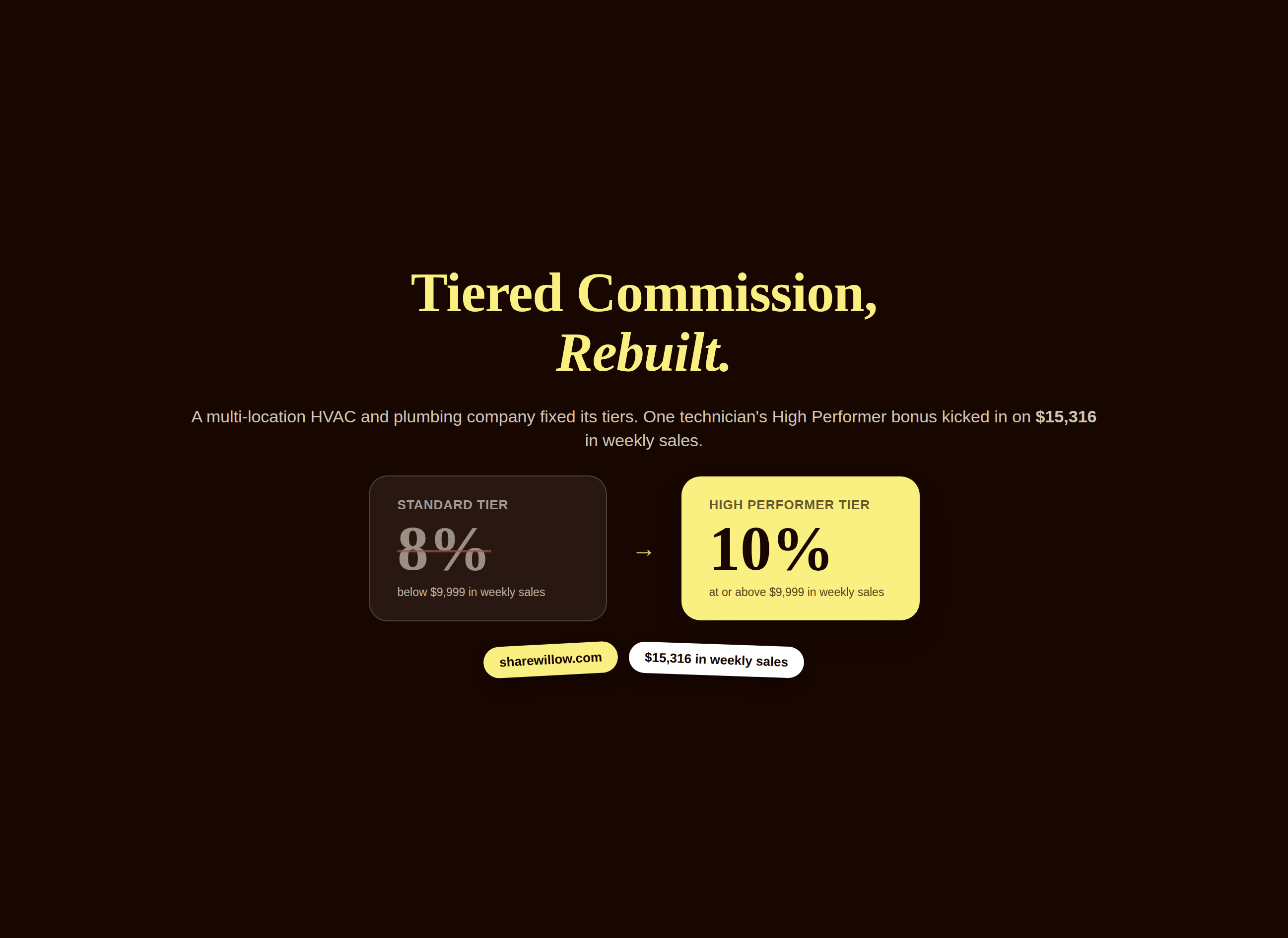
An HVAC commission structure fix aligned helper and lead job rules, closing a reconciliation gap and adding fair callback deductions on a $3,468 install.
A clean HVAC commission structure on paper can still shortchange people in practice, especially once a job involves more than one technician. That is what a growing HVAC company discovered when it looked closely at how it was paying install helpers, the second and third technicians on a job who are not the lead, and found two separate rules quietly working against each other.
The company runs commission for both install leads and install helpers: leads earn their share for jobs they run, and helpers split a separate helper amount based on how many people worked the install. A job with three helpers splits that amount three ways; a lone helper gets the full amount. It is a sensible structure. The trouble was that the eligibility rules behind it, meaning which jobs actually counted, had quietly drifted apart between leads and helpers.
The Problem: Two Roles, Two Different Sets of Rules
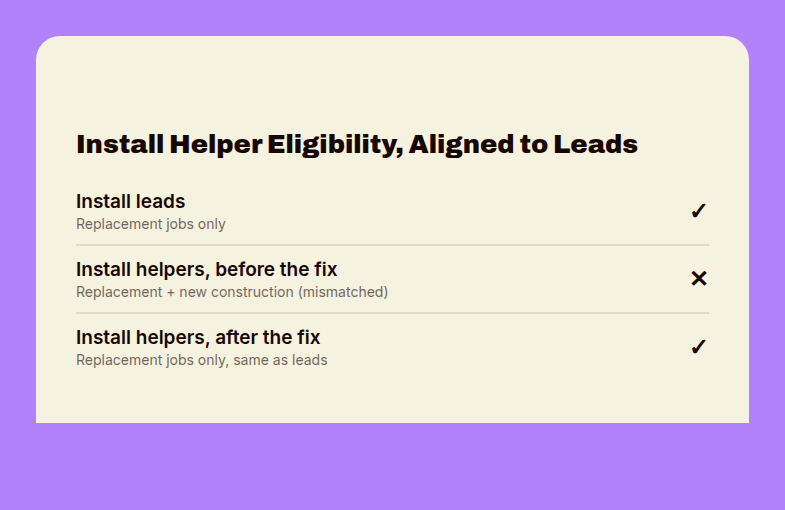
Install leads were already filtered correctly: only replacement jobs counted toward their commission, not new-construction work. Install helpers were not filtered the same way. Helper eligibility still included both replacement and new-construction jobs, which meant the two roles on the exact same crew were being measured against different definitions of a qualifying job. When the office ran its August review, the eligible-install total for one technician's helper commission showed $39.42, a number that did not reconcile against what it should have been under a replacement-only standard. Small as that figure looks, it was a symptom of a larger structural mismatch that would eventually apply to every install crew on the payroll, not just one technician in one month.
A second gap sat inside the same commission structure: callback handling. ServiceTitan automatically docks a callback against whichever technician is listed as the lead, even when a helper is the one who actually caused the issue that led to the return trip. That meant a lead could get penalized for a mistake a helper made, while the helper who caused it took no hit at all. It is a version of a problem familiar to any HVAC company running multi-technician install crews: the software only has one slot to assign responsibility to, so it defaults to the role that is easiest to track, whether or not that role is actually at fault.
Owners who design an HVAC commission structure around a single technician per job often do not notice the gap until the company scales past solo installs. Two-and-three-person crews are common on anything bigger than a routine service call, and the moment a second name enters the picture, every rule written with one technician in mind needs a second look: eligibility, callback responsibility, and what happens when a split needs to be corrected after the fact.
Both issues came to a head on a specific disputed job in late August, a $3,468.45 install the office manager and technicians later nicknamed the Wagner job. The lead on that job manually reassigned himself 100 percent of the commission split, expecting that to zero out what the other technicians on the crew would receive. Instead, the system kept paying automatic helper credit to technicians who were not supposed to be getting a share, because there was no straightforward way to simply remove a job from the underlying dataset once it had been logged. The company had run into a structural limit: it is much easier to add a rule to a commission structure than to cleanly undo one job's default behavior after the fact.
The Fix: Matching Rules and a New Accountability Field
The first fix was the simpler of the two: align install-helper eligibility with install-lead eligibility so both roles are measured against the same standard, replacement jobs only. That single change resolved the $39.42 mismatch and made the two roles on every crew comparable again, instead of one being filtered more strictly than the other for no operational reason.
The callback fix required something new: a separate, manually entered helper-callback field, distinct from the automatic lead deduction that ServiceTitan already applies. The field is set at $25 per callback and supports fractional entries, so a manager can assign half a callback's worth of responsibility, 0.5, when fault is genuinely split between two people on a job. Instead of every callback automatically landing on the lead by default, the office can now look at what actually happened and dock the technician who caused it, lead or helper, using a deduction built for exactly that purpose.
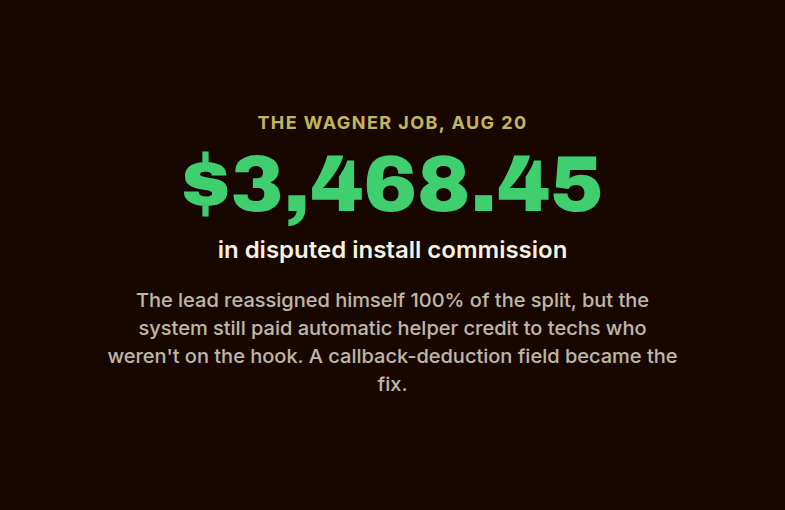
That same field turned out to solve the Wagner job dispute too, even though it was not originally built for that purpose. Since there was no clean way to exclude a specific job from the dataset once entered, the company used the callback-deduction field as a workaround: applying it to offset the unwanted automatic helper credit on that one job, rather than trying to manually unwind the entire pay period's calculations. It is not the most elegant solution, but it is a practical one, and it points to a real gap worth building for directly: any commission structure covering multi-technician jobs eventually needs a way to manually override or exclude a single disputed job without touching every other calculation around it.
The company also flagged a reporting gap while working through this: the helper view showed dollar amounts and technician names, but not the job name itself, which made it hard to investigate a specific attribution question without cross-referencing another system. Adding the job name directly to that view was queued as the next fix, a small change, but one that matters more than it sounds like it should when someone is trying to explain a pay discrepancy to a technician standing in front of them. Getting job-level detail into the same view as the payout is the same lesson another HVAC company learned the hard way in How a Small HVAC Crew Closed a $268 Payroll Gap in One Call, where tracing individual jobs end to end was what actually closed the gap, not the summary total.
Profit sharing
made simple.
Give your team a stake in the company’s success. ShareWillow helps you create and manage profit-sharing programs that motivate employees and drive business results.
The Result: An HVAC Commission Structure Where Both Roles Play by the Same Rules
Once the eligibility filters matched and the helper-callback field was live, the company's HVAC commission structure treated leads and helpers consistently for the first time: same job-type standard, and a real mechanism for assigning callback responsibility to whichever technician actually caused it. The $39.42 reconciliation gap closed. The $3,468.45 Wagner job dispute got resolved without a manual payroll override. And technicians, lead or helper, stopped absorbing blame or losing credit for jobs and callbacks that were not theirs to begin with.
None of this required a new commission plan. It required the existing plan's two roles, lead and helper, to actually run on the same rules, and it required a way to correct a single disputed job without unwinding an entire pay period. Multi-technician jobs are where most commission structures quietly break down, not because the base percentages are wrong, but because the software crediting the work was built with a single technician in mind and never fully extended to cover a second or third person on the same ticket.
Companies evaluating commission and incentive software for install crews should ask specifically how the platform handles multi-technician attribution and disputed jobs, not just how it calculates a percentage. A tool that can only credit one technician per job, or that cannot cleanly exclude a single job from a payout run, will eventually produce a version of the Wagner job dispute, whatever the trade. This same attribution gap shows up whenever premium pay depends on a job type field being set correctly, a pattern covered in more depth in The $28,448 Sale That Almost Paid the Wrong Technician.
Frequently Asked Questions
Should install helpers be paid on the same commission rules as install leads?
Generally, yes. If leads and helpers are being measured against different definitions of a qualifying job, such as one role excluding new-construction work and the other not, the two roles on the same crew end up paid inconsistently for doing the same category of work. Aligning eligibility rules across roles is usually the first fix worth making.
Who should be responsible for a callback: the lead or the helper?
Whoever actually caused the issue, not automatically whoever is listed as the lead technician. Most field service software defaults callback deductions to the lead because that is the easier field to track, which can penalize a lead for a helper's mistake. A separate, manually assignable callback deduction for helpers fixes that gap without removing the lead's own accountability.
How do you fix a disputed commission split after a job has already been logged?
Most platforms do not offer a simple way to delete or exclude a single job from a commission dataset. A manual deduction or adjustment field, applied to offset an incorrect automatic payout on that specific job, is usually the practical workaround until the platform adds a dedicated exclusion feature.
Related reading
Conclusion
Aligning helper and lead eligibility, plus a real callback-deduction field, turned a $3,468 dispute into a fixed commission structure.
Create incentives
that
drive results
You shouldn't need complex equity plans to align your team. ShareWillow makes it simple to create transparent profit-sharing programs that motivate employees and grow your business.

Incentive plans to help
small businesses thrive.
.png)
"I was able to leverage the knowledge of the ShareWillow team to learn how other companies were designing their bonus plans. The template was extremely helpful."

Brian Tustin
Owner, First Rate Movers