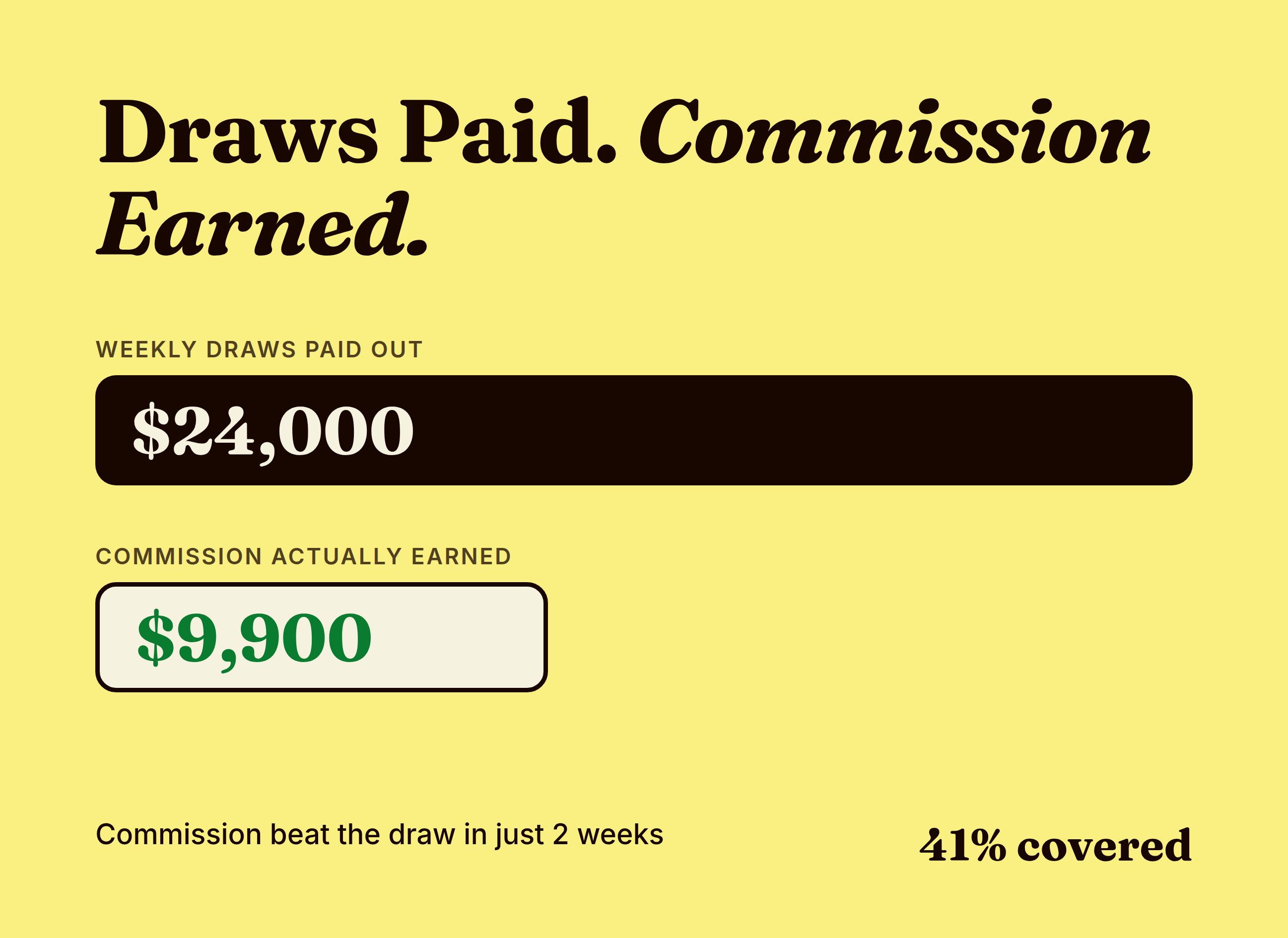
A residential HVAC company's commission data passed through four different systems before it reached a paycheck, and one missing tag was nearly enough to route a technician's biggest commission of the month to someone else. Here's how tightening that handoff caught the error before payday.
Ask most HVAC owners how commission gets from a signed work order to a technician's paycheck, and you'll get a confident answer. Ask them to actually trace one dollar through every system it passes on the way, and the confidence usually drops. That gap, between how a pay process is supposed to work and what it's actually doing behind the scenes, is where real money quietly goes missing. Not stolen. Not miscalculated on purpose. Just lost in a handoff nobody was watching closely enough.
That's close to what happened at a residential HVAC company running installs and VIP maintenance plans with a small, steady crew of technicians. The company's commission data didn't move in one clean step from job to paycheck. It moved in four: a technician's job got tagged in ServiceTitan, those tags fed a mapping spreadsheet the office maintained by hand, the mapping spreadsheet fed an integration tool, and that tool finally pushed clean numbers into ShareWillow for payroll. Every one of those handoffs worked most of the time. The problem was what happened on the pay periods when one of them didn't.
Quick facts
- Residential HVAC company running installs and VIP maintenance plans, ServiceTitan for job data, ADP for payroll
- Commission flowed through four systems: ServiceTitan tags, a manual mapping spreadsheet, an integration tool, then ShareWillow
- A completed $28,448.98 install was missing its sale tag and had the wrong salesperson attached
- The resulting $2,002.75 commission, at an 8% rate, was headed to the wrong technician's pay
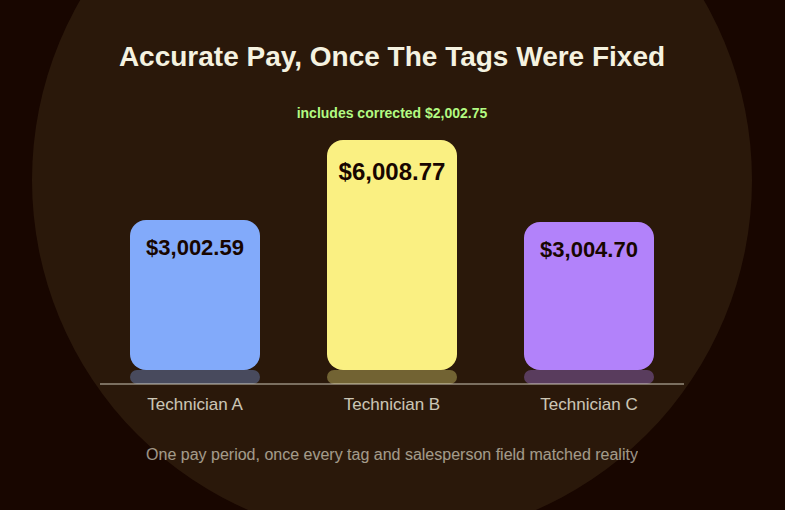
- After the fix, the pay period closed with technician payouts of $3,002.59, $6,008.77, and $3,004.70
The clearest example from that pay period involved a completed system installation worth $28,448.98, a real job, fully sold and finished, sitting in ServiceTitan with a full paper trail. It should have been simple. Instead, the job was missing the specific tag that tells ShareWillow this is a full system sale, and separately, the job's salesperson field had been set to the wrong technician entirely. Two small data problems, neither one dramatic on its own, stacked on top of each other on a single job. The result: an 8% commission worth $2,002.75 was on track to either disappear from the calculation entirely or land in the wrong person's pay, depending on which error got caught first.
A second, quieter issue was running in parallel. A batch of hourly performance pay events, worth $15 an hour each, were being filtered using the wrong ServiceTitan activity type. The report was pulling from a category effectively labeled not paid instead of the paid version of the same activity, so those hours were silently excluded from the sync. One technician's non-paid job time imported as 2.28 hours for a stretch of work that should have logged closer to ten. Nobody would have seen a red flag or an error message. The number just came in low, and low numbers on a payroll report tend to get accepted rather than questioned, especially when a business is moving fast.
How the Errors Actually Got Caught
What makes this story worth telling isn't the bugs themselves. Data pipelines with four handoffs will always produce the occasional mismatch, that's just what happens when systems built by different companies have to agree with each other every two weeks. What matters is whether anyone is positioned to catch the mismatch before a paycheck goes out wrong, not after.
In this case, it was a technician who caught it first, not a system. While reviewing pay data ahead of a scheduled sync, one team member manually cross-checked a colleague's jobs against the tags ShareWillow was reading and found five separate instances where the tags were simply missing. That kind of peer review is unglamorous and easy to skip when things are busy, but it's exactly the kind of check that catches what an automated sync can't: a tag that was never applied in the first place has nothing for the sync to find wrong. It just quietly produces a lower number, and a lower number without an error message is the hardest kind of mistake to notice.
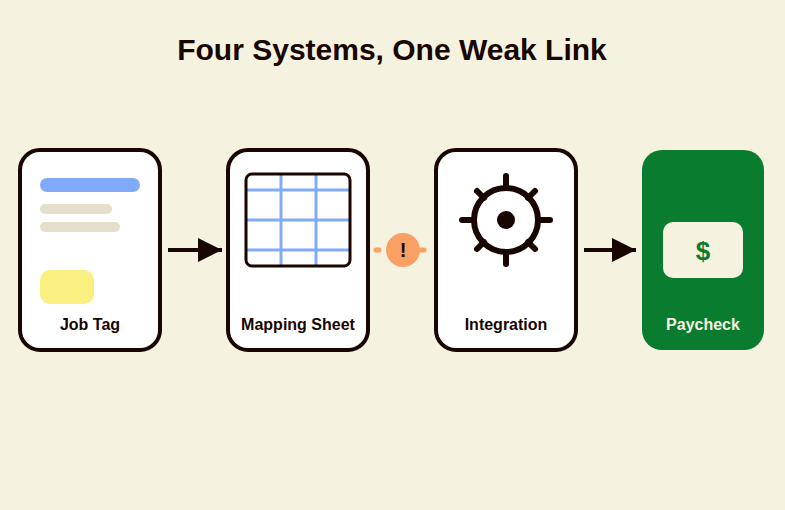
Once the missing tags and the misattributed sale were flagged, the fix itself moved fast: the sale tag got added, the job's salesperson field got corrected, and the ServiceTitan activity-type filter for the $15 hourly events got remapped from its incorrect not paid version to the correct paid one. Each of those is a small, specific correction. None of them required rebuilding the plan or renegotiating a single commission rate. They required someone to notice that the plumbing between systems had a leak, and to trace it back to the exact valve.
The more durable fix was procedural, not technical. The company standardized the tag names in its mapping spreadsheet so a future rename or typo couldn't silently break the same link again, and tightened the daily workflow around it: a technician debriefs with the operations team the same day a job closes, the person handling that debrief checks money-related tags first instead of last, and a second team member reviews the batch again the next morning before anything gets finalized. Technicians were also asked to log their own daily sale and maintenance counts and flag anything that didn't match what they saw in their own numbers, the same day, rather than waiting until a payday surprise forced the conversation.
That last piece matters more than it sounds. A commission pipeline with several handoffs is never going to be perfectly self-correcting. What makes it trustworthy isn't the absence of errors, it's a short enough gap between a mistake happening and someone catching it that it never reaches a paycheck. Two people checking tags a day apart is a small process. It's also the difference between a $2,000 commission landing in the wrong place for one pay period and a technician quietly losing faith that the numbers behind their pay are accurate at all. Take a look at how ShareWillow's tag-based commission tracking connects field service data straight through to payout, without the manual mapping step this company was running.
Profit sharing
made simple.
Give your team a stake in the company’s success. ShareWillow helps you create and manage profit-sharing programs that motivate employees and drive business results.
What The Numbers Looked Like Once They Were Right
Numbers are the easiest way to see what a fix like this is actually worth. Once the tag was added, the salesperson field was corrected, and the activity-type filter was fixed, the pay period closed with real, reconciled payouts: one technician at $3,002.59, a second at $6,008.77, driven largely by the corrected $2,002.75 commission on the $28,448.98 install, and a third at $3,004.70. Those are not projected numbers or best-case estimates. They're what actually went out the door once the data underneath them was accurate.
It's worth sitting with what almost happened instead. Left uncorrected, the technician who closed that $28,448.98 sale stood to lose a meaningful share of their commission for the period, and internally, the team estimated the exposure at up to roughly $1,000 from the missing tag and misattribution alone, before the full commission value was even factored in. For a technician who did the work, sold the system, and closed the job, that's not a rounding error. It's the difference between a pay period that reflects the month they actually had and one that quietly shortchanges them for a mistake that had nothing to do with their performance.
There's a broader pattern worth drawing out of a story this specific. Most owners think about incentive pay as a design problem: what rate, what threshold, what metric. Fewer think about it as a data-integrity problem, which is really what it is once a plan is live. A commission structure can be perfectly designed and still fail the people it's meant to reward if the pipeline feeding it has a weak link nobody's watching. That's especially true for HVAC companies running install-heavy revenue through ServiceTitan, where a single sale can represent a meaningful share of a technician's month, and a single missing tag can make that sale functionally invisible to payroll.
What To Check In Your Own Commission Pipeline
- Pick one big-ticket job from last month and trace it, tag by tag, from the job record to the actual paycheck line. Does the trail hold up at every step?
- If your commission process routes through a manual mapping spreadsheet or a middle tool between your field service software and payroll, ask when someone last audited it for renamed or missing tags.
- Ask technicians to flag pay discrepancies the same day they notice them, not at the end of the pay period. A same-day flag is a quick fix. A payday surprise is a trust problem.
None of this required a new incentive philosophy or a bigger commission budget. It required someone willing to trace a real dollar amount through every system it touched and fix the exact spot where it dropped out. If your own commission plan runs through more than one system before it reaches a paycheck, that's worth doing before your next big sale is the one that goes missing. Take a look at how ShareWillow's commission and payout tracking keeps that chain visible in one place, or read how another HVAC company caught a sixfold tracking error before it reached a single paycheck for a related look at what happens when nobody's checked the numbers in a while.
Related reading
Conclusion
A $28,448 sale nearly paid the wrong technician over one missing tag. Tracing the dollar through every system it touched caught it before payday.
Create incentives
that
drive results
You shouldn't need complex equity plans to align your team. ShareWillow makes it simple to create transparent profit-sharing programs that motivate employees and grow your business.

Incentive plans to help
small businesses thrive.
.png)
"I was able to leverage the knowledge of the ShareWillow team to learn how other companies were designing their bonus plans. The template was extremely helpful."

Brian Tustin
Owner, First Rate Movers