An HVAC owner found a technician credited with 71 hours of paid non-job time, and an $18,005 sale attributed to the wrong rep. Here's how catching both turned into a payroll system his whole team trusts.
"They Only Call Me When They're Missing Money"
The owner of a residential HVAC company in central Florida said something on a routine payroll review that every trades owner will recognize instantly, even if they've never said it out loud. He'd just found out one of his technicians had been credited with 71 hours of paid non-job time in a single pay period, at $15 an hour, nearly two full extra work weeks that shouldn't have existed. His response was half a joke and entirely serious: "It's funny how the guys only call me when they're missing money. But if I overpay them, they don't call me."
Then he played out the counterfactual, imagining the phone call that never comes: "Hey, boss. My check is too big this week. Something's wrong." A pause. "No. You ready?"
It's a genuinely funny line. It's also a precise description of a problem that costs real trades businesses real money every single pay period: payroll trust runs one direction. Underpay a technician and you'll hear about it within the hour. Overpay one and the silence can last for months, quietly compounding, until someone finally sits down and checks the math against what actually happened in the field.
An Owner Who's Still In the Field
This company runs residential HVAC service and installation in the Orlando area, with a team split across sales, install, and service. What stands out immediately, talking to the owner, is how hands-on he still is. During the same call where his team walked through payroll corrections, he took a live phone call from a technician in the middle of an unrelated job, a condenser-leveling issue that needed his input right then, and picked the review back up without missing a beat once it was handled.
That's not a small detail. It's the whole reason a system like this matters. An owner who's still fielding live technician calls, still making real-time decisions about jobs in progress, does not have the bandwidth to personally audit every payroll line every two weeks. He needs a system that catches the anomalies and hands him a short, specific list, not a spreadsheet he has to comb through himself. "They only call me when they're missing money" isn't a complaint about his technicians. It's an honest description of how much he was, until recently, flying blind on the other side of that equation.
The company's setup is a common one for growing HVAC businesses: one department runs cleanly through a job management platform, while a second department's incentive tracking, warranty adjustments, recall pay, and membership spiffs, lives in a manually maintained spreadsheet, referred to internally as "the bucket sheet." The staff member who maintains it takes real pride in the discipline it requires: "I always double check it and double check the numbers and everything before I put it on the sheet." That care matters, because unlike the automated department, there's no system double-checking behind her. As the owner put it plainly about that side of the business: "You're the only one that can get screwed. If somebody debriefs wrong or puts the wrong tag, that's when it gets dicey."
The Math That Almost Got Missed
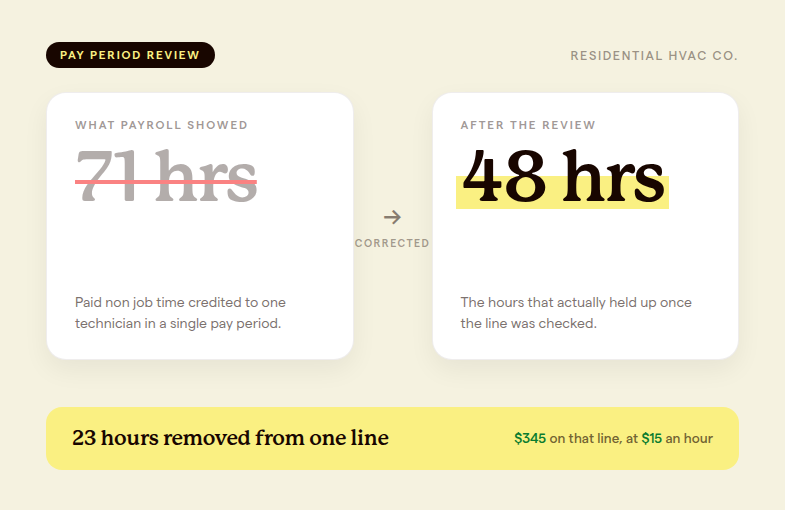
The 71-hour overage wasn't the only number that looked wrong once someone actually lined up every technician's paid non-job time for the pay period. Alongside it: one tech at 35 hours, another at 33, another at 18, another at 16. The owner didn't accept any of them at face value, specifically challenging the 35-hour figure as implausible on its own. Once reviewed, the 71-hour figure corrected down to 48, a difference of 23 hours on that single line, worth roughly $345 in that one pay period alone.
What made the moment land harder wasn't the dollar figure. It was the question that followed immediately, unprompted, once the pattern became clear: "That means this entire time from when we started to ShareWillow that we were giving them more money for events than we should have?" That's the real cost of a quiet payroll error: it's never just one pay period. It's every pay period since the error started, silently compounding, until somebody finally checks.
The team offered to audit the historical data back to onboarding and correct it, which visibly took the tension out of the conversation. This is the part of the story worth sitting with if you run a shop of any size: finding an error is uncomfortable for exactly as long as it takes to also see a plan for fixing it. The discomfort isn't the problem being found. It's not knowing what to do about it.
The $18,005 Sale Credited to the Wrong Person
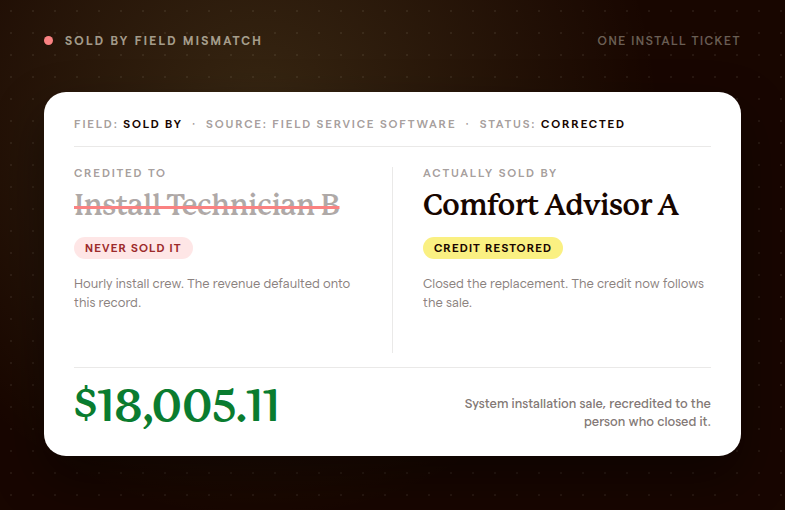
A separate issue surfaced the same day, one with a sharper edge to it. A full system installation worth $18,005.11 had been credited, in the official reporting field, to a salesperson who hadn't sold it. The cause was a mismatch between two fields inside the company's job platform, an official "sold by" field used for reporting, and a separate custom field staff had been using day to day. The two had drifted out of sync.
The owner's reaction wasn't frustration, it was something closer to delight at finally having a tool sharp enough to catch it: "This is very interesting that we could actually find out the incorrect jobs by looking at this. That tech has never sold a system in his life." The credit moved to the technician who'd actually earned it. Multiply a mistake like that across a busy sales season, and it's not hard to see how a top performer could quietly watch their numbers, and their pay, drift below what they'd genuinely earned, month after month, without anyone noticing until someone finally cross-references the two fields.
Simplifying the Language, Not Just the Math
One of the more understated fixes from this review wasn't a number at all. It was a word. Staff kept getting confused about the difference between a "warranty" tag and a "recall" tag on jobs, and that confusion was translating into inconsistent pay adjustments. The owner's own explanation of the problem is worth quoting directly, because it's plainer and more useful than most consultants could manage: "The word warranty is very deceiving. It's just who are we gonna pay 25 dollars for, or who are we gonna take away 25 dollars for. That's what that tag means. That's why the girls are getting confused."
That's the whole insight in two sentences. An incentive plan doesn't fail because the math is wrong. It fails because the people entering the data every day don't have a plain-English handle on what each label actually means for their paycheck. Once the tags got renamed around what they actually do, pay it or dock it, the confusion cleared up immediately, no retraining required.
Profit sharing
made simple.
Give your team a stake in the company’s success. ShareWillow helps you create and manage profit-sharing programs that motivate employees and drive business results.
What Got Tracked Once the Numbers Were Trustworthy
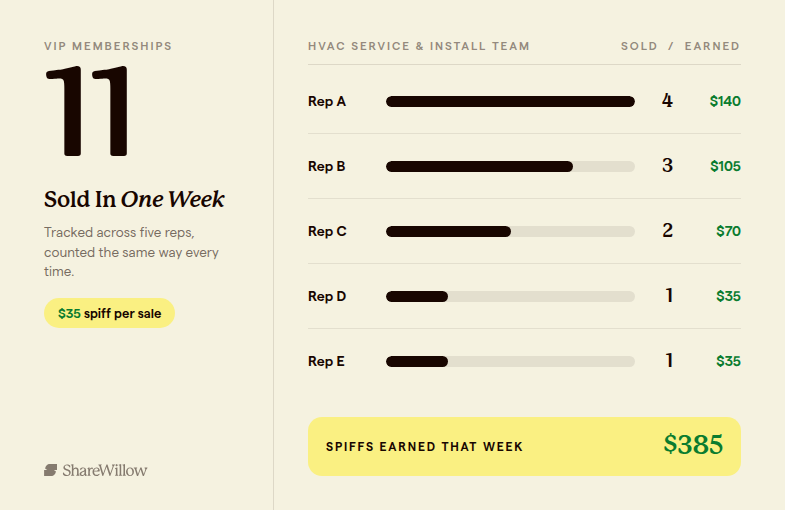
With the payroll math corrected and the sale properly credited, the same review surfaced a clean, specific week of performance data: eleven VIP membership sales across five reps, each one paying a $35 spiff, tracked individually by name. A structured $25-per-hour adjustment, added or deducted depending on whether a technician was marked at fault or credited with the fix on a warranty or recall job. A $40 flat spiff for a specific maintenance category. All of it synced automatically from the job platform three times a day, ahead of a firm 5pm payroll cutoff, so nothing had to be assembled by hand under deadline pressure.
None of that is possible when payroll math is quietly wrong. You can't build clean incentive tracking on top of numbers you don't trust yet. Fixing the 71-hour error and the $18,005 misattribution wasn't a detour from building a better incentive plan. It was the prerequisite for one.
By the end of the call, the tone had shifted completely from the tension of "that means this entire time" to something closer to relief: "We got everything fixed now. So thank you. Cool. Thank you. Alright guys, thank you ladies, appreciate it."
Three Questions Worth Asking About Your Own Payroll
You don't need a manual "bucket sheet" and a mismatched sold-by field to have this exact problem hiding somewhere in your shop. A few questions worth asking this week, regardless of what field service software you run:
- If a technician's paid non-job hours jumped 50 percent in a week, would anyone notice before payroll ran? Most shops only catch overpayment errors by accident, months later, if at all.
- Do you have two fields anywhere in your system that are supposed to say the same thing, like an official reporting field and a field your team actually uses day to day? Any place two systems are supposed to agree and might not is a place credit, and pay, can quietly drift to the wrong person.
- Could your own team explain what every pay-affecting tag or label in your system actually means, in plain language, without checking a manual? If the answer is no, the confusion is costing you accuracy even if nobody's complained yet.
Why Spiffs Only Work If the Ledger Is Boring
VIP membership spiffs, warranty pay adjustments, maintenance flat rates, these are the tools most residential HVAC shops already reach for to motivate the behavior that actually grows the business: selling memberships, taking ownership of a callback instead of dodging it, doing the small maintenance job right even when it's not glamorous. None of that is a new idea. Every shop owner in this trade has tried some version of it.
What separates a spiff program that actually changes behavior from one that quietly dies after two months is almost never the size of the incentive. It's whether the ledger behind it is boring. Boring, in this context, is the highest compliment you can pay a payroll system. It means a tech sells a membership on Tuesday and sees it reflected correctly on their next check without a conversation, an argument, or a "let me check on that." The moment a tech has to ask whether a spiff actually landed, or worse, notices one that should have and didn't, the incentive stops working as an incentive and starts working as a source of friction.
That's really the throughline of everything that got fixed on this one call: the 71-hour correction, the misattributed $18,005 sale, the warranty-versus-recall confusion. None of them are exciting on their own. Together, they're what "boring and correct" actually requires: someone checking the seams between systems regularly enough that a tech never has reason to wonder if the ledger is honest.
Where This Leaves Every HVAC Owner Reading This
Most owners assume the risk in incentive pay is overpaying. What this story shows is that the bigger risk is usually invisible: money quietly misdirected to the wrong person, or paid for hours that were never actually worked, for months at a time, because nobody's checking both sides of the ledger. Underpayment gets a phone call. Overpayment gets silence, right up until someone finally does the audit.
If you want to see exactly how ShareWillow catches these kinds of gaps automatically, before they compound across a whole season, the product features page walks through how job data, spiffs, and payroll adjustments get reconciled in one place. And if you're not sure where your own numbers might be quietly off, the free incentive audit connects to your existing ServiceTitan, Housecall Pro, or Jobber account and shows you exactly where to look first, no manual bucket sheet required.
Related reading
Conclusion
One overpaid line, one misattributed sale, and a payroll system this HVAC owner finally trusts.
Create incentives
that
drive results
You shouldn't need complex equity plans to align your team. ShareWillow makes it simple to create transparent profit-sharing programs that motivate employees and grow your business.

Incentive plans to help
small businesses thrive.
.png)
"I was able to leverage the knowledge of the ShareWillow team to learn how other companies were designing their bonus plans. The template was extremely helpful."

Brian Tustin
Owner, First Rate Movers