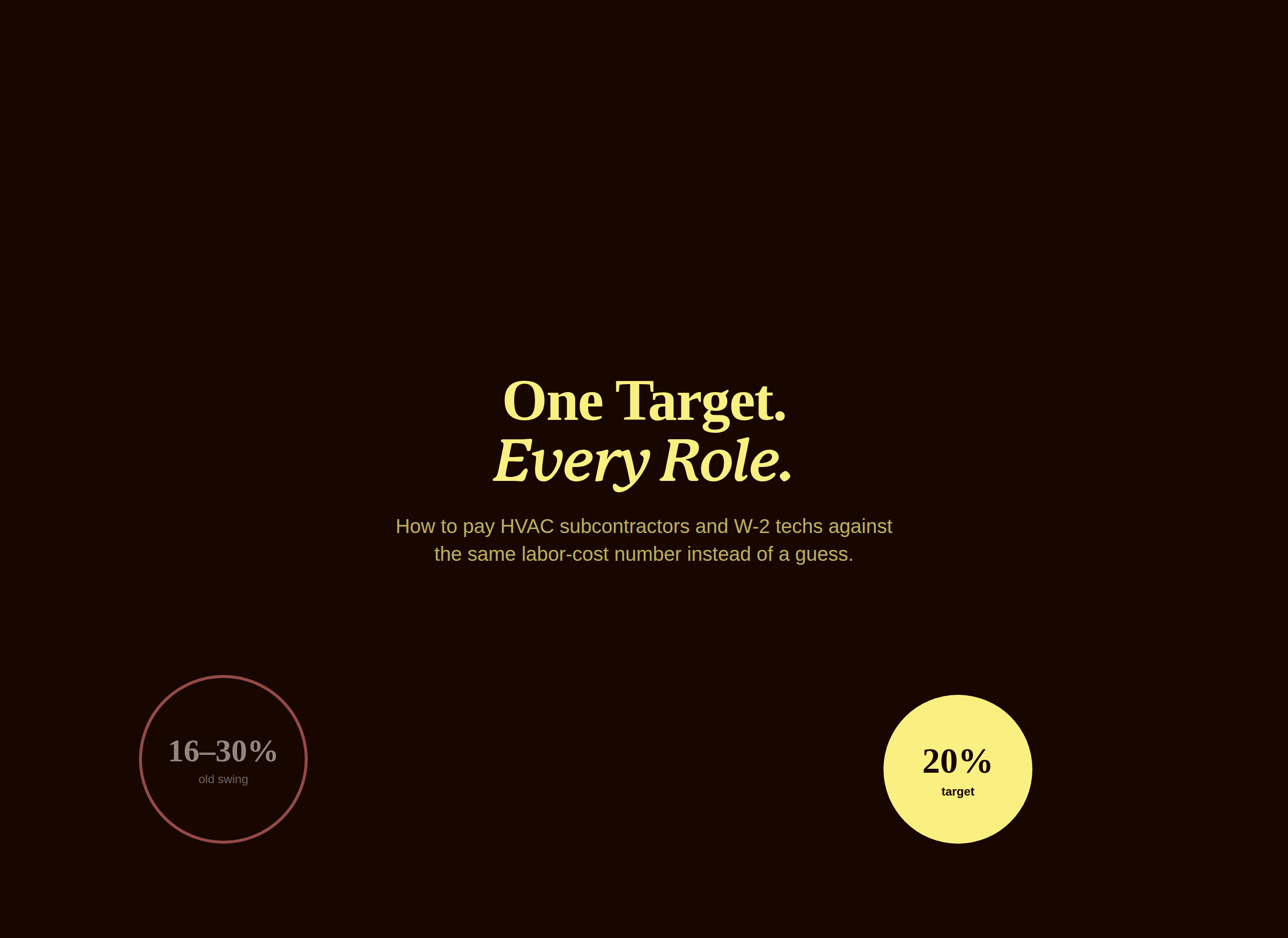
A 23-person HVAC and light plumbing company outside St. Louis was staring down a technician shortage in a market where every competitor was hiring too. Here is what happened once five separate incentive plans went live off the same ServiceTitan data everyone already trusted.
Every HVAC owner has heard some version of the same warning: the labor market is tight, good technicians know their worth, and a shop that cannot show a technician a clear path to more money will eventually watch that technician walk across the street to a competitor who can. A 23-person HVAC and light plumbing company just south of St. Louis was living that warning in real time. Revenue had climbed to nearly $5 million the year before, and the owner had set a target of $10 million for the year ahead, a number that would be impossible to hit without keeping the technicians already on the team and giving them a reason to stay through a hiring crunch that was squeezing every shop in the region.
The company was not short on ambition or on data. It ran on ServiceTitan, which meant job completions, callback rates, membership sales, and review counts were all being tracked somewhere. What it did not have was a way to turn that data into money technicians could see and trust, spread across five very different roles: service technicians split across two experience tiers, an install crew with its own managed and helper positions, and a customer service team fielding the phones. A single, one-size-fits-all bonus plan was never going to work for a team that different. Whatever plan the company built had to flex across five distinct jobs while still running off the same underlying numbers, or the owner would be right back to a spreadsheet nobody trusted.
Five Roles, Five Plans, One Source Of Truth
Rather than force every position into a single bonus formula, the company built five separate monthly scorecard plans, one for each role, all pulling live from ServiceTitan instead of a manually maintained sheet. Service technicians at the first experience tier and the second each got their own plan, reflecting that a newer tech and a lead tech are not chasing the same numbers. The install side split the same way: a managed-install plan for the technicians running the job and a helper plan for the second set of hands, with a roughly 70/30 split between lead and helper that mirrored how the work actually got done in the field. Customer service reps, who never touch a wrench but absolutely influence whether a job gets booked at all, were brought into their own plan built around review generation, worth around ten dollars per five-star review, so the person answering the phone had just as much reason to care about the outcome as the technician standing in the driveway.
The maintenance technicians got a commission layer on top of their base structure: 4 percent on new equipment sales for the accounts they serviced, which meant a technician who noticed a fifteen-year-old unit on its last leg and had an honest conversation with the homeowner about replacement now had a direct financial reason to have that conversation, instead of just fixing what was in front of him and moving to the next call. None of these plans replaced the underlying incentive plan software doing the calculation. They all ran through the same system, which is what let five different plan structures stay coordinated instead of turning into five separate spreadsheets that somebody in the office had to reconcile by hand every month.
What Happens When Five Plans Actually Fill Up
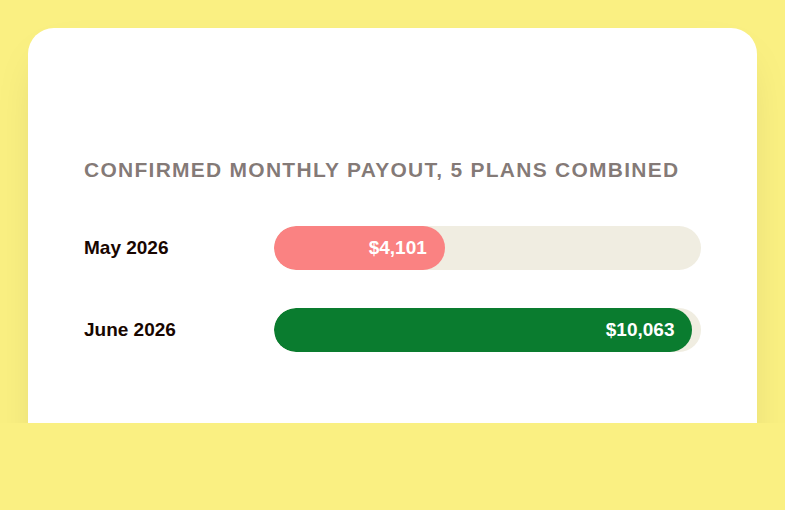
Standing up five plans at once is a heavier lift than launching one, and the first full month showed it. May 2026, the first month with confirmed numbers across all five plans, closed at a combined $4,101 in confirmed payouts. That is a real number, but it is also what a rollout looks like before enrollment and reporting have fully caught up to plan design: some employees were still getting mapped into the right plan, some job types were still being tagged correctly for attribution, and the CSR and install-helper plans in particular were only a few weeks old.
By June, with enrollment settled and the data flowing cleanly, the same five plans paid out $10,063.28 combined, a 145 percent increase in a single month with no change to the underlying plan design. That kind of jump is exactly what you want to see from a rollout problem rather than a plan problem: the mechanics were right from the start, and the number moved because the system caught up to reality, not because anyone changed the rules midstream. By the time July's numbers were coming in, the service technician plan alone had already confirmed $2,533.53, with the other four plans projecting a combined total north of $7,800 pending final sign-off, a trend line still pointed up rather than settling back down.
Roughly 21 of the company's 23 employees are now enrolled in one of the five plans, a 91 percent adoption rate that matters as much as the dollar figure. An HVAC incentive plan that only reaches half the team is really just a bonus program for whoever happens to be paying attention. One that reaches nearly everyone, from the CSR booking the call to the helper riding along on an install, changes how the whole shop talks about a good month.
Why Splitting The Plan By Role Mattered More Than The Dollar Amount
It would be easy to read this as a story about a number that got bigger, but the more interesting part is what the five-plan structure fixed that a single company-wide bonus never could. A CSR does not control callback rates. An install helper does not control equipment sales commission. A lead technician on a two-person install crew is not doing the same job as a service tech running solo calls all day. Every one of those roles, lumped into a single incentive formula, produces a plan where most people feel like the metrics do not apply to them, which is functionally the same as having no incentive plan at all.
Splitting the plan by role instead of trying to write one formula that covered everyone let each group see a bonus tied to something they actually influence day to day. The CSR plan rewards booking behavior, not job margin. The install-helper plan reflects that a helper's contribution to a job is real but different from the lead's, instead of pretending both roles deserve an identical split. The service tech tiers separate newer technicians from senior ones, so a level-one tech is not chasing the same benchmark as someone five years into the trade. None of this required exotic plan design. It required treating five different jobs as five different jobs, something a lot of shops skip because building one plan feels simpler than building five, right up until that one plan fails to motivate four out of five roles it was supposed to cover.
The Retention Bet Behind The Numbers
The owner never expected a payout report to hand him a retention percentage, and it did not. What the confirmed payout data does show is a program with real money moving, growing month over month, reaching nearly everyone on staff. That is the leading indicator that tends to show up before a lagging one like turnover ever does. A technician who sees $10,000 distributed across the team in a single month, and can trace their own name to a specific number inside that total, has a concrete answer the next time a competitor's recruiter calls with a vague promise of "better pay." A technician working off a spreadsheet nobody fully trusts does not have that answer, no matter how generous the underlying commission structure actually is.
This is also where running five plans at once starts to look less like added complexity and more like the only honest way to build an incentive program for a company with five genuinely different jobs on the payroll. The alternative, a single blended plan simple enough to explain in one sentence, almost always ends up rewarding the roles closest to revenue while leaving CSRs and helpers wondering why the bonus program does not seem to include them. Five smaller, role-specific plans cost more to design up front and pay off by making nearly the entire staff feel like the incentive program was actually built with their job in mind.
Profit sharing
made simple.
Give your team a stake in the company’s success. ShareWillow helps you create and manage profit-sharing programs that motivate employees and drive business results.
What A Two-Month Snapshot Can And Cannot Tell You
Two months of confirmed data is not a full year, and it would be dishonest to present a 145 percent month-over-month jump as a permanent growth rate. Enrollment ramps level off. Some months will run softer than June did, the way any incentive-driven number moves with call volume, install schedules, and seasonal demand. What two months of clean, confirmed, role-specific payout data does prove is that the mechanics work: money is flowing to the right people, for the right reasons, without anyone in the office having to reconcile five spreadsheets by hand every time payroll runs. Getting that plumbing right is the unglamorous part of an incentive plan that almost never shows up in the pitch, and it is usually the part that determines whether a plan survives past its first quarter.
For a shop chasing a $10 million year in a labor market where every competitor is hiring from the same shrinking pool of qualified technicians, that kind of infrastructure is not a nice-to-have. It is the difference between an incentive plan that technicians reference the next time they think about leaving, and one that quietly stops getting mentioned once the novelty wears off. Companies exploring a similar move can start with a free incentive plan audit to see where their own field-service data already supports role-specific payout structures like this one, often without touching the underlying commission philosophy the owner already believes in.
How This Compares To Other HVAC Shops
It helps to see this against a wider set of shops running similar programs. Across HVAC companies using role-based incentive plans, the typical shop runs close to 39 distribution cycles with a median payout per cycle a little under $1,000. A company running five concurrent plans, each cycling monthly, is generating a much higher volume of smaller, more targeted payouts than a shop running one annual bonus or a single quarterly plan, which is part of why the total moves so much faster once enrollment catches up. More cycles means more chances for a technician to see the connection between a specific month's work and a specific month's check, instead of waiting for one big number at the end of the year that is disconnected from any particular decision they made in the field.
That comparison also puts the June number in context. $10,063 across five plans in one month is a strong result, not an outlier so extreme it is meaningless to any other shop reading this. It sits in a believable range for a company this size running this many concurrent plans, which is exactly the kind of number an owner evaluating a similar move should be looking for: proof the model works at a scale they can picture in their own shop, not a headline number so far outside the norm it feels like a fluke.
Where This Goes From Here
The company is now watching whether June's number holds as a new baseline or settles somewhere between the two data points already on the board, and whether the two employees still outside any plan eventually get folded into one as their roles solidify. Either way, the shop has already cleared the hardest part of standing up an incentive program across a team this varied: five plans, live on the same data, reaching 91 percent of the staff, with two consecutive months proving the payouts land correctly before anyone has to ask where their bonus went. That is the foundation a $10 million year gets built on, one confirmed payout cycle at a time.
Related reading
Conclusion
Five incentive plans, live on the same ServiceTitan data, took this HVAC company from $4,101 to $10,063 in confirmed monthly payouts in a single month, with 91 percent of the team now enrolled. The company is now watching whether June's number holds as the new baseline heading into a $10 million year.
Create incentives
that
drive results
You shouldn't need complex equity plans to align your team. ShareWillow makes it simple to create transparent profit-sharing programs that motivate employees and grow your business.

Incentive plans to help
small businesses thrive.
.png)
"I was able to leverage the knowledge of the ShareWillow team to learn how other companies were designing their bonus plans. The template was extremely helpful."

Brian Tustin
Owner, First Rate Movers