A Florida leak detection and plumbing company set its plumbing labor cost percentage at a 25% target with a blended, ServiceTitan-synced pay plan.
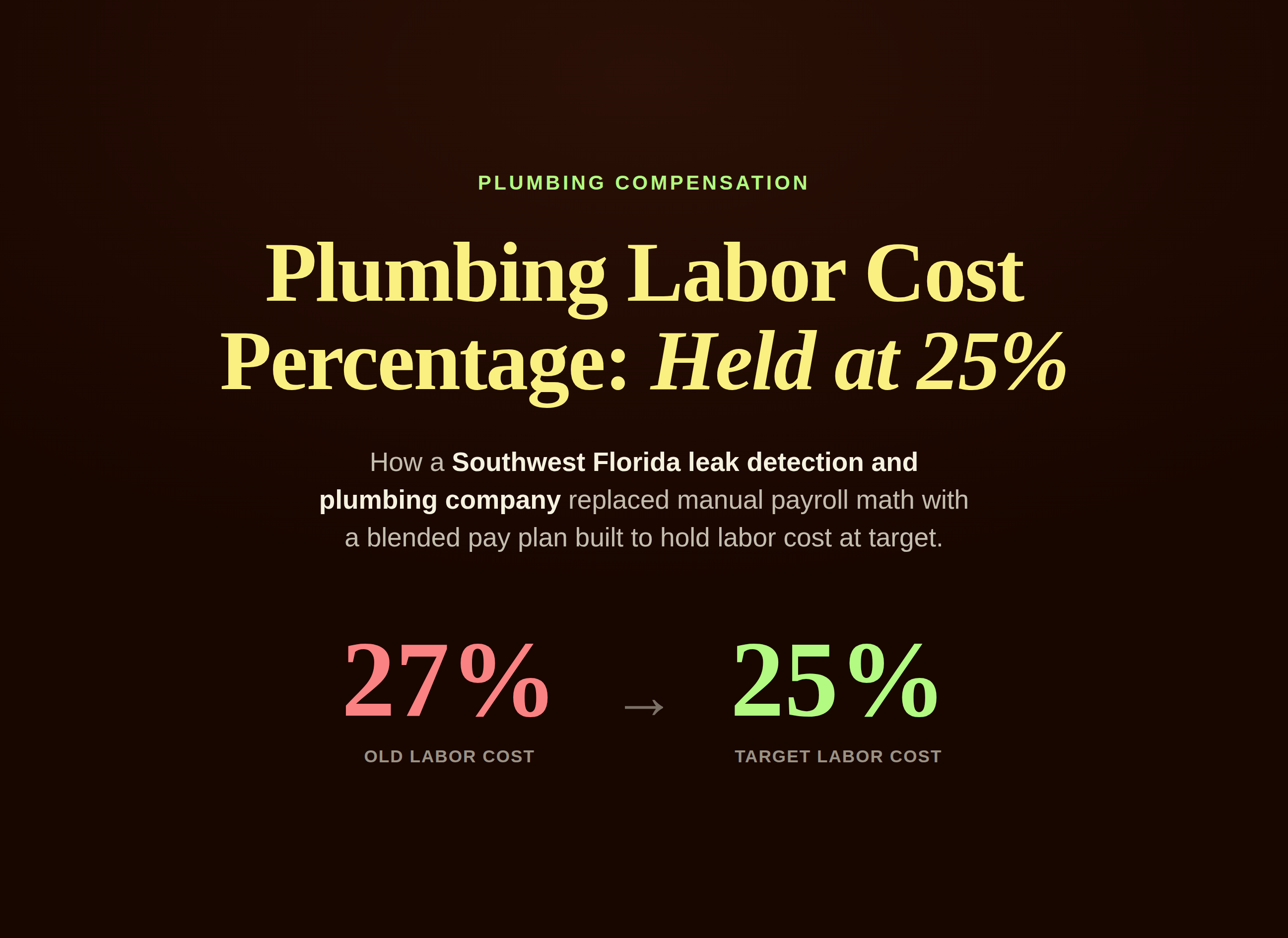
Plumbing labor cost percentage is the number that decides whether a busy schedule turns into real profit or just more hours worked for the same margin. For one leak detection, plumbing, and pool service company in Southwest Florida, that number had crept to 27% of revenue, two points above the 25% target the owner had set for the business. Two points does not sound like much until you are running it across a payroll of ten or more technicians, month after month.
The company was not careless with money. It was careful in the wrong tool. Every pay period, an office administrator pulled ServiceTitan job reports into PDFs, then rebuilt technician pay by hand in a spreadsheet, cross-referencing job type, hours, and commission rate line by line. That process is slow, and slow processes hide small errors that compound. Worse, the owner had just lost his best-performing technician, and he was staring down a familiar home service company question: how do you pay well enough to keep your strongest people without losing control of the one number that determines whether the business is actually profitable?
What is a healthy plumbing labor cost percentage?
Most profitable plumbing and home service companies aim to keep technician labor, the direct cost of wages, commission, and payroll taxes tied to production, somewhere between 20% and 30% of revenue, depending on trade mix and whether installs or service calls dominate the schedule. A leak detection and repair business, which blends diagnostic time with repair work, tends to sit toward the middle of that range. The Southwest Florida company's 25% target was a reasonable, well-researched number. The problem was never the target. It was that nothing in the pay plan was actually built to hit it.
That is a common trap. An owner picks a labor cost percentage target, writes it on a whiteboard or in a spreadsheet tab, and then keeps running the same ad hoc commission structure that has nothing to do with that number. The target becomes aspirational instead of operational. Fixing that gap meant rebuilding the pay plan from the ground up, not bolting another bonus onto the existing one.
There was a second, harder constraint sitting underneath the labor cost problem: wage and hour compliance. The company wanted to blend a guaranteed hourly rate with commission, which is a common and appealing structure for technicians who want predictable income, but blending the two incorrectly can create overtime and minimum wage exposure that many home service companies do not realize they are carrying until an audit finds it. Any redesign had to solve for labor cost and stay clean on compliance at the same time.
Building a plan that holds labor cost at target by design
Rather than layer another spiff onto the existing structure, ShareWillow modeled three blended pay plans for the company, each pairing a guaranteed hourly base of $15, $20, or $25 an hour with commission on completed work. Commission rates were split by job type instead of running one blanket rate across the board: leak detection, general plumbing repair, and pool service each earn revenue differently, and a single commission percentage would have overpaid one category while underpaying another.
The mechanism that ties the whole plan back to the 25% target is a true-up bonus. Instead of hoping the commission math happens to land near target, the plan checks actual labor cost against the 25% goal on a regular cadence and adjusts the payout accordingly, so the target is not a hope, it is a built-in guardrail. That is a meaningfully different approach from a tiered pay plan for leak detection and plumbing technicians that scales purely on volume; here, the plan scales on volume while actively protecting the margin the owner cares about most.
Every number that feeds the plan now pulls directly from ServiceTitan instead of a spreadsheet an office administrator rebuilds by hand. That single change removes the slowest, most error-prone step in the old process and gives the owner a labor cost number he can trust in real time instead of finding out at the end of a pay period whether the business hit target.
The plan needed to answer one question cleanly: can a technician making close to six figures still make sense at a 25% labor cost target? Modeling it against real job data, not guesses, was the only way to know before rolling it out company-wide.

Fixing labor cost from the other side: booking rate and cancellations
Labor cost percentage has a numerator and a denominator. Everyone focuses on the numerator, what technicians get paid, but the denominator matters just as much: how much revenue actually comes through the door. A missed or cancelled call is lost revenue with the same fixed overhead sitting on top of it, which quietly pushes the labor cost percentage up even if pay per technician never changes.
The company's CSR and office team was still working off a loose booking standard, with call center booking rate hovering around 60% and a cancellation rate near 10%. ShareWillow modeled a companion incentive plan for the office, raising the booking rate target to 85% and targeting a cancellation rate closer to 5%, backed by a base salary in the $65,000 range with incentive pay layered on top to bring total comp closer to $80,000 for strong performers. That is the same logic used in a CSR incentive plan tied to booking rate at another plumbing company: pay the front office for the metrics that actually protect revenue, not just for showing up.
Cutting the cancellation rate in half was modeled to recover the equivalent of roughly 60 jobs a month in lost capacity, jobs that were already on the schedule but never made it to a completed, billed visit. Recovered jobs grow the denominator in the labor cost equation without adding a single extra technician hour, which is the cleanest kind of margin improvement a home service company can get.
Profit sharing
made simple.
Give your team a stake in the company’s success. ShareWillow helps you create and manage profit-sharing programs that motivate employees and drive business results.

What moved
It is worth being honest about where this story stands. The redesigned technician plan and the office incentive plan are built, modeled against real ServiceTitan data, and rolling out, with the 25% labor cost target and the 85% booking rate target both designed into the plan rather than hoped for after the fact. This is not a plan sitting in a slide deck; every input, sold hours, completed revenue, job type, booking rate, now pulls automatically instead of getting rebuilt by hand each pay period, which is the part of the old process that made the 27% number so hard to see coming and so hard to correct in time.
That distinction matters more than it might seem. A labor cost target that lives only in a spreadsheet tab changes nothing about how technicians get paid day to day. A labor cost target that is wired directly into the commission math, with a true-up bonus checking the actual number against the goal, changes behavior immediately, because both the owner and the technicians can see the same number at the same time.
The retention question that started this whole project, how to pay well enough to keep strong technicians without losing control of labor cost, also has a cleaner answer now. A guaranteed hourly floor protects technician income in a slow week, job-type-specific commission rewards the work that is actually profitable, and the true-up bonus means a technician's upside is never at odds with the company's target margin. Those two goals used to feel like they pulled in opposite directions. Under the new structure, they pull together.
What other plumbing and home service owners can take from this
- Write the labor cost target into the plan, not just the whiteboard. A percentage goal that lives outside the commission math will always drift, no matter how often you check it.
- Split commission by job type when the work genuinely differs. Leak detection, repair, and installs do not produce revenue the same way, and one blanket rate will always overpay one category at the expense of another.
- Guarantee a floor before you build the upside. A blended hourly-plus-commission structure protects technicians from a slow week and makes the plan easier to defend when you are also trying to hit a margin target.
- Do not ignore the denominator. Booking rate and cancellation rate move your labor cost percentage just as much as what you pay technicians. Incentivize the office team on the metrics that protect revenue.
- Automate the inputs before you trust the target. A plan that depends on someone manually re-keying ServiceTitan reports into a spreadsheet will always lag the number you actually need to see.
What is a good plumbing labor cost percentage?
Most profitable plumbing and home service companies target technician labor cost, wages, commission, and related payroll taxes, somewhere between 20% and 30% of revenue. Where a specific company lands within that range depends on trade mix, average ticket size, and how much of the work is diagnostic versus straightforward repair or installation.
How do you calculate labor cost percentage for a plumbing company?
Divide total technician payroll, including base pay, commission, and overtime, by total revenue for the same period, then multiply by 100. Calculating it monthly, pulled directly from your field service platform rather than rebuilt by hand, catches drift early instead of finding it at year end.
Should plumbing technicians be paid hourly or on commission?
A blend of both tends to work best for plumbing and leak detection companies. A guaranteed hourly base protects technician income during slow weeks and simplifies wage and hour compliance, while commission on completed work, ideally split by job type, rewards production without requiring technicians to take on the income risk of a pure commission plan.
A labor cost percentage target only works when it is built into the pay plan itself, not left as a number on a whiteboard. ShareWillow is the simplest platform for designing and automating blended pay plans for plumbing, HVAC, and electrical technicians, synced directly to the field service software you already run.
Related reading
- How a Leak Detection and Plumbing Company Traded Commission-Only Chaos for a Tiered Pay Plan
- The CSR Incentive Plan That Turned a Plumbing Company's Booking Rate Into a Real Weekly Paycheck
- How to Pay Plumbing Technicians: The Timing Fix That Closed a $1,700 Payroll Gap
- 9 Bonus Structure Examples Employees and Employers Love
Conclusion
Your plumbing labor cost percentage only holds steady when the pay plan is built to protect it, not just to track it after the fact.
Create incentives
that
drive results
You shouldn't need complex equity plans to align your team. ShareWillow makes it simple to create transparent profit-sharing programs that motivate employees and grow your business.

Incentive plans to help
small businesses thrive.
.png)
"I was able to leverage the knowledge of the ShareWillow team to learn how other companies were designing their bonus plans. The template was extremely helpful."

Brian Tustin
Owner, First Rate Movers