
A multi-trade HVAC, plumbing, and install company in California used to spend five full days every pay period hand-calculating technician bonus pay. Here is what changed when they stopped doing the math by hand, and what it took to get there.
The Pay Period That Ate A Week
Ask any HVAC or plumbing business owner what they dread most about running a shop, and payroll rarely tops the list of things they got into the trades to do. Yet for a multi-trade HVAC, plumbing, and install company in California, payroll had quietly become a second full-time job.
The company runs performance pay for its field technicians. Every install, every repair, every upsell can earn a tech a bonus on top of their base pay. It is a good system on paper: techs who hustle get paid more, and the company retains its best people because the incentive is real. The problem was never the idea. The problem was the math.
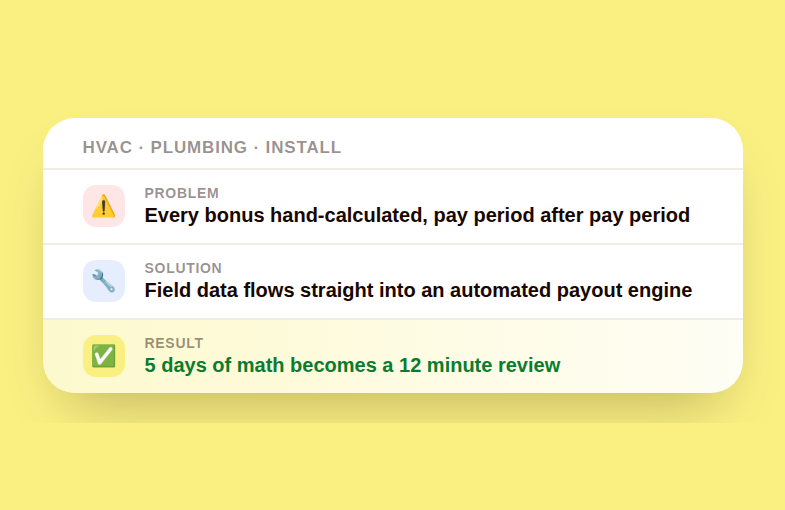
Every pay period, someone in the office pulled job data, cross-referenced it against a spreadsheet of bonus rules, checked it against what had already been paid, and hand built the numbers that went to payroll. For a shop juggling HVAC, plumbing, and install crews with different bonus structures for each trade, that process routinely ate five full days. Five days of a manager's time, every single pay period, just to confirm what techs had actually earned.
That is not a rare story. It is close to the default state for HVAC and home services companies that build real incentive pay plans instead of a flat hourly rate. The plan works. The spreadsheet does not scale.
Why Manual Bonus Math Breaks Down
The trouble with hand-calculated performance pay is not that any one calculation is hard. It is that the number of calculations multiplies fast. A 12-person crew earning bonuses on three or four different criteria, spread across HVAC service calls, plumbing repairs, and new installs, generates hundreds of line items every pay period. Each one has to be pulled from the field service software, matched to the right bonus rule, checked for errors, and reconciled against prior payouts so nobody gets paid twice for the same job.
Do that by hand long enough and a few things start to happen. First, the person doing it becomes a single point of failure. If they are out sick during payroll week, the whole shop feels it. Second, small mistakes creep in. A mistagged job category, a missed callback, a formula that was not updated when the bonus structure changed last quarter. None of these are dramatic on their own, but they chip away at trust. Techs notice when their check does not match what they expected, and once they stop trusting the number on the paycheck, the whole incentive plan loses its power to motivate anyone.
Third, and maybe most costly, manual math puts a ceiling on how ambitious a pay plan can be. It is tempting to keep bonus structures simple just because complexity is hard to calculate by hand. But simple plans often fail to reward the behavior that actually grows the business, like upsells, five-star reviews, or first-time-fix rates. A shop that could design a smarter plan often does not, purely because someone would have to compute it manually every two weeks.
What Changed: Field Data Straight Into Payout
The fix here was not to simplify the bonus plan. It was to stop calculating it by hand. The company connected its field service data directly to an automated performance pay engine, so completed jobs, upsells, and other bonus-eligible activity flow into the calculation the moment they are logged, instead of getting rebuilt from scratch at the end of the period.
In practice, that means three things changed:
- Bonus rules are defined once and applied consistently across every trade and every technician, so an HVAC install bonus and a plumbing repair bonus can run side by side without needing separate spreadsheets.
- Every payout is auditable. Instead of trusting a formula buried in a spreadsheet, the owner can see exactly which job, which rule, and which dollar amount produced each tech's number.
- Review replaced recalculation. The office no longer builds the numbers from scratch. They check a dashboard that already reflects the math, catch anything that looks off, and export straight to payroll.
That last point matters more than it sounds. Automating a calculation is only half the job if a manager still has to double check every line by hand. The goal was a system trustworthy enough that review takes minutes, not days, while still giving the owner full visibility into how every bonus dollar was earned.

Five Days To Twelve Minutes
The result speaks for itself. What used to take five days of manual calculation now takes about twelve minutes to review, audit, and export to payroll. That is not a rounding error. It is the difference between payroll consuming a full week of a manager's schedule and payroll being something that happens between two other meetings.
The time savings alone would justify the change, but the bigger shift is less visible and, honestly, more valuable. Techs get consistent, accurate, on-time pay tied directly to the work they did. The owner gets a system that scales without needing to hire someone whose entire job is running bonus math. And because the numbers are auditable, disputes over a paycheck turn into a two-minute conversation backed by data instead of a re-run of the whole spreadsheet.
There is also a quieter benefit worth naming. Once bonus pay stops being a manual burden, it becomes much easier to actually improve the plan. This company can now test a new bonus tier, add an incentive for a specific service line, or adjust a rule for one trade without dreading the added calculation work. The pay plan can evolve with the business instead of staying frozen because change is expensive to compute.
If this sounds familiar, whether you run a single-trade HVAC shop or a multi-trade operation juggling install, service, and repair crews, the pattern tends to be the same: the incentive plan itself was never the weak link. The manual math behind it was. Related reading on getting the plan right in the first place: The 58.5% Problem: How One HVAC Team Fixed Its Labor Cost Without Losing Its Techs and The Travel-Time Miscalculation That Was Quietly Overpaying an HVAC Team by $30,000 a Year.
For any field service business still running performance pay through a spreadsheet, the question worth asking is not whether the bonus plan is good. It is whether the math behind it can keep up with how good it could be.
Profit sharing
made simple.
Give your team a stake in the company’s success. ShareWillow helps you create and manage profit-sharing programs that motivate employees and drive business results.
What To Check Before You Automate Bonus Pay
Not every shop is ready to flip the switch on day one, and that is fine. A few things tend to separate a smooth rollout from a frustrating one, and they are worth checking before you touch your first automated payout.
- Your field data is clean. If job types, technician assignments, and completion statuses are entered consistently in your field service software, whether that is ServiceTitan, Housecall Pro, or something else, automation has something reliable to calculate from. If job records are messy, automation will just calculate the mess faster, so it is worth a quick cleanup pass first.
- Your bonus rules are actually written down. A lot of shops carry their incentive plan in the owner's head, or in a mix of verbal agreements and half-updated spreadsheets. Before you automate anything, get the current rules on paper: who earns what, on which jobs, under which conditions. That exercise alone often surfaces inconsistencies worth fixing.
- Someone still owns the review. Automation removes the manual math, not the oversight. The healthiest setups keep a human reviewing the numbers each pay period, not because the system is untrustworthy, but because a second set of eyes catches the rare edge case, like a canceled job that should not have counted, before it reaches a paycheck.
- You are ready for the plan to change. Once the math stops being the bottleneck, most owners start improving their incentive structure faster than before. Go in expecting that your first automated version of the plan will not be the last version, and treat that as a feature, not a problem.
None of this requires a big technology overhaul. It requires treating your incentive plan like a real system with rules, data, and a feedback loop, rather than a once-a-year spreadsheet exercise. For a California multi-trade shop, that shift turned five days of dread into a twelve minute Tuesday task. For most HVAC, plumbing, and install businesses running performance pay today, the opportunity is sitting in the same place: not in a better bonus idea, but in the math standing between the idea and the paycheck.
Common Questions Owners Ask
Does automating bonus pay mean giving up control over the plan? No. If anything, owners end up with more control, not less. Because every payout is tied to a visible rule and a specific job, an owner can change a rule, test a new bonus, or shut off an incentive that is not working without waiting for the next spreadsheet rebuild.
What happens when the bonus plan is different across trades? This is exactly the case that breaks manual spreadsheets fastest, and it is where automation earns its keep. HVAC, plumbing, and install crews can each run their own bonus rules under one system, so a multi-trade shop does not need three parallel spreadsheets that quietly drift out of sync with each other.
Is this only worth it for larger shops? Not really. A smaller shop with six or eight techs feels the five-days-a-period problem just as sharply as a larger one, often more, because there is rarely a dedicated office staffer to absorb the work. The time saved scales down just as well as it scales up.
Related reading
Conclusion
Performance pay only works if people trust the number on their paycheck, and trust is hard to build on top of a spreadsheet that takes five days to reconcile. This company did not simplify its incentive plan to make the math easier. It automated the math so the plan could stay as smart as it needed to be. If your shop is still rebuilding bonus payroll by hand every pay period, the five days you are spending are not the cost of a good incentive plan. They are the cost of doing the math the hard way.
Create incentives
that
drive results
You shouldn't need complex equity plans to align your team. ShareWillow makes it simple to create transparent profit-sharing programs that motivate employees and grow your business.

Incentive plans to help
small businesses thrive.
.png)
"I was able to leverage the knowledge of the ShareWillow team to learn how other companies were designing their bonus plans. The template was extremely helpful."

Brian Tustin
Owner, First Rate Movers
