
An HVAC and plumbing company's technician pay was built on uncapped spiffs and commissions disconnected from sold hours, driving labor cost to an unsustainable 58.5% of revenue. Rebuilding pay around sold hours, with a guaranteed 3% minimum incentive, brought labor cost down to roughly 40% while revenue came in near double budget.
Spiffs feel generous right up until someone adds up what they actually cost. An HVAC and plumbing company built its technician pay around exactly that kind of open-ended structure: a spiff on nearly everything a tech sold, stacked with a separate commission on top, with neither one tied to how many billable hours the tech had actually sold that week. It felt like a strong incentive plan for a long time, because technicians were making real money and morale around pay was good. The problem only showed up when leadership finally looked at what it was costing against revenue.
Labor cost had crept up to 58.5% of revenue. For a service business, that is not a high number, it is close to an unsustainable one, the kind of ratio that quietly eats every other line on the income statement until there is very little margin left to run the business on.
A Pay Structure Too Generous to Simply Cut
The uncomfortable part of this story is that the fix was not as simple as lowering the spiff rate. Technicians were earning real, meaningful money under the old structure, and any abrupt cut risked losing a chunk of the HVAC team to a competitor willing to match the old, unsustainable pay. That is the trap an ungoverned incentive plan creates over time: it becomes a retention tool even as it undermines the business's ability to keep paying it. A wage structure that is too generous to safely correct is still a serious problem, just a slower-moving one than a structure that is too stingy.
The root issue was not that technicians were earning too much for good work. It was that nothing in the pay structure was actually tied to sold hours, the one number that connects a technician's pay directly to the revenue they generate. Spiffs got paid on top of jobs regardless of how efficiently or profitably those jobs were sold and completed, which meant the plan was rewarding activity, not the specific outcome the business actually needed more of.
Redesigning Pay Around Sold Hours, Not Just Activity
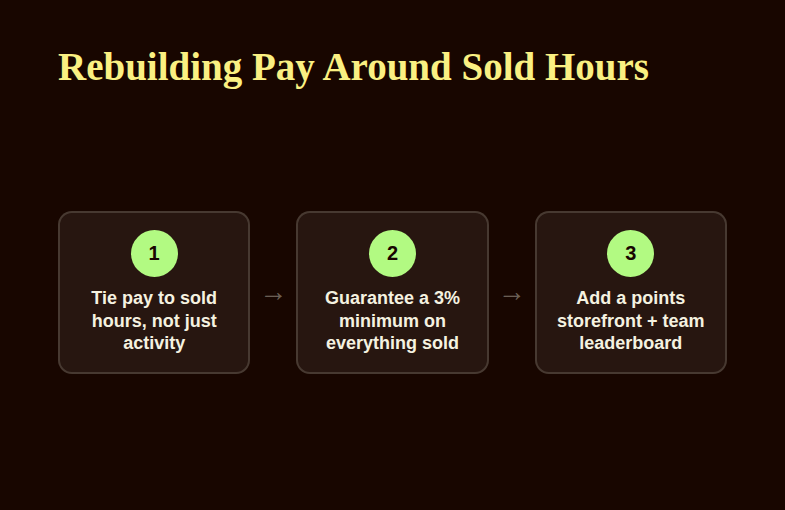
The rebuilt plan ties technician pay directly to sold hours, with a guaranteed minimum incentive of roughly 3% on everything a technician sells, integrated with the company's HVAC field service platform so reviews and membership sales feed into the same system automatically. That 3% floor matters because it keeps the plan simple to explain and impossible to feel shortchanged by. Every dollar sold guarantees a real, visible incentive on top of it, but the incentive is now anchored to a number, sold hours, that the business can actually track against its own labor cost targets.
Turning Pay Into a Game, Not Just a Number
Alongside the sold-hours redesign, the company layered in a points-based rewards storefront, essentially an internal shop where technicians redeem points earned through the incentive plan for real items, plus cross-department leaderboards that let HVAC, plumbing, and other teams see how they stack up against each other. That might sound like a small addition next to a full compensation redesign, but it solves a real problem: a pay plan that only shows up in a paycheck every two weeks is invisible for most of the pay period. A points storefront and a leaderboard make performance visible daily, which keeps the incentive top of mind between paychecks instead of only on payday.
Cross-department leaderboards do something else worth calling out: they turn what could have been an HVAC-only conversation into a company-wide one. Plumbing techs competing on the same visible board as HVAC techs creates a shared culture around the metrics that matter, sold hours and efficient, profitable work, rather than each department quietly optimizing its own pay in isolation.
From 58.5% to Roughly 40% Labor Cost
The redesigned plan brought labor cost down from that unsustainable 58.5% to roughly 40% per unit, against an internal target of 35%. Leadership called it a huge improvement, and the number backs that up: a nearly nineteen-point swing in labor cost as a share of revenue is the difference between a business quietly bleeding margin and one with real room to invest in growth again.
What makes that swing especially notable is that it did not come from technicians earning less for the same work. It came from tying pay to the metric, sold hours, that actually correlates with sustainable revenue, instead of paying out spiffs on activity that was not reliably connected to the business's bottom line. The technicians who were selling efficiently and well kept earning well. The plan simply stopped rewarding volume disconnected from value.
Profit sharing
made simple.
Give your team a stake in the company’s success. ShareWillow helps you create and manage profit-sharing programs that motivate employees and drive business results.
Revenue Doubled Against Budget, Not Just Labor Cost Fixed
The other half of this story is easy to miss if you only look at the labor cost improvement. Because the new plan guarantees at least 3% on everything a technician sells, techs had a direct, uncapped reason to sell more, not less. The team came in at roughly double its budgeted revenue for the period, driven by that same incentive that was simultaneously bringing labor cost down as a percentage of a now much larger revenue number. A pay plan redesign that only cut cost without growing revenue would have been a smaller, thinner win. This one did both at once, because the incentive was rebuilt around the thing the business actually wanted more of, efficient, well-sold hours, rather than simply capped or reduced.
Why This Works Better Than Simply Cutting Spiffs
It would have been far simpler, and far riskier, to just announce a spiff cut and hope the HVAC team stayed. Instead, the redesign kept technicians whole on upside potential, arguably better off, since a guaranteed 3% on everything sold plus a gamified points system gives them more ways to earn, not fewer, while finally connecting that earning potential to a number the business can actually sustain. Automated, data-driven incentive tracking is what makes a redesign like this possible without turning it into a manual spreadsheet exercise every pay period, since sold hours, reviews, and membership sales all need to flow into the same plan from the field service platform in real time.
What Other HVAC and Plumbing Companies Should Take From This
If your technician pay includes spiffs or commissions that are not explicitly tied to sold hours, it is worth running the same exercise this company did: pull your actual labor cost as a percentage of revenue and see where it really sits. A number that feels fine in the day-to-day, because technicians are happy and turnover is low, can still be quietly unsustainable underneath.
The margin-based version of this same lesson shows up in this factory-direct installation company's commission redesign, where the fix was tying commission to real job margin instead of a flat rate. Different metric, same underlying move: anchor the incentive to the number the business actually needs to protect.
It is also worth resisting the instinct to simply cut an overly generous plan once you spot the problem. The better fix is usually a redesign that keeps technicians' earning potential intact, or even expands it, while anchoring that potential to a metric, like sold hours, that the business can actually afford to keep paying for as it grows. Cutting pay solves a spreadsheet problem and creates a retention one. Redesigning the incentive around the right metric can solve both at the same time.
Related reading
Conclusion
Rebuilding technician pay around sold hours, with a guaranteed 3% floor, brought this HVAC and plumbing company's labor cost from 58.5% down to roughly 40%, while revenue came in near double budget.
Create incentives
that
drive results
You shouldn't need complex equity plans to align your team. ShareWillow makes it simple to create transparent profit-sharing programs that motivate employees and grow your business.

Incentive plans to help
small businesses thrive.
.png)
"I was able to leverage the knowledge of the ShareWillow team to learn how other companies were designing their bonus plans. The template was extremely helpful."

Brian Tustin
Owner, First Rate Movers
