
A factory-direct home services and installation company had a commission plan paying a flat 24% rate regardless of a job's real profitability, and a perfect billing bonus that kept landing 0.36% short every month. Tying commission to real job margin, fixing sales attribution, and extending review incentives to the whole team closed both gaps.
Commission plans in the trades usually start simple: a flat percentage of the sale, paid the same way whether the job barely broke even or came in at a fat margin. That simplicity feels fair on the surface, until you actually look at what it is rewarding. A factory-direct home services and installation company ran its numbers and found a commission structure that was, in effect, paying the same percentage regardless of whether a job made the business real money or almost none at all.
The company sells and installs product directly, cutting out a middle layer of distribution, which means margin is the whole game. A flat commission on top of that model does not just fail to reward profitable jobs more, it actively works against the business, because a sales rep has no financial reason to prefer a high-margin job over a low-margin one. Revenue is revenue either way, from a paycheck's point of view.
The frustrating part is that flat commission plans usually start out as a reasonable compromise. Calculating commission off gross revenue is simpler to explain to a sales team than calculating it off margin, and in a business with fairly uniform job profitability, the difference between the two approaches barely matters. It only becomes a real problem once margin starts to vary a lot from job to job, which is exactly the situation a factory-direct model creates: some jobs move in efficiently with minimal labor, others run into site complications that eat into the margin substantially, and a flat commission cannot tell the difference between the two.
A 24% Commission on a 91.9% Margin Job
The number that exposed the problem was stark. On a job with a 91.9% gross profit margin, close to as good as a job gets, the commission structure was still paying out 24%, the same rate that would apply on a job with a fraction of that margin. The reason traced back to something unglamorous: job costing. Material cost, labor cost, and total cost were not being entered consistently in the field service platform, which meant a lot of jobs were defaulting to zero cost. Zero cost makes every job look like it has enormous margin, whether it actually does or not, and a commission formula built on top of that distorted number pays out distorted commissions.
This is a trap that is easy to fall into precisely because nothing about it looks broken from the outside. The commission checks go out, the sales reps are happy, the reports show green. The only sign something is wrong is a business owner sitting down with the actual numbers and asking why a near-perfect-margin job and a thin-margin job are paying the exact same commission rate.
It is worth being specific about why zero-cost jobs are so easy to end up with. Entering material cost, labor cost, and total cost for every job is genuinely tedious, and it produces no immediate reward for whoever is supposed to enter it. A busy operations team will always deprioritize the field that nobody notices being empty over the field that blocks an invoice from going out. The result is a metrics dashboard that looks complete and healthy, green across the board, while quietly running on a foundation of missing numbers underneath it.
Tying Commission to Real Margin, Not Assumed Margin
The fix starts with data discipline before it ever touches the commission formula. Material cost, labor cost, and total cost now get captured on every job inside the field service platform, as a daily habit rather than an occasional cleanup task. Once that data is actually there, commission can be calculated against a job's real gross profit margin instead of an assumed one, which means a 91.9%-margin job and a thin-margin job stop paying identical rates. The commission structure was left largely intact. What changed is the number it is calculated against.
Sales attribution got the same treatment. The company had been tracking leads through a marketing-level lead source field, which is useful for ad spend decisions but nearly useless for figuring out which sales rep actually closed which job. Every sales rep's name was added to the job-level lead source dropdown, and mirrored into the customer-level list, so a job report can finally answer a simple question accurately: who sold this.
Neither of these fixes required new software or a new vendor relationship. The lead source field and the job costing fields already existed inside the field service platform the company was already paying for. The gap was operational discipline, not missing technology, which is often the case with data problems that quietly distort a commission plan.
Extending Review Incentives to the Whole Team, Not Just the Field
Alongside the commission fix, a second lever got built directly into every plan on the team, including the operations manager's: five-star review incentives. A standard review earns $25. A review that includes a photo earns $50. That gap is not arbitrary, a review with a photo is more persuasive to the next customer reading it, and the incentive reflects that difference in value.
Extending that incentive to the operations manager matters more than it might look. Reviews are usually treated as a field-technician metric, something a tech earns by being polite and competent on a job site. But an operations manager influences review outcomes constantly, through scheduling, through how a callback gets handled, through whether a customer's issue actually gets resolved on the first attempt. Leaving that role out of the review incentive means leaving out one of the people with the most leverage over whether reviews happen at all.
There is a compounding effect worth naming here too. A five-star review with a photo does more than sit on a profile page collecting stars. It becomes the exact piece of social proof the next undecided customer sees before booking, which is precisely why it is worth double the incentive of a plain review. Paying for that outcome across the whole team, not only the technician on site, aligns everyone's incentive with the one marketing asset a factory-direct company cannot simply buy more of with ad spend.
Profit sharing
made simple.
Give your team a stake in the company’s success. ShareWillow helps you create and manage profit-sharing programs that motivate employees and drive business results.
Closing a 0.36% Gap That Was Costing the Team a $500 Bonus
A separate but related metric, a "perfect billing" bonus tied to invoicing accuracy, was sitting at roughly 99.6% against a 100% target, month after month. That last 0.36% was a single unsettled invoice, and it was enough to block the entire bonus every time. A team that is 99.6% of the way to a goal is not failing. It is one cleanup task away from a real payout, and the plan redesign treats it that way, building in room for situational exceptions so one stray invoice does not erase an otherwise clean month for the whole team.
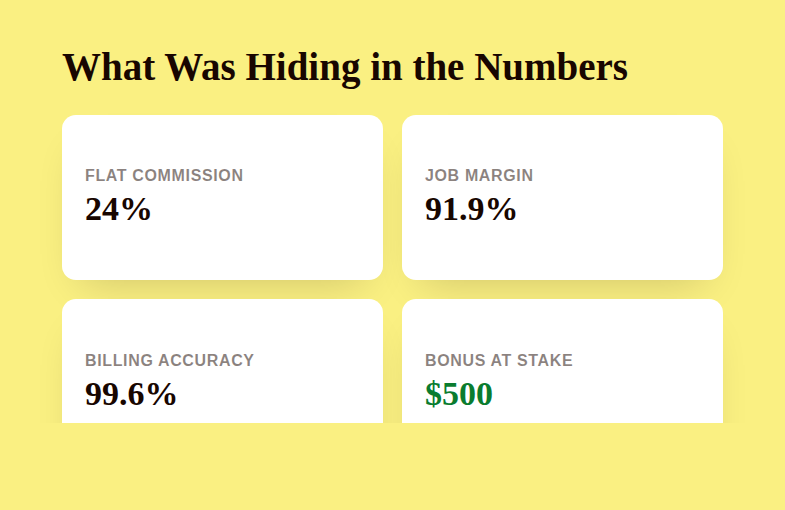
Situational exceptions matter here because a rigid 100%-or-nothing billing metric creates a strange incentive of its own: it can push a team to rush or write off a genuinely disputed invoice just to protect the bonus, rather than resolving it correctly. Building in room for a documented exception keeps the target meaningful. Perfect billing should mean the team is billing accurately and following up diligently, not that they are engineering around the metric to protect a payout.
The operations manager's own compensation got rebuilt around the same philosophy: pay for what is measurable now, not just what shows up in an annual net-profit number. Monthly goals now cover gross profit, revenue, and a new margin-erosion metric built around callbacks and rework, with a structure that allows a draw against a larger annual bonus. That monthly cadence matters for the same reason it mattered in the CSR incentive story above: a bonus that only pays out once a year, based on a number nobody sees until the year is nearly over, does not change behavior nearly as effectively as a number that moves every month.
Why Margin-Based Commission Is Worth the Setup Cost
Building accurate job costing into daily workflow is genuinely more work than leaving commission as a flat percentage of revenue. It is tempting to skip it. But a flat commission on a factory-direct model, where margin is the entire value proposition of cutting out the middleman, quietly pays sales reps to be indifferent to the thing that actually makes the business money. Automated, margin-aware incentive tracking only works as well as the cost data feeding it, which is exactly why the fix started with job costing discipline rather than a new commission formula.
What Other Installation and Retail Companies Should Take From This
If your business sells and installs its own product, audit whether your commission plan actually knows the difference between a 92%-margin job and a 40%-margin job. If job costing fields are optional or frequently left blank, the honest answer is that it does not, no matter what the commission formula on paper says it is supposed to do.
The same principle, pay for the metric that reflects real business health rather than raw activity, applies just as much to office and customer-facing roles as it does to sales commission. This plumbing company's CSR incentive redesign is a good example of that same idea applied to booking rate instead of margin.
It is also worth checking whether your best reputation-building incentive, five-star reviews, is limited to field technicians. Anyone with real influence over the customer experience, including office and operations roles, should have a reason to care about that number too. And if any bonus metric on your dashboard is sitting frustratingly close to its target month after month, look for whether one small process gap, not a real performance problem, is the thing standing between your team and the payout they have basically already earned.
Related reading
Conclusion
Tying commission to real job margin, and closing a 0.36% billing gap, turned two invisible leaks into a $500 monthly bonus and a fairer commission plan.
Create incentives
that
drive results
You shouldn't need complex equity plans to align your team. ShareWillow makes it simple to create transparent profit-sharing programs that motivate employees and grow your business.

Incentive plans to help
small businesses thrive.
.png)
"I was able to leverage the knowledge of the ShareWillow team to learn how other companies were designing their bonus plans. The template was extremely helpful."

Brian Tustin
Owner, First Rate Movers
