
A residential plumbing company had a customer service team fielding calls and booking jobs with no incentive plan of their own, plus a manual weekly payout process that was quietly dropping small amounts here and there. The fix was a tiered booking-rate bonus, per-call and per-sale spiffs, and a standardized close-out flow the office runs every Wednesday before payroll.
Most incentive plans in the trades start with the technicians, because they are the ones out on the truck generating revenue. That makes sense, but it also means the office almost always gets forgotten. A residential plumbing company with a small customer service team ran into exactly that gap. Technicians had bonuses tied to their work. The customer service reps, the people actually answering the phone, booking the job, and making the follow-up call that turns a maybe into a scheduled appointment, had nothing.
That is a strange place to leave a hole, because a CSR's day-to-day choices, whether to push for the booking on a borderline call, whether to make the extra follow-up call instead of moving on, whether to mention the water treatment upsell, add up to real dollars every single week. None of that was rewarded. It also was not tracked in a way that made it visible to the CSR herself, which meant there was no reason to change behavior even if someone wanted to.
A Booking Rate With No Incentive Attached To It
The company already had the data. Every inbound call gets logged, and every booked job gets logged, which means a booking rate, the percentage of inbound calls that actually convert into a scheduled job, was sitting right there in the numbers the whole time. Nobody had built anything around it. A CSR converting 85% of calls into bookings and a CSR converting 95% of calls into bookings were paid exactly the same, which is another way of saying the plumbing company was paying for a seat, not for performance.
The same was true for two smaller, but real, revenue levers: outbound follow-up calls to customers who did not book the first time, and add-on sales like water treatment bottles and club memberships. Both of those depend entirely on whether a CSR bothers to make the extra ask. Neither one had a dollar attached to it, so neither one got the extra ask often enough.
A Weekly Payout Process With Its Own Quiet Leaks
On top of the missing incentive, the existing weekly bonus process for technicians had a mechanical problem. Payouts had to be closed out for each person before Wednesday payroll ran, and when that close-out step got skipped or rushed, small errors crept in. One technician's expected $2.78 bonus never got recorded for a given week. Another record showed an extra $5 that should not have been there. Individually those numbers are trivial. Systemically, they are exactly the kind of thing that erodes trust in a bonus plan, because a technician who spots even a small missing amount starts wondering what else might be off.
Any plumbing company running incentive pay on a manual weekly close-out is exposed to this same failure mode. A bonus plan is a promise, and a promise that pays out $2.78 short, even by accident, is a promise that stops feeling reliable.
It is worth sitting with why this particular gap is so common. Technician bonuses are visible because they usually tie to a job that just got completed, a dollar figure that is easy to point to. Office and CSR performance is quieter. Nobody stands over a CSR's shoulder while she decides whether to make one more follow-up call before lunch. That invisibility is precisely why the incentive matters more here, not less. Without a number attached to the behavior, the behavior has no reason to change, and a manager has no easy way to even notice it changing.
A Tiered Booking Rate Bonus, Built Around Real Thresholds
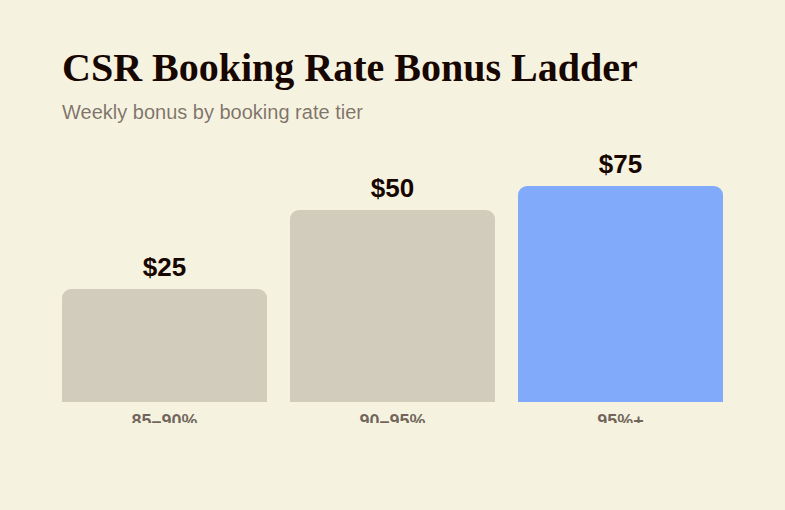
The plan built for the CSR role turned the booking rate metric into a tiered weekly bonus with three thresholds. Hit 85% to 90% booking rate for the week and earn $25. Hit 90% to 95% and earn $50. Clear 95% and earn $75. That is not a single pass or fail line, it is a ladder, and a ladder changes behavior differently than a threshold does. A CSR sitting at 88% has a visible, specific next rung to reach for, instead of a single distant cutoff that feels out of reach until the very last day of the week.
The three tiers were also set close enough together that movement between them feels achievable inside a single week, rather than requiring a once-a-quarter step change in performance. Going from an 87% booking rate to a 91% booking rate is a realistic week-to-week swing for a CSR who is paying attention, and the plan pays for exactly that kind of incremental improvement instead of only rewarding a rare, dramatic jump.
Layered on top of the booking rate tiers, two more levers were built directly into the same plan. Every outbound follow-up call that turns into a booking pays $10. Every water treatment bottle sold and every club membership sold pays $15 each. None of that requires the CSR to do anything different in terms of tools, it requires tagging the right outcome in the field service platform the company already uses, and the incentive plan picks up the tag automatically from there.
Making the Incentive Plan Live Immediately, Not Next Quarter
One detail matters as much as the plan design itself: timing. The plan was published effective immediately, which meant it was already running by the very next payroll cycle. There was no multi-week lag between "we designed a plan" and "the CSR can actually feel the plan in her paycheck." That immediacy is a big part of why incentive plans succeed or fail. A plan that pays out two months after the behavior it is supposed to reward is a plan that has already lost the connection between action and reward in the CSR's head.
The mechanics matter too, but they only work if the person earning the bonus can trust the number attached to their name every single week. That is where the second half of the fix came in.
Why a Flat Bonus Would Have Missed the Point
It would have been simpler to hand the CSR a flat weekly bonus for good performance and call it done. That approach almost always underperforms a tiered one, because a flat number does not scale with effort. A CSR at an 85% booking rate and a CSR at a 95% booking rate are doing meaningfully different work, and a flat bonus tells both of them the same thing: close enough is close enough. The ten-point spread between the bottom and top tier in this plan, $25 versus $75, is deliberately wide enough that the difference between an average week and a great week actually shows up in the paycheck, not just in a spreadsheet somewhere in the back office.
Profit sharing
made simple.
Give your team a stake in the company’s success. ShareWillow helps you create and manage profit-sharing programs that motivate employees and drive business results.
Closing the Weekly Payout Leaks Before They Reach Payroll
The fix for the payout errors was less about new incentive dollars and more about discipline in the existing process. Every Wednesday morning, before payroll runs, the office now closes out the prior week's incentive payouts for each technician using the same three-step flow: start, continue, save. That sounds almost too simple to matter, but it is exactly the kind of small operational habit that prevents a $2.78 miss or a stray $5 from ever reaching a paycheck in the first place. A downloadable payout report, filtered to the specific date range for that pay period, now backs up every number that goes into payroll, so there is a paper trail if a number is ever questioned again.
What This Adds Up To For a Plumbing Company's Office Team
Stack all four levers together and the math is not subtle. A CSR who clears the top booking rate tier, books a couple of extra follow-up calls, and sells even one or two water treatment bottles or memberships in a given week is realistically looking at somewhere in the neighborhood of $100 to $150 in incentive pay on top of base pay, in that single week. That is not a once-a-year profit share landing in a lump sum that is hard to connect to any one decision. It is a number that moves visibly from one week to the next based on specific, repeatable choices: pushing for the booking, making the extra call, remembering the upsell.
That is the real shift here. The booking rate, the follow-up calls, and the add-on sales were always happening, or not happening, inside a CSR's normal day. What changed is that all three now show up in the same paycheck, on the same weekly cycle, tied to a number the CSR can see and improve. Automated, data-driven incentive tracking is what makes that possible without turning payroll into a manual audit every single week.
What Other Plumbing Companies Should Take From This
If your plumbing company has a CSR or dispatch team with no incentive plan of their own, you are very likely sitting on the same untapped lever this company found: a booking rate metric you already track but have never turned into pay. A tiered structure, not a single pass or fail line, gives that metric room to reward steady improvement instead of only rewarding the reps who were already at the top.
It is also worth auditing your own weekly close-out process before you scale up incentive pay across more roles. A $2.78 miss on one technician's bonus is easy to shrug off as a rounding error. A pattern of misses, across a growing team, is a trust problem waiting to happen. Fix the process before you grow the incentive, not after.
There is also a broader lesson here about which roles get left out of incentive design in the trades. Dispatchers, CSRs, and other office staff sit closer to revenue than most owners give them credit for. A technician cannot get to a job that never got booked, and a technician cannot sell a maintenance membership that a CSR never mentioned on the phone. Building a plan for the office team is not a nice-to-have add-on to a technician incentive program, it is closing a gap in the same revenue chain the technician plan already depends on.
The same underlying idea, tie pay to a metric the business can actually sustain and reward the exact behavior that moves it, shows up again in this HVAC and plumbing labor cost turnaround, just applied to technician pay instead of the office team.
Plumbing companies thinking about this for their own office team do not need to start from scratch. The booking rate, follow-up call, and add-on sale data almost certainly already exists inside whatever field service platform is already in use. The work is in turning that existing data into a plan with real thresholds, publishing it so it is live the same week it is designed, and building a close-out habit sturdy enough that nobody has to wonder whether their number is right.
Related reading
- How a Leak Detection and Plumbing Company Traded Commission-Only Chaos for a Tiered Pay Plan
- Ten Years Without Working Metrics: How a Water Treatment Company Found $70,000 in Week One
- How to Calculate Bonus Pay: A Step-by-Step Guide to Fair and Motivating Compensation
- Companies with Profit Sharing: Who They Are & What They Offer
- CSR Bonus Structure: How a Plumbing Company Built One Around Memberships, Booking Tiers, and Call Categorization
Conclusion
Turning an untracked booking rate into a tiered weekly bonus gave this plumbing company's CSR team a real, visible reason to push for every booking, every call, and every upsell.
Create incentives
that
drive results
You shouldn't need complex equity plans to align your team. ShareWillow makes it simple to create transparent profit-sharing programs that motivate employees and grow your business.

Incentive plans to help
small businesses thrive.
.png)
"I was able to leverage the knowledge of the ShareWillow team to learn how other companies were designing their bonus plans. The template was extremely helpful."

Brian Tustin
Owner, First Rate Movers
