
A multi-location HVAC and plumbing company had a bonus plan almost nobody could hit, paid out once a quarter with no real visibility into how it was calculated. Here is how they rebuilt it into four territory-specific pools with monthly payouts, and what changed when they did.
Here is a number worth sitting with: a bonus plan that pays out 0.5% once a technician crosses $1,000 in qualifying work sounds generous on paper. In practice, at one multi-location HVAC and plumbing company, almost nobody was hitting it. Month after month went by with the threshold sitting there, technically active, functionally decorative.
That is the trap a lot of growing field service companies fall into. You build an incentive plan with good intentions, it gets buried under years of small tweaks and exceptions, and eventually it stops doing the one thing an incentive plan is supposed to do: change behavior. If your team can't tell you off the top of their head roughly what they will earn this month, the plan isn't working, no matter how well-intentioned the original design was.
A Bonus Plan Nobody Could Reach
This company operates across two markets, with its own install crews for HVAC and for plumbing in each territory, plus a separate pool-installation line. That is a lot of different jobs, crew types, and revenue patterns living under one roof. For years, all of it was squeezed into a single bonus structure that made sense for none of it.
The mechanics were the real problem. The plan was measured monthly but paid out quarterly, through a static "install incentive report" that someone had to build by hand. It had no built-in way to account for actual days and hours worked, so every cycle required manual adjustment for things like callback tagging and eligibility exceptions. Multiply that by four job categories and two territories, and you get a process that ate hours of admin time every quarter and still left technicians confused about what they had actually earned.
The dollar figures were real, just slow. The HVAC install pool in one of its two territories alone ran around $28,000 per quarter under the old system. That is not a small number. But paid out once every three months, through a report nobody on the crew ever saw until it landed, it did almost nothing to connect a technician's day-to-day performance to their paycheck. By the time the check arrived, most people had forgotten which jobs from three months back had even pushed them into it.
Multi-location shops run into this exact wall constantly. A plan built for one market, one crew type, or one season of the business gets stretched to cover everything else, and the stretching is where it breaks. If you are running more than one territory or more than one type of install crew, a single flat incentive number almost never reflects reality for all of them at once. What counts as a good month for a plumbing crew looks nothing like a good month for a pool install team, and treating them the same in one shared bonus pool just breeds resentment on both sides.
There is also a quieter cost that rarely shows up on a balance sheet: admin hours. Someone on the office side was pulling ServiceTitan exports, cross-referencing callback tags by hand, and rebuilding the same report from scratch every quarter, four times a year, for four different crew types. That is not a one-afternoon job. It is the kind of recurring task that eats a full week of somebody's quarter, every quarter, and produces a report that technicians still had trouble trusting once it landed. Growth tends to make this worse, not better. Add a third territory or a fifth crew type, and a manual process that was merely annoying at two locations becomes genuinely unworkable at three.
Rebuilding the Plan Territory by Territory
The fix here was not a bigger bonus. It was a structurally different plan, built around how the business actually operates instead of how it was easiest to administer years ago.
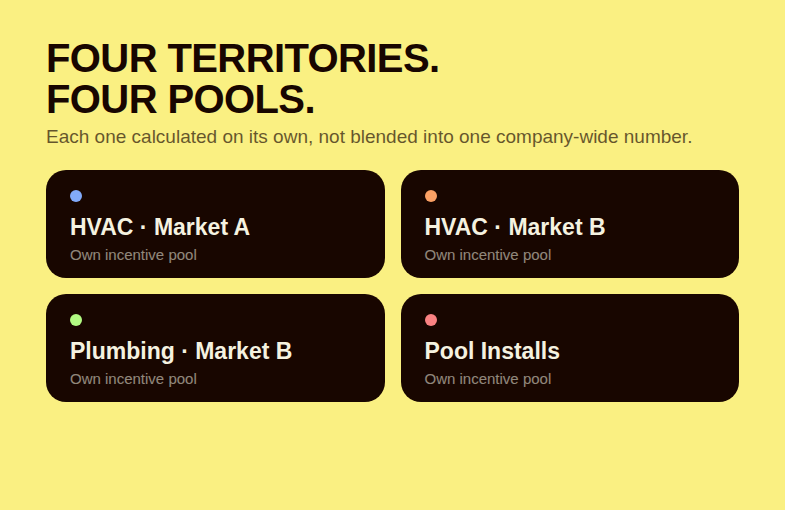
The company worked with ShareWillow to split the single bonus pool into four separate incentive pools, each calculated on its own:
- HVAC install crew, Market A
- HVAC install crew, Market B
- Plumbing install crew, Market B
- Pool installation, company-wide
Each pool runs on a 25%-of-revenue labor-cost formula, with one important new guardrail: a minimum monthly revenue threshold, in the neighborhood of $20,000 to $21,000, before any commission percentage kicks in at all. That single change did more than tighten the numbers. It stopped the plan from paying bonuses to technicians who genuinely were not producing enough to justify one, which is exactly the kind of quiet payroll leak that erodes trust in an incentive program over time. Everyone else in the crew notices when a bonus goes out for a month that wasn't actually a good one.
The team also cleaned out a piece of legacy confusion: a "half-point" bonus adjustment that almost nobody understood and that had been generating support questions for years. Sometimes the best fix to a comp plan isn't adding a smarter rule, it's removing a rule nobody can explain anymore.
Why Payout Frequency Matters More Than Owners Think
It's tempting to treat payout cadence as a back-office detail, something payroll figures out after the plan design is done. In practice it is one of the biggest levers you have for whether an incentive plan actually motivates anyone. Behavioral research on pay and motivation says the same thing you'd guess from running a shop for a few years: the closer a reward sits to the behavior that earned it, the more that reward shapes future behavior. A quarterly bonus, however well-calculated, is trying to reinforce a decision a technician made ten or twelve weeks earlier. A monthly one is talking about last month. It is a much easier connection for a person to make in their head.
There's also a trust dimension that's easy to underestimate. When a bonus report only shows up once a quarter and nobody on the crew has visibility into it in between, the plan starts to feel like something that happens to technicians rather than something they have a hand in. Moving to a faster cadence, paired with a clear, visible calculation, is one of the more reliable ways to rebuild that trust without spending an extra dollar on the bonus pool itself. If you're weighing changes to your own incentive plan structure, payout frequency is worth as much design attention as the percentages themselves.
The last piece was making the whole thing runnable without a spreadsheet marathon every cycle. ShareWillow now syncs data from the company's ServiceTitan account four times a day, so the numbers behind each pool are current, not reconstructed after the fact from a month of exports. An operations lead reviews and edits the report fields as needed, a second person finalizes the payout plan in a dedicated history view, and the finalized numbers flow straight to payroll. No PDF exports, no hand-built Excel formulas, no waiting until quarter-end to find out whether the math holds up. The company also caught and fixed a smaller but nagging bug along the way, where a job's completion date was getting compared against its invoice date for photo-completion qualifiers, occasionally disqualifying a technician from an award through no fault of their own, just because the office was slow to invoice. Small fixes like that one rarely make headlines, but they are exactly the kind of detail that determines whether a crew trusts the numbers on their bonus statement.
Profit sharing
made simple.
Give your team a stake in the company’s success. ShareWillow helps you create and manage profit-sharing programs that motivate employees and drive business results.
From Quarterly to Monthly: The Real Result
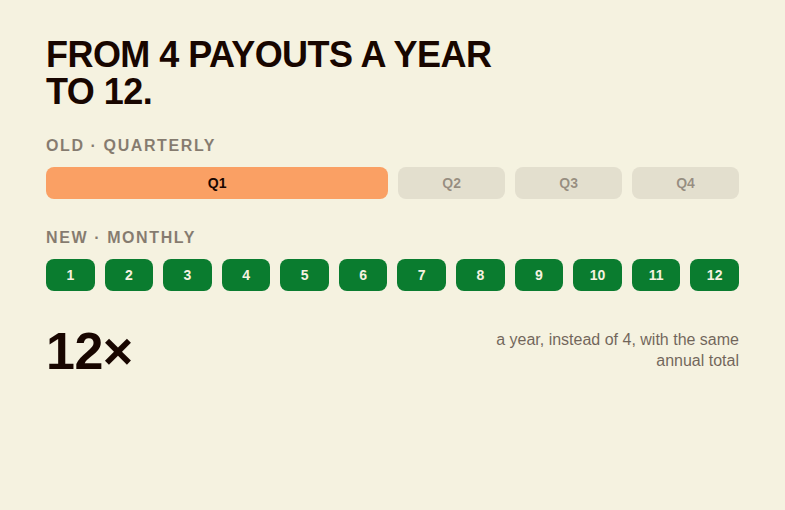
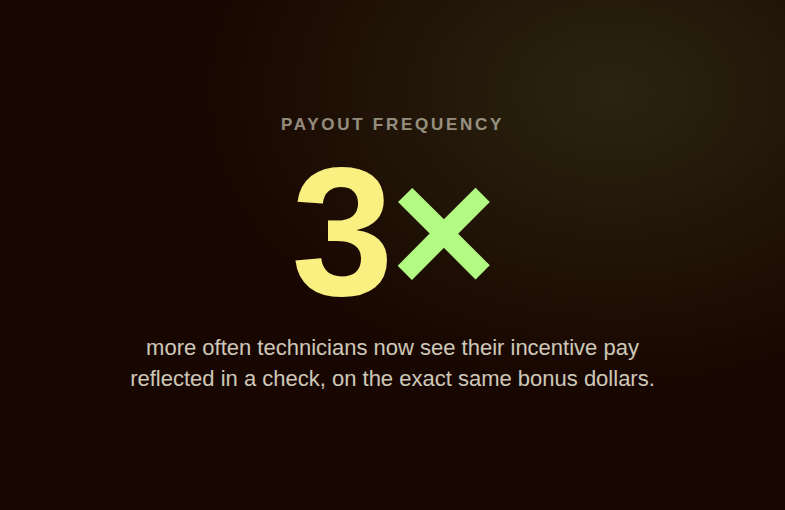
Here is the headline change, in plain terms: the same HVAC install pool that used to pay out roughly $28,000 once a quarter now pays out roughly $8,000 to $9,000 a month. Do the math and it lands close to the same annual total, which is exactly the point. This was never about inflating the bonus pool. It was about paying the same real dollars on a cadence technicians can actually feel and plan around, roughly three times more often than before.
The qualitative shift matters just as much as the cadence change. In a recent check-in, the team's own read on the new system was logged plainly in the notes: the platform reduces manual work compared to previous external processes, and the team is comfortable with the review workflow. That is not a dramatic before-and-after dollar story. It's something more durable: a process that used to require a person to hand-build a report every quarter now runs on a rhythm the whole team trusts, month after month.
"Platform reduces manual work compared to previous external processes and the team is comfortable with the review workflow."
A recurring monthly check-in is now locked into the calendar for the first week of every month, a small but telling detail. The old quarterly rhythm was something that happened to the business. The new monthly one is something the business runs on purpose.
It is also worth being honest about the rollout itself, because it did not flip on overnight. Service technicians and the install crew in the first market were live on the new monthly cadence by early August, while the install rollout in the second market was still ramping. That staged approach is normal, and arguably smarter than a single company-wide flip. Rolling out territory by territory means the team can catch data issues, like the invoice-date bug mentioned above, on a smaller group before they touch every technician's paycheck.
What This Means If You Run a Multi-Location Shop
A few things are worth taking from this if you're running incentive pay across more than one location or crew type in the HVAC industry or an adjacent trade:
- Don't force one flat plan across different territories or job types. A pool install crew, a plumbing crew, and an HVAC crew in two different markets rarely have comparable revenue patterns. Separate pools, even with a shared formula, produce numbers that feel fair to everyone.
- Set a floor before commission kicks in. A minimum revenue threshold protects the plan from paying out on months that weren't actually strong, which protects the credibility of every other payout.
- Shorten the cadence wherever you reasonably can. Moving from quarterly to monthly won't necessarily change how much you pay over a year. It will change how connected your team feels to that pay.
- Automate the data pull, not just the math. A plan is only as reliable as the data behind it. Syncing job and revenue data multiple times a day, instead of exporting PDFs by hand, removes most of the errors that erode trust in a bonus report.
None of this required a bigger bonus budget. It required a plan that matched how the business actually runs, and a process fast enough that the plan could show its work every single month instead of once a quarter.
Related reading
Conclusion
If your incentive plan has drifted out of sync with how your business actually operates across territories or crew types, or your team is still waiting on a quarterly report to find out what they earned, it may be time for a rebuild. ShareWillow works with multi-location HVAC and plumbing companies to build territory-specific plans that sync with your existing systems and pay out on a cadence your team can actually feel.
Create incentives
that
drive results
You shouldn't need complex equity plans to align your team. ShareWillow makes it simple to create transparent profit-sharing programs that motivate employees and grow your business.

Incentive plans to help
small businesses thrive.
.png)
"I was able to leverage the knowledge of the ShareWillow team to learn how other companies were designing their bonus plans. The template was extremely helpful."

Brian Tustin
Owner, First Rate Movers
