
A 6-tech HVAC company watched technician labor cost swing from 16% of revenue one month to 50% the next, with no way to see it coming. Here is how tying pay to job revenue turned that swing into one stable, predictable target.
Labor Cost Roulette
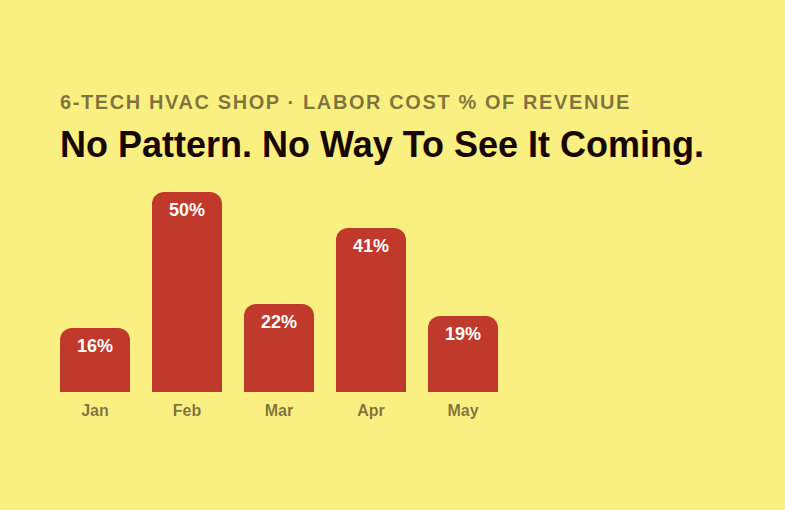
A 6-technician HVAC company had a number that should never move as much as theirs did. Technician labor cost, the share of revenue going out the door in field pay, swung from 16% of revenue in one month to as high as 50% in another. Same company, same six trucks, same general mix of service and install work. The number on the spreadsheet just refused to sit still.
For a small shop, a swing that size is not a rounding error. It is the difference between a comfortable month and a month where the owner is quietly wondering whether payroll is going to be a problem. And because the swing had no clear pattern to it, no clean seasonal explanation, no obvious tie to a specific type of job, there was no way to see it coming. Budgeting became a guessing game every single month, built on whatever the prior month happened to look like rather than any real ability to forecast what was ahead.
Sixteen percent one month. Fifty percent the next. Same company, same crew, and no way to see which one was coming.
This kind of volatility usually traces back to the same root cause: pay that is not structurally tied to the value of the work being done. When technicians are paid on a flat hourly basis regardless of job mix, a month heavy on quick, high-margin service calls looks completely different, on paper, from a month heavy on long, lower-margin installs, even if the crew worked exactly the same number of hours in both. The labor cost percentage becomes a byproduct of whatever jobs happened to come in that month, not something the business has any real ability to steer.
For a business this size, that unpredictability carries real weight. A six-person shop does not have the cash cushion of a fifty-truck operation to absorb a 50% labor month without feeling it. The owner needed something more useful than a number that looked fine in hindsight. They needed a structure built to land in a predictable, sustainable range every month, on purpose, regardless of exactly which jobs happened to come through the door.
Building a Plan Around One Target Number, Not a Range of Guesses
The fix started with picking a single, specific target: technician labor cost landing at roughly 20% of revenue, every month, instead of drifting anywhere between 16% and 50% depending on what jobs happened to come in.
Why One Target Beats a Wide Range
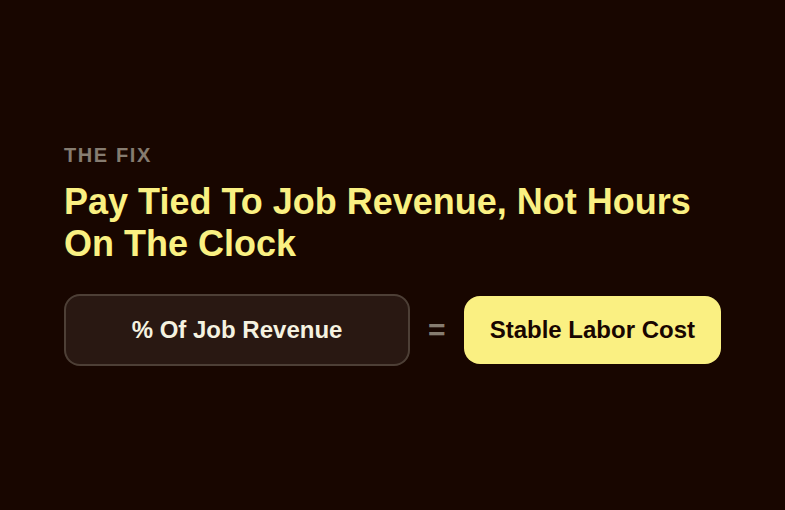
Picking one number rather than accepting a wide acceptable range forces a different kind of pay structure. A performance-pay plan built to hold labor cost near 20% of revenue has to scale technician pay with the actual revenue each job produces, not just the hours it takes to complete. A quick, high-ticket service call and a long, lower-margin install stop looking like two completely different labor cost outcomes and start looking like two jobs the pay structure was built to handle consistently, because the incentive is tied to revenue generated rather than hours logged.
That is the mechanical shift that makes a stable percentage possible. Flat hourly pay has no way to self-correct for job mix. It pays the same whether a technician spends the afternoon on a job that generates enormous margin or one that barely covers its own cost. A performance-pay structure tied to revenue percentage does self-correct, because the payout itself scales with what each job actually brought in, which is exactly what keeps the labor cost ratio from swinging wildly month to month.
Predictability as the Actual Goal
It is worth being clear about what this plan was optimizing for. It was not built to minimize labor cost to the lowest possible number. A shop that squeezes technician pay too hard will lose its best people to a competitor paying closer to what the work is worth, a false economy that shows up as a turnover problem a few months later. This plan was built to make the number predictable, landing in a sustainable range the owner could actually plan around, month after month, rather than discovering after the fact whether this particular month happened to be a 16% month or a 50% month.
Predictability is its own kind of value for a business this size. A six-person shop that knows, going into a month, roughly what its labor cost will land at can price jobs with more confidence, plan cash flow with more confidence, and make hiring or growth decisions without waiting to see how the labor cost dice happen to land. That is a different kind of win than simply cutting the number as low as possible, and it is the one this shop actually needed.
For a look at how a larger multi-trade HVAC and plumbing company tackled a similar labor cost problem at bigger scale, see how one HVAC and plumbing company cut labor cost from 58.5% of revenue to under 40%.
Profit sharing
made simple.
Give your team a stake in the company’s success. ShareWillow helps you create and manage profit-sharing programs that motivate employees and drive business results.
The Result: Predictable Payroll, Finally
Instead of a labor cost number that could land anywhere from 16% to 50% of revenue depending on the month, the shop now had a performance-pay structure built to hold that number near a stable 20% target, month after month, regardless of exactly which mix of service calls and installs came through the door.
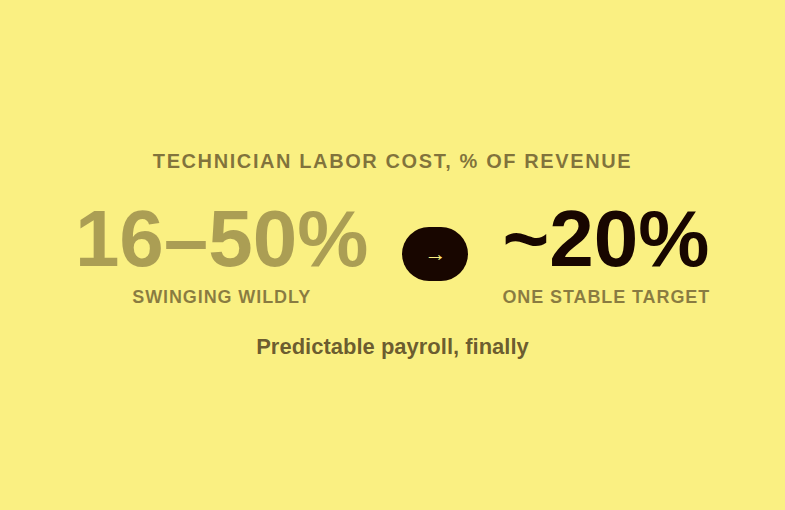
The value of that shift is not really about the specific number 20%. It is about what a business owner can do once that number stops moving unpredictably. Pricing decisions get easier when labor cost is not a wildcard. Cash flow planning gets easier when a slow-looking month on the calendar does not carry the risk of also being a 50% labor month. Even hiring decisions get easier, because the owner has an actual, trustworthy baseline to model a seventh technician against, instead of a number that has bounced between 16% and 50% with no clear pattern.
It is worth naming honestly what this result is and is not. It is not a story about slashing technician pay to hit an arbitrary target. The plan still rewards technicians for the value they generate, and a strong month for the crew is still a strong month for the crew's paychecks. What changed is that the business finally has a structure designed to keep that reward proportional and predictable, instead of a flat rate that produced wildly different outcomes depending on which jobs happened to land in a given month.
What This Means for Your Crew
- A swinging labor cost percentage is usually a pay structure problem, not a bad-luck problem. If your number bounces around with no clear pattern, look at whether pay is tied to job value or just to hours worked.
- Pick one target number, not a wide acceptable range. A specific target forces a pay structure that can actually be built to hit it. A vague range just gets rationalized after the fact.
- Tie pay to revenue generated, not hours logged, if you want the ratio to hold steady. Flat hourly pay has no built-in way to adjust for a month heavy on high-margin work versus a month heavy on lower-margin installs.
- Predictability is a real win on its own, separate from cutting costs. A stable, known labor cost percentage makes pricing, cash flow planning, and hiring decisions easier, even before you touch the number itself.
- Small crews feel volatility harder than large ones. A six-truck shop does not have the cushion to absorb a 50% labor month the way a fifty-truck company might. Predictability matters more, not less, at smaller scale.
If your HVAC labor cost feels like it is landing on a different number every month with no way to see it coming, that is very often fixable, and it rarely requires cutting anyone's pay to fix it. Learn more about how ShareWillow can model a performance-pay structure against your own revenue history before it changes a single paycheck.
Related reading
Conclusion
If your labor cost swings from one number to a completely different one every month, that is usually a pay structure problem, not bad luck. ShareWillow builds performance-pay plans tied to revenue so labor cost holds near one predictable target, modeled against your own numbers first. Reach out to see what a stable target could look like for your shop.
Create incentives
that
drive results
You shouldn't need complex equity plans to align your team. ShareWillow makes it simple to create transparent profit-sharing programs that motivate employees and grow your business.

Incentive plans to help
small businesses thrive.
.png)
"I was able to leverage the knowledge of the ShareWillow team to learn how other companies were designing their bonus plans. The template was extremely helpful."

Brian Tustin
Owner, First Rate Movers
