
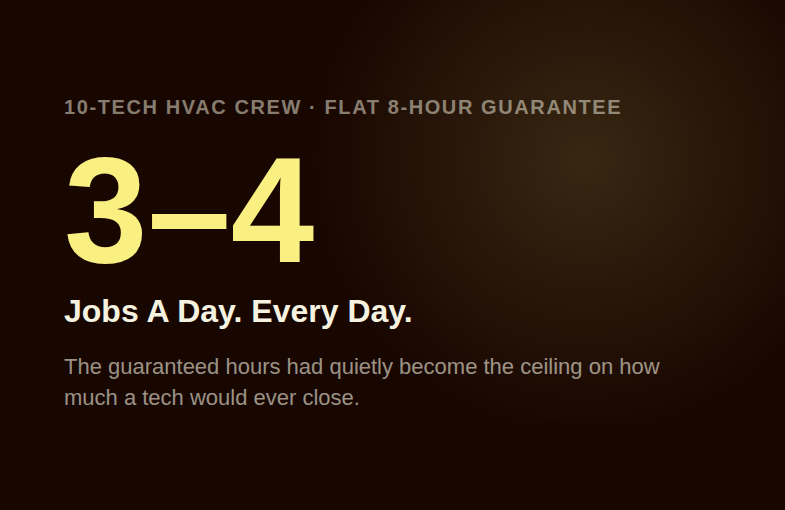
A 10-tech HVAC company in California guaranteed flat pay no matter how many jobs a technician closed, and output quietly plateaued at 3 to 4 jobs a day. Here is how stacking performance pay on top of the guarantee pushed the target to 5 to 7.
When Guaranteed Pay Becomes a Ceiling
A 10-technician HVAC company in California ran into a problem that is easy to miss until you look directly at it. Every technician was guaranteed a full eight hours of pay for every day worked, no matter how many jobs they actually closed. On paper, that sounds like a reasonable, stable way to compensate a field crew. In practice, it had quietly become a ceiling.
Technicians settled into a rhythm of three to four completed jobs a day and stayed there, month after month. Nobody was slacking off in any obvious way. The trucks rolled out on time, the jobs got done, the customers got serviced. But there was no financial reason for a tech to push for a fifth job, or a sixth, when the fourth one had already filled the guaranteed eight hours on the clock. Once a day's pay was locked in regardless of output, output naturally settled at whatever pace felt comfortable.
Three to four jobs a day, every day, for a crew that had the physical capacity to do more. The guarantee had become the ceiling.
This is one of the least visible costs of flat guaranteed pay in field service. It does not show up as a morale problem or a retention problem, at least not right away. It shows up as a quiet plateau in the numbers, dispatch logs and close rates that look steady on the surface but never climb, because nothing in the pay structure ever asked them to. A shop can run this way for years without anyone quite putting a finger on why growth in technician output has stalled while demand keeps climbing.
The company knew the guarantee itself was not the enemy. Technicians reasonably expect some floor under their pay, especially on slow days when job flow is thin through no fault of their own. The problem was that the guarantee had become the entire structure instead of a piece of it. What was missing was a second layer on top, something that rewarded a technician for closing a fifth job instead of stopping comfortably at the fourth. Building that layer meant rethinking the plan from the ground up rather than trying to patch around a structure that had no room in it for performance to matter.
Rebuilding the Math: A Base Rate Plus Stacked Performance Pay
The fix was not to remove the guarantee. It was to stack a real performance layer on top of it, so a technician's pay finally moved when their output did.
Keeping the Floor, Adding a Ladder
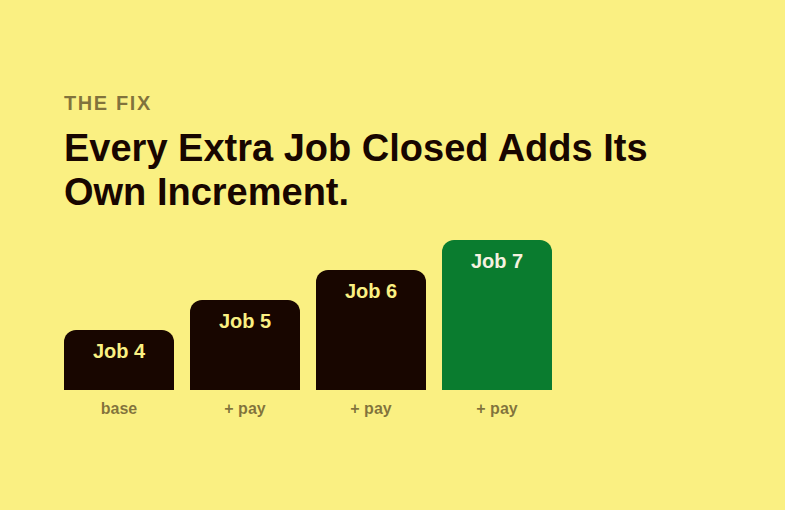
The new structure kept a base rate in place, so nobody's income became unpredictable overnight. What changed was what sat on top of it: a stacked performance-pay component tied directly to jobs closed. Close the jobs a tech had always closed, and pay looked roughly the same as before. Close a fifth job, or a sixth, and pay climbed with it, in a way the old flat structure never allowed. "Stacked" matters here specifically: instead of one flat bonus threshold that either does or does not get hit, each additional completed job adds its own increment, so the difference between an average day and a strong one shows up directly in the paycheck rather than disappearing into an already-guaranteed eight hours.
That distinction is what makes a stacked structure different from a simple bonus tacked onto flat pay. A single bonus threshold, hit a target number and get a flat extra amount, still leaves a plateau just one step higher than before. A stacked structure removes the plateau entirely, because there is always another increment available for the next job closed. A technician deciding whether to squeeze in one more call before heading back to the shop now has an actual financial answer to that question, every single day, not just on the days they happen to clear some arbitrary monthly bar.
Setting a Target the Crew Could Actually Reach
Leadership did not simply demand more output and hope the new pay structure would follow along. They set a specific target range, five to seven completed jobs a day, built directly around what the stacked pay model made financially worthwhile for a technician to reach. That target was not arbitrary. It reflected what a tech's day could realistically hold once the fifth and sixth jobs actually paid something meaningful, instead of vanishing into hours that were already covered by the guarantee.
Anchoring the target to the pay structure, rather than picking a number first and figuring out compensation later, is what keeps a plan like this credible with a crew. Techs can see exactly why five to seven jobs is the number leadership is asking for: it lines up with where the stacked pay actually starts rewarding the extra effort. A target that is not connected to the pay plan reads as pressure. A target that is built on top of the pay plan reads as opportunity, and that difference shows up fast in how a crew responds to a new structure.
This kind of stacked model works especially well for HVAC field service crews because the unit of work is so countable. A completed job is a clear, unambiguous event, not a fuzzy proxy metric, which makes it a clean thing to build performance pay around. For a look at how another HVAC company automated a similar tiered structure it used to track by hand, see how a $250,000 commission tier stopped living in a spreadsheet.
Profit sharing
made simple.
Give your team a stake in the company’s success. ShareWillow helps you create and manage profit-sharing programs that motivate employees and drive business results.
The Result: A New Ceiling, Two to Three Jobs Higher
With the stacked performance layer in place, the company set its new working target at five to seven completed jobs a day, up from the three to four that had held steady under the old flat guarantee. That is not a marginal gain. For a ten-technician crew, moving the average day up by even two completed jobs compounds fast, across every truck, every week, every month on the calendar.

What makes this result worth paying attention to is where the increase came from. Nobody hired additional technicians. No trucks were added to the fleet. The same ten people, with the same tools and the same territory, simply had a financial reason to close a job they would have previously left for tomorrow, or handed off, or quietly let slide. The capacity had been sitting there the whole time. The flat guarantee had just never asked anyone to use it.
That is the broader lesson underneath this specific number. A lot of field service companies assume that increasing daily job counts requires more headcount, longer hours, or tighter dispatch software. Sometimes it does. But sometimes the capacity is already sitting inside the crew you have, waiting on a pay structure that actually rewards using it. Flat guaranteed pay, however well-intentioned, quietly tells a technician that the fifth job of the day is optional. A stacked performance layer tells them it is worth their time.
What This Means for Your Crew
- A flat guarantee without a performance layer becomes a ceiling, not a floor. If pay stops changing once a technician clears the guaranteed hours, output will naturally settle wherever feels comfortable, regardless of real capacity.
- Stack the incentive instead of using a single bonus threshold. One flat bonus just moves the plateau up by one step. A stacked structure, where every additional job adds its own increment, keeps rewarding effort with no ceiling built back in.
- Set your target around the pay structure, not the other way around. A number that is visibly tied to what the plan actually pays reads as opportunity to a crew. A number picked first and explained later reads as pressure.
- Protect the guarantee while you add the layer. Techs need a stable floor, especially through slow stretches. The fix is not removing the guarantee, it is making sure it is not the only thing determining pay.
- Look for capacity you already have before you assume you need more headcount. This crew found two to three more jobs a day inside their existing ten technicians. That capacity is worth checking for before adding trucks or hires.
Every HVAC or field service crew running on flat guaranteed pay is carrying some version of this same hidden ceiling. Finding it does not require new equipment or new hires, just a pay structure honest enough to show a technician exactly what the next job is worth, and a target built to match. Learn more about how a stacked performance pay plan can be modeled against your own dispatch history before it ever touches a paycheck.
Related reading
Conclusion
If your technicians are guaranteed pay but plateaued on output, the fix is rarely more hours or more hires. ShareWillow builds stacked performance-pay plans that reward every extra job closed, modeled against your own dispatch history before it changes a single paycheck. Reach out to see what your crew's real capacity looks like.
Create incentives
that
drive results
You shouldn't need complex equity plans to align your team. ShareWillow makes it simple to create transparent profit-sharing programs that motivate employees and grow your business.

Incentive plans to help
small businesses thrive.
.png)
"I was able to leverage the knowledge of the ShareWillow team to learn how other companies were designing their bonus plans. The template was extremely helpful."

Brian Tustin
Owner, First Rate Movers
