A 130-person multi-trade company fixed a ServiceTitan report split that was hiding technician sales from commission, and weekly incentive pay nearly quadrupled.
Commission math only works if everyone shows up in the report it's built from. That sounds obvious until it breaks, and for a large multi-location home services company running HVAC, plumbing, and electrical crews across several branches, it broke in a way that took months to fully untangle. Technician sales were being split across two separate ServiceTitan reports depending on how a job got tagged, and the two reports did not talk to each other. One administrator described the problem bluntly: when she filtered by sold-by to check a technician's numbers, his stuff would simply disappear, not because he hadn't sold it, but because it had landed in the report nobody was checking.
Installers had it worse. On certain job types, they were missing from the commission-feeding reports entirely, which meant the people doing some of the most demanding physical work on a job site were the ones most likely to get shorted on the bonus tied to it. Before ShareWillow, the fix was manual: someone in the office would notice a number looked wrong, dig through both reports by hand, and resync the data before payroll ran. That is not a process, it is a routine near-miss, and it was happening across more than a hundred employees every single pay cycle.
One Report Instead Of Two, Refreshed Three Times A Day
ShareWillow's fix started with consolidation. Instead of pulling commission data from whichever of the two ServiceTitan reports happened to catch a given job, the company moved to a single source of truth, synced automatically three times a day at 10am, 3pm, and 6pm Eastern. Nobody has to remember to trigger a resync anymore. As one team member put it, with the new platform they don't have to resync it themselves, it just automatically brings in the correct numbers every day. That sentence alone is a good measure of how much manual firefighting the old process required.
On top of the consolidated reporting, ShareWillow built tiered, source-verified commission plans specific to each role. One electrical technician's plan, for example, pays 5 percent commission on sales, stepping up to 6 percent once his cumulative sales for the year cross $250,000, tracked weekly rather than left to accumulate quietly until year-end. Tiered plans like this only work if the underlying sales data is trustworthy. Before the fix, nobody could fully trust it. After, the tier could be tracked automatically, because the report feeding it no longer had a blind spot where an installer's numbers could simply vanish.
Rolling A Fix Out Across Three Trades At Once
Consolidating two reports into one sounds like a single afternoon of work, but doing it across a company running HVAC, plumbing, and electrical crews out of several branches meant accounting for how differently each trade tags a job in the first place. An electrical service call, an HVAC install, and a plumbing repair all move through ServiceTitan a little differently, which is part of how the split happened in the first place: whatever logic routed a job into one report or the other was inconsistent across trades, so a fix that worked cleanly for electrical didn't automatically work for HVAC. ShareWillow had to verify the new, single source of truth against real historical data from each trade before turning it on for payroll, rather than assuming a fix validated on one crew's jobs would hold for another's.
What A Weekly Payout Trend Actually Looks Like
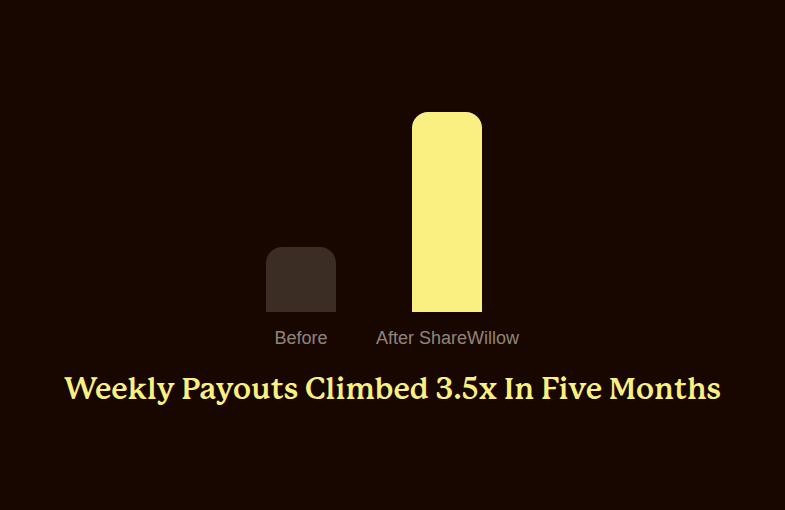
The clearest proof the fix worked shows up in the company's Electrical On Call plan, a 10-person weekly incentive covering the on-call rotation. Averaged across the plan's first four confirmed weeks in early January, the team earned roughly $233 per week combined. That is a small number, and it reflects exactly the kind of rollout period where enrollment and report accuracy are still catching up to plan design, not a sign the incentive itself was weak.
By late June, averaged across four confirmed weeks from mid-June through mid-July, the same plan was paying out roughly $820 per week, with individual weeks peaking above $1,700. That is close to a 3.5x increase in average weekly payout, on the same plan structure, the same eligible roster, and the same underlying commission rates. Nothing about the formula changed between January and June. What changed was whether the data feeding that formula could be trusted, and once it could, the number the plan had been designed to produce finally showed up consistently, week after week, instead of getting lost in whichever report happened to catch a given technician's sales that day.
There is a second layer to why the tiered structure matters here. A flat commission rate does not need especially clean data to feel fair, five percent of a sale is five percent whether the report is perfect or not. A tiered rate does. The moment a technician's rate is supposed to step up after crossing $250,000 in cumulative sales, every dollar has to be counted and attributed correctly, or the tier either triggers too early, which overpays, or too late, which shorts the technician who earned it. Before the consolidated report, nobody could have run a tiered plan like this with any confidence, because the cumulative total feeding the tier calculation had a hole in it every time a sale landed in the wrong place. The fix did not just recover missing dollars in any single week, it made an entire category of more sophisticated, performance-scaled commission plans possible for the first time.
Why A Data Problem Looks Like A Pay Problem
It is tempting to treat commission-accuracy issues as an IT problem rather than a compensation problem, something for the office to quietly fix in the background. That framing misses what it actually costs. Every week a technician's numbers landed in the wrong report was a week that technician's check was smaller than it should have been, through no fault of his own. Multiply that across a hundred-plus person roster running five figures a month for the office to manually check, and a reporting quirk stops being a technical detail and becomes a trust problem between the company and the people doing the work.
That is also why the fix mattered more for installers than for anyone else. Techs running solo service calls had an easier time getting flagged correctly, since their jobs tended to map cleanly to one report or the other. Installers working two-person crews on more complex jobs were the ones most likely to fall into the gap between the two systems. Fixing the sync did not just raise a number, it closed a gap that was quietly disadvantaging the specific role least equipped to notice and flag it on their own, since installers rarely have the same visibility into back-office reporting that a service tech checking his own numbers might.
Profit sharing
made simple.
Give your team a stake in the company’s success. ShareWillow helps you create and manage profit-sharing programs that motivate employees and drive business results.
How This Compares To Other Large Field Service Teams
It helps to see this against a wider set of larger home service companies running incentive plans through ShareWillow. Among companies with 25 or more employees, the typical shop runs a little over 44 confirmed distribution cycles with a median payout per cycle around $675. A company running a weekly on-call plan for a 10-person rotation, alongside several other role-specific plans across its HVAC, plumbing, and electrical teams, fits comfortably inside that pattern rather than standing far outside it. The June average of roughly $820 a week for this one plan is a strong number, but it is a believable one for a company this size running this many concurrent cycles, not an outlier so extreme it is hard for another large shop to picture happening to them.
That context matters for an owner evaluating whether a similar consolidation is worth the effort. This was not a story about a company discovering some hidden growth lever. It was a company fixing a plumbing problem, in the data sense, that had been quietly suppressing numbers the underlying plans were already designed to produce. The incentive plan platform did not need a new formula or a more generous commission rate to get there. It needed one report instead of two, refreshed automatically instead of by hand.
There is also a retention angle here that never shows up in a payout report but is easy to infer. A technician who quietly gets shorted a few times, without ever being told why, does not usually complain. He just starts to suspect the company is skimming, or careless, or both, and that suspicion shows up months later as a resignation letter that seems to come out of nowhere. Fixing the sync issue did not just make the numbers bigger, it removed a slow, invisible source of distrust between the office and the field, the kind that never gets a formal complaint filed against it but still costs a company its best people over time.
Where This Goes From Here
The company is now watching whether the roughly $820 weekly average holds through the back half of the year or settles somewhere between that number and the peak weeks above $1,700. Either way, the harder problem is already solved. A hundred-plus person roster spread across three trades and several branches now runs on one source of truth instead of two competing reports, synced three times a day without anyone in the office needing to remember to check it. For a multi-trade field service company this size, that kind of infrastructure is what makes it possible to trust a tiered commission plan enough to expand it, branch by branch, instead of manually auditing it every time payroll runs. Companies dealing with a similar split-report problem in their own commission data can start with a free incentive plan audit to see whether the same fix would apply.
Related reading
Conclusion
Consolidating two competing ServiceTitan reports into one, synced three times daily, took this multi-trade company's weekly on-call incentive pay from about $233 to about $820 across five months.
Create incentives
that
drive results
You shouldn't need complex equity plans to align your team. ShareWillow makes it simple to create transparent profit-sharing programs that motivate employees and grow your business.

Incentive plans to help
small businesses thrive.
.png)
"I was able to leverage the knowledge of the ShareWillow team to learn how other companies were designing their bonus plans. The template was extremely helpful."

Brian Tustin
Owner, First Rate Movers