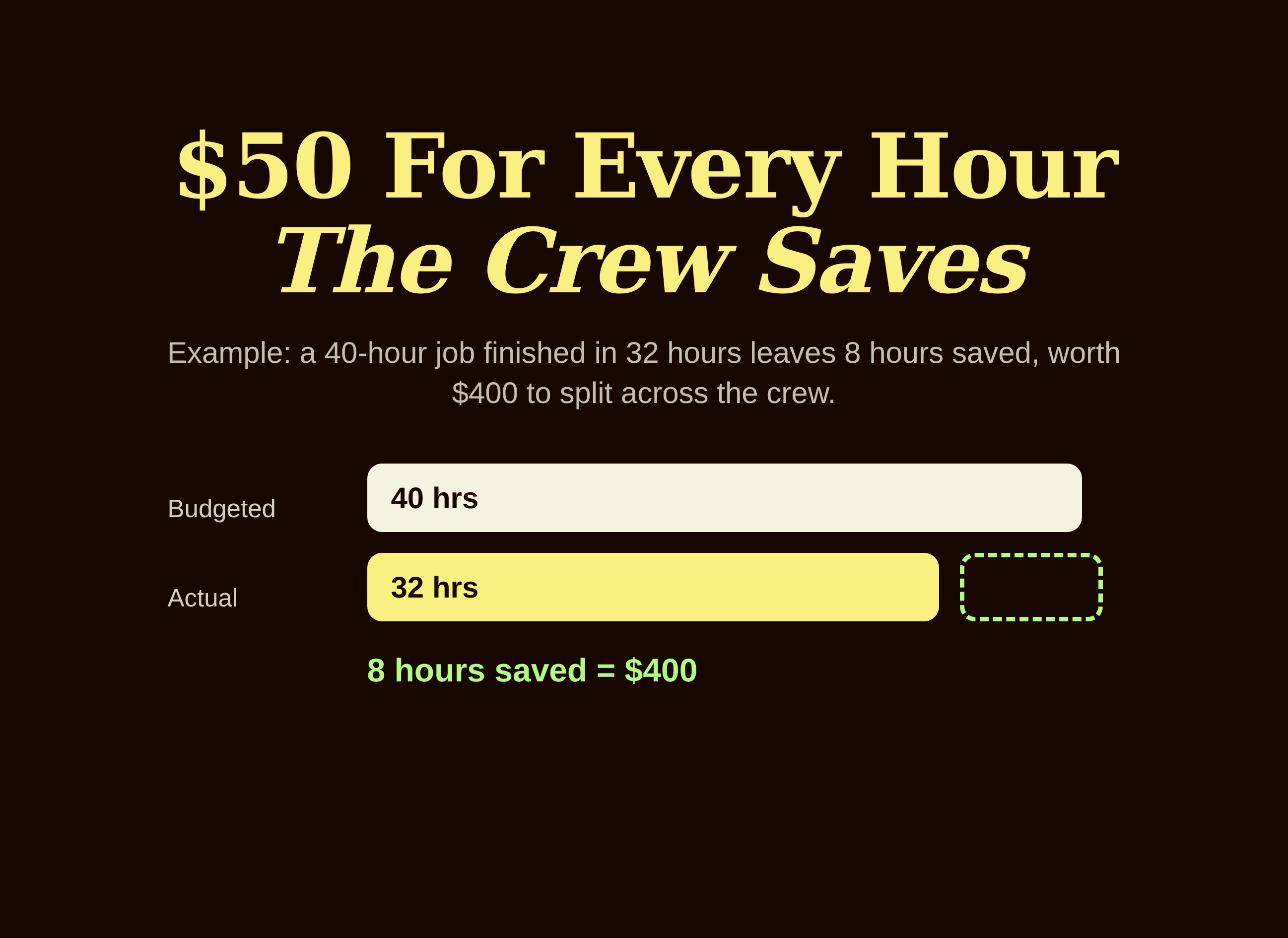
An exterior home improvement company built a tracker that catches a discount the moment it drifts past policy, before it ever reaches commission.
Ask most owners in the trades whether their techs are giving away discounts in the field, and you will usually get a confident no. Ask to see a report showing exactly how much was discounted, by whom, and against what policy, and the confidence tends to disappear. Discounting is one of the easiest ways for a business to lose margin, precisely because it happens verbally, in a customer's kitchen, with nobody but the technician and the homeowner in the room. Unless a company builds a system that tracks it deliberately, a discount is invisible until someone finally goes looking.
That is what happened at an exterior home improvement company that installs windows, doors, and gutters, much of its volume arriving through a well-known retail referral channel. The company had a stated discount policy: 10 percent standard, 15 percent for members. It seemed reasonable on paper. What the owner did not know until a routine review was that some jobs in the field were being discounted as much as 32 percent, more than three times the intended ceiling, with no dedicated line item anywhere in the job system to flag it.
A policy with no way to check itself
The core problem was not that technicians were dishonest. It was that the system had no mechanism to catch a discount that drifted outside policy. Commissions kept calculating off standard job percentages regardless of what the customer actually paid, which meant a technician who quietly approved a steep discount to close a hesitant homeowner still got paid as if the job had come in at full price. There was no friction anywhere in the process to slow that decision down or flag it for review. A discount that size, agreed to verbally in someone's living room, simply flowed straight through into the commission calculation as if it had never happened.
That kind of invisible margin leak compounds in a specific way for referral-driven businesses. Jobs sourced through a retail partner channel already carry a different economics than jobs a company generates on its own, since a portion of the deal's value effectively belongs to the referral relationship. Layer an unchecked 32 percent discount on top of that and the actual profit on a job can end up far thinner than anyone modeled when they set pricing. The owner was not chasing a hunch here. A 22-point gap between a 10 percent policy and a 32 percent real-world discount is not a rounding error, it is a structural hole in how the business protects its own margin.
It helps to walk through why a technician would approve a discount that large in the first place, because the answer is rarely greed. A homeowner hesitates at the price. The technician, standing in the kitchen with a signature within reach, does the mental math that closing the job at a steep discount still beats losing it entirely and driving to the next appointment empty-handed. That instinct is not wrong from the technician's seat. It is exactly the kind of decision a company wants a motivated closer making under pressure. The failure was never that a technician had the authority to negotiate. It was that nothing downstream of that decision ever checked whether the negotiated price still made sense for the business, or adjusted the technician's own commission to reflect what the company actually collected instead of what the job would have been worth at full price.
Building a tracker that separates what actually happened
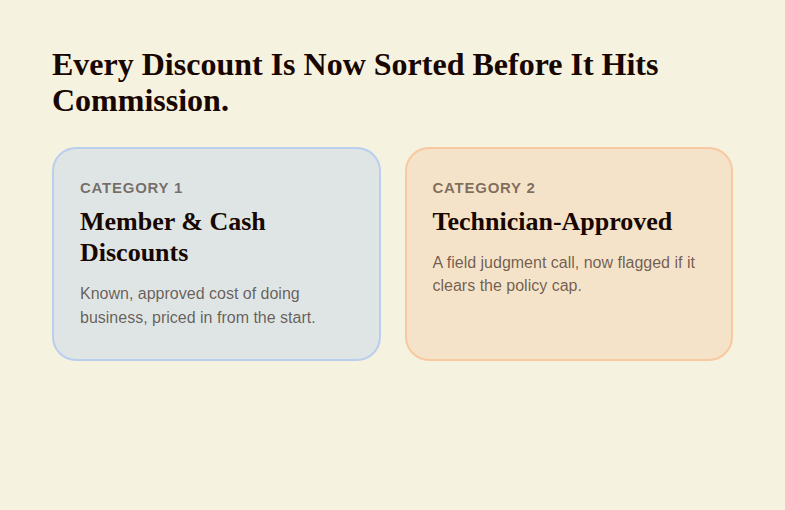
The fix started with visibility, not punishment. The company built a discount tracker that separates discount types into distinct categories: technician-approved discounts and member or cash discounts, rather than lumping every reduced price into a single undifferentiated bucket. Once a discount is categorized, the system flags anything that exceeds the policy cap before it flows into the commission calculation, instead of after a job has already closed out and been paid on.
That distinction between discount types matters more than it looks like at first glance. A member discount is a known, approved cost of doing business, priced into the model from the start. A technician-approved discount in the field is a judgment call made under pressure, in the moment, usually to close a deal that felt at risk of walking. Both are legitimate business decisions in the right circumstances. The problem was never that discounts existed. The problem was that both types were invisible in the same way, so there was no way to tell a reasonable member discount apart from a technician giving away nearly a third of the job's value to avoid an awkward conversation.
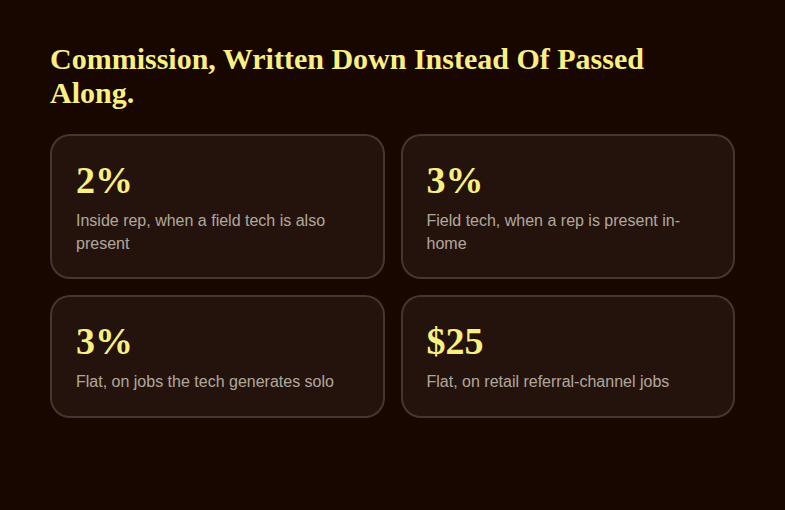
Alongside the discount tracker, the company formalized commission-split logic that had previously lived as a set of verbal agreements passed down between managers. The new structure pays 2 percent to the inside rep and 3 percent to the field technician when a sales rep is present in the home, 3 percent flat on jobs the technician generates entirely on their own outside a scheduled appointment, and a flat $25 on jobs sourced through the retail referral channel. Writing that logic down and building it into the same system that tracks discounts closed a second gap that often hides behind the first one: a commission split nobody can point to in writing is just as prone to drift as a discount policy nobody enforces.
Solving the wrong incentive at the same time
While reviewing the discount data, the company surfaced a related problem that had been sitting quietly underneath it. Senior technicians earning $40 or more an hour felt under-incentivized on the existing flat 16 percent commission tier, since a flat rate does not scale to reflect the fact that an experienced technician typically closes larger, more complex jobs than a newer hire. Rather than guess at a fix, the company modeled a second tier, 20 percent instead of 16 percent, specifically for its higher-paid senior technicians, and pulled four to five weeks of actual historical payroll data from its field service software to run a side-by-side comparison of real earnings under both structures before rolling anything out.
That modeling step is worth calling out on its own, separate from the specific numbers. It would have been faster to simply announce a new tier and see what happened. Instead, the company tested the proposed structure against real historical jobs first, which meant ownership could see exactly how much a change would have cost or saved over a real five-week stretch before it became a live commitment. That is a meaningfully lower-risk way to change a pay plan than adjusting it live and hoping the math works out, and it is a habit worth borrowing regardless of what specific commission structure a company ends up choosing.
There is also a retention argument buried in the senior-tier decision that is easy to overlook. A technician earning $40 or more an hour has almost certainly been offered work elsewhere, and a flat commission rate that does not distinguish between a rookie and a ten-year veteran sends an unintentional signal that experience does not matter to how the company pays. Building a second tier specifically for senior technicians is not just a raise, it is a public acknowledgment, visible in every paycheck, that the company's best people are treated differently than its newest hires. That kind of signal tends to matter more to retention than the actual dollar difference between 16 and 20 percent, because it changes how a technician answers the question of whether this company sees them as replaceable.
What changed, concretely
- Discount overages as large as 32 percent, more than three times the stated policy ceiling, are now caught and flagged before they reach commission math, not discovered later during a manual review.
- Discounts are categorized by type, technician-approved versus member or cash, so ownership can see which discounts are policy and which are judgment calls made in the field.
- Commission splits that used to live as verbal agreements are now written into the same system: 2 percent inside and 3 percent field when a rep is present, 3 percent flat on technician-generated jobs, and a flat $25 on retail-referral jobs.
- A second, higher commission tier for senior technicians was modeled against real historical payroll data before launch, rather than estimated and adjusted after the fact.
None of this required the company to slow down its sales process or make discounting harder to offer when a job genuinely calls for one. It required building a system that could tell the difference between a reasonable discount and one that had quietly drifted three times past policy, and making that difference visible before it hit commission, not after.
Profit sharing
made simple.
Give your team a stake in the company’s success. ShareWillow helps you create and manage profit-sharing programs that motivate employees and drive business results.
A margin check worth running in your own shop
Discount drift is not unique to exterior home improvement work. Any construction or home services business where technicians or sales reps have room to negotiate price in the field is exposed to the same risk, whether the discount shows up as a flat percentage off, a bundled add-on thrown in for free, or a "close it today" price that never gets logged anywhere formal. A few questions worth running against your own numbers:
- Do you have a stated discount policy, and separately, do you have any system that would catch a discount that exceeds it before the job closes out?
- Can you tell the difference in your own reporting between an approved member discount and a technician's in-the-moment judgment call?
- Are your commission splits written down somewhere everyone can see, or do they live as a set of verbal agreements between whoever trained whoever?
- If you changed your commission structure tomorrow, could you model it against real historical payroll data first, or would you be adjusting it live and hoping it works out?
The company's incentive pay platform now handles the discount flagging and the tiered commission math automatically, pulling from the same job data the field team already generates. But the underlying discipline, categorizing discounts, writing down commission logic, and testing pay changes against real numbers before committing to them, is a habit any owner can start building this week, with or without new software. The 22-point gap between a stated policy and an actual discount is the kind of number that only shows up once, right after you finally decide to look for it.
One more thing worth noting for any owner reading this and thinking their own discount policy is airtight: the company in this story had a written policy too. It had a stated 10 percent standard and 15 percent member cap, communicated to the team, sitting in an employee handbook somewhere. A policy that exists on paper is not the same thing as a policy that gets enforced in software, and the gap between those two things is exactly where a business bleeds margin without anyone deciding to let it happen. Writing the rule down was necessary but not sufficient. What actually closed the gap was building a system that could not be talked past in the moment, one that flagged the overage automatically instead of relying on a technician to self-report a discount they already knew was outside policy.
That is probably the most exportable lesson in this entire story, more than the specific 10, 15, or 32 percent figures. Any incentive plan, discount policy, or commission structure is only as strong as its weakest enforcement point. A policy that depends on a busy technician remembering the rule while standing in a customer's kitchen, mid-negotiation, with a signature within reach, is not really a policy. It is a hope. Systems that check themselves automatically, at the moment a number gets entered rather than weeks later during a review, are what turn a hope into something an owner can actually rely on.
Related reading
Conclusion
A policy nobody enforces is just a hope wearing a handbook.
Create incentives
that
drive results
You shouldn't need complex equity plans to align your team. ShareWillow makes it simple to create transparent profit-sharing programs that motivate employees and grow your business.

Incentive plans to help
small businesses thrive.
.png)
"I was able to leverage the knowledge of the ShareWillow team to learn how other companies were designing their bonus plans. The template was extremely helpful."

Brian Tustin
Owner, First Rate Movers