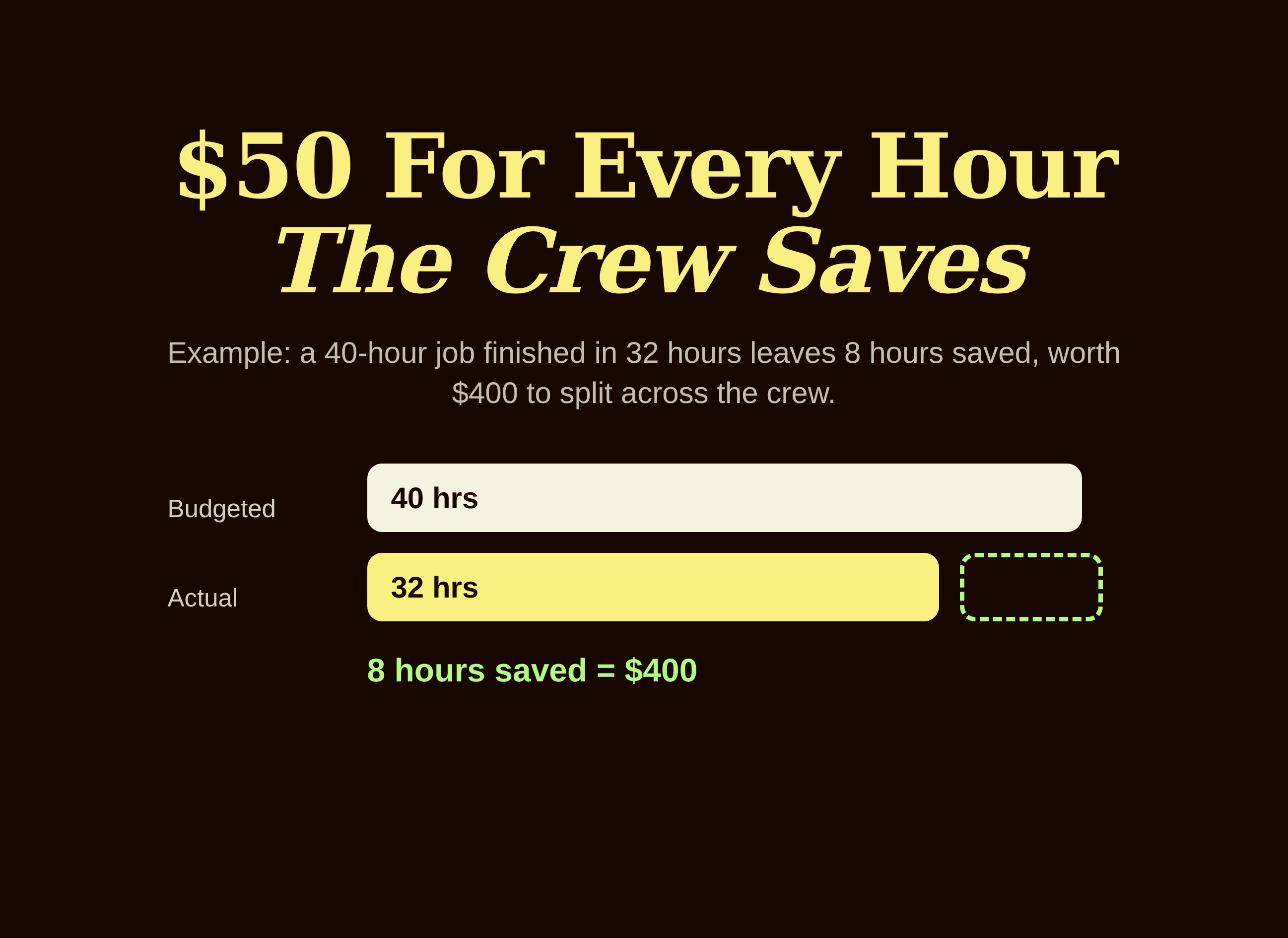
A Southwest Florida plumbing and pool company lost its highest-earning technician, so it rebuilt pay around a formula anyone on the team could run: 25 percent of the revenue they generate.
A technician who carries a disproportionate share of a shop's revenue is a compliment and a risk at the same time. He is proof the trade can be lucrative when someone is good at it, and he is a single point of failure sitting in a company truck. When that technician gives notice, most owners spend the next few weeks worrying about the calls he used to close. Few owners stop to ask a more useful question: what was actually driving his numbers, and can a pay plan reproduce it without him?
That is the question a plumbing and pool service company in Southwest Florida had to answer this year. It is a small operation, the kind with a handful of trucks and a dispatcher who still keeps a whiteboard in the back office next to the digital schedule. For a long stretch, one technician quietly generated more revenue than anyone else on the team, and when he left, the remaining crew looked at his numbers the way a new homeowner looks at a mortgage payment: technically possible, but hard to picture actually hitting.
The problem was never really about the technician
Ownership's first instinct, understandably, was to worry about the gap he left behind. But the deeper issue had been sitting under the surface for a while: the pay plan itself was ad hoc. Technicians were on a blend of hourly wages and commission tiers that ran from 20 to 24 percent, with a 30 percent weekend bonus layered on top for anyone who picked up Saturday or Sunday calls. It worked, in the loose sense that people got paid and nobody complained loudly enough to force a change. But nobody could look at the plan and say what a technician doing solid, average work should expect to earn in a year. There was no ceiling to point to, no number a new hire could be told during onboarding. Pay was a byproduct of the schedule, not a plan.
Payroll itself compounded the problem. Every week, an admin pulled PDF exports out of the field service software and rebuilt them into spreadsheets by hand, blending hourly pay, PTO, and commission into a single number for each technician. That process is slow on a good week. On a bad week, when someone took time off in the middle of a pay period or a job got rescheduled across two weeks, it turned into a wage-and-hour compliance question nobody wanted to answer under pressure. A single technician generating an outsized share of revenue was the visible symptom. The invisible problem was a comp structure that could not be explained in one sentence, calculated without a spreadsheet marathon, or trusted to hold up if the state ever asked to see the math.
This is a familiar spot for small field service shops, not because owners are careless but because pay plans tend to grow the way a garden grows: one exception at a time. A good technician negotiates a slightly better rate. A busy season justifies a temporary bonus that never quite gets un-installed. A weekend differential gets added to keep someone from quitting during a staffing crunch. None of those decisions is unreasonable in the moment. Stacked on top of each other over a few years, they add up to a pay structure that only one or two people in the building fully understand, and that tends to be exactly the people who are hardest to replace if they leave.
"Every callback costs us. Techs don't see how their work turns into pay." That is a common refrain among owners running informal commission tiers, and it captures exactly what was happening here: the plan existed, but nobody could feel it working day to day.
Rebuilding pay around a ratio, not a person
Instead of trying to replicate one technician's output, the company worked with ShareWillow to rebuild the plan around a fixed target: keep technician gross pay near 25 percent of the revenue they personally generate. That single ratio became the anchor for everything else. It is simple enough to say out loud to a new hire on day one, and it scales cleanly whether someone is a rookie working a slow month or a veteran running a full board.
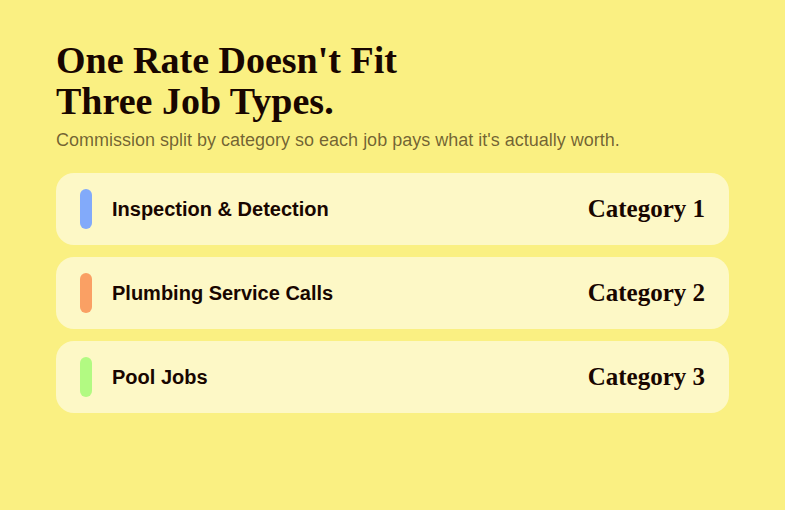
Underneath that anchor, the plan splits pay into three separate commission categories that mirror how the business actually books work: inspection and detection calls, plumbing service calls, and pool-related jobs. Each category carries its own rate, modeled against hourly pay scenarios at $15, $20, and $25 an hour so ownership could see exactly how the blended commission-plus-hourly math landed at different base wages before locking anything in. That modeling mattered. It let the owner test the plan against real payroll numbers instead of guessing and adjusting after the fact, which is usually when a plan starts to feel unfair to whoever notices the math first.
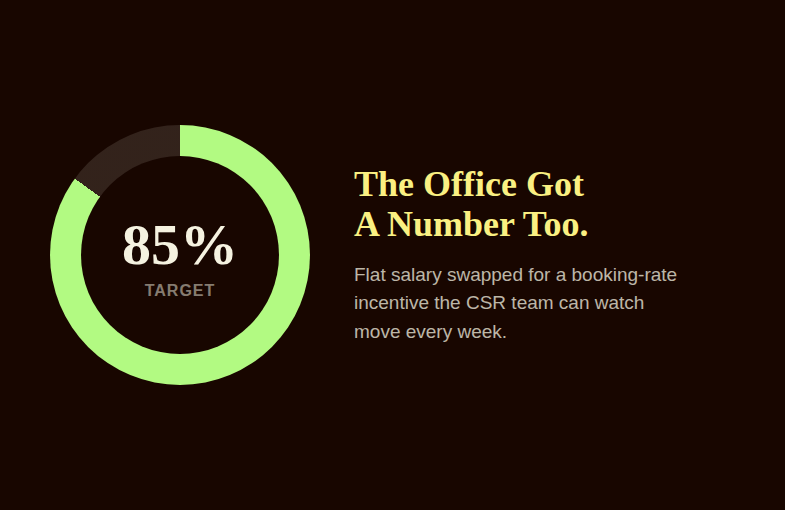
The redesign did not stop at the technician role. The company's office and customer service staff had been on flat salaries with no direct line between their day-to-day performance and the company's results, so a parallel incentive plan was built for that role too, tied to booking rate rather than a fixed paycheck. The target was set at 85 percent, a number the office team could actually see move week to week on their own dashboard instead of hearing about it secondhand during a review. For a small shop, that is often the more underrated fix: the person answering the phone has as much influence on whether a job gets booked as the technician has on whether it gets done well, and most incentive plans in the trades only ever pay one of those two roles.
None of this required new software from scratch. The company's incentive pay platform pulled the same job and revenue data the team was already generating in the field, mapped it to the new categories, and handled the payroll math that used to live in an admin's weekend. The weekly PDF-to-spreadsheet routine went away because the numbers were already sitting in one place, calculated the same way every time.
Why three categories instead of one blended rate
It would have been simpler to set a single commission rate across every job type and call it done. The company chose not to, for a practical reason: inspection and detection work, plumbing service calls, and pool jobs do not carry the same margin, the same time-on-site, or the same difficulty of upsell. A flat rate applied evenly across all three would have quietly overpaid the easiest category and underpaid the hardest one, and technicians notice that kind of thing faster than owners expect. Splitting the categories meant the commission rate on each type of job could reflect what that job actually contributes to the business, instead of forcing every call into the same math.
That distinction matters more as a shop grows. A two-truck operation can get away with a single blended rate because everyone is doing roughly the same mix of work anyway. Once a company is running multiple service lines, whether that is plumbing and pool like this shop, or install and service like a typical HVAC company, a single rate starts to reward the wrong behavior. Techs gravitate toward whichever job type pays best under the flat rate, even when the business needs coverage somewhere else. Category-specific commission removes that distortion. Each job pays what it is actually worth to the business, and the technician's total income still rolls up to that same 25 percent target regardless of how the week's mix shakes out.
What the new ceiling actually looks like
Modeled against the company's real revenue numbers, a technician generating $360,000 in annual revenue lands at $90,000 in gross pay, the 25 percent target made concrete. That is not a promise or an incentive gimmick. It is arithmetic anyone on the team can do in their head. A tech who wants to earn more knows exactly what number to move. A tech who is doing fine at their current pace can see where they land without needing an owner to explain it to them.
Compare that to the old structure, where a technician's actual take-home depended on which commission tier they landed in, whether the job fell on a weekend, and how the office happened to reconcile hours that week. Under the old plan, hitting a specific income goal required knowing several moving variables at once. Under the new plan, it requires knowing one: revenue generated. That shift, from a plan nobody could fully explain to a plan anyone could sketch on a napkin, is the actual win here, more than any single dollar figure. The company did not need to find a replacement for its best technician. It needed a formula that could produce the same outcome regardless of who was running the truck.
There is a recruiting benefit hiding in that math too, one owners tend to underrate until they need it. When a plan can be reduced to a single, honest ratio, it becomes a selling point during hiring instead of a source of confusion after the fact. A candidate interviewing at three different shops can compare "gross pay tracks 25 percent of what you generate" against a competitor's vague promise of "competitive commission" and immediately understand which offer is easier to plan a life around. In a labor market where experienced technicians have options, that clarity is worth more than a slightly higher headline commission rate buried in fine print.
Profit sharing
made simple.
Give your team a stake in the company’s success. ShareWillow helps you create and manage profit-sharing programs that motivate employees and drive business results.
The lesson for any shop with a "what if they leave" problem
Most owners in the trades can name their highest earner without checking a report. Fewer can say, off the top of their head, what a technician doing average work should expect to take home in a year, or what happens to the pay plan if that top earner walks. That gap is worth closing before it becomes urgent, not after.
A few questions worth asking about your own shop's pay plan:
- If your best technician left tomorrow, would your commission structure still make sense to the rest of the team, or was it quietly built around one person's numbers?
- Can you explain your current pay plan in one sentence to a new hire, or does it take a spreadsheet and twenty minutes?
- Does your office or CSR team have any incentive tied to results, or are they the only people in the building on a flat check regardless of how the month goes?
- How much of your weekly payroll process still depends on one person manually reconciling hours, PTO, and commission by hand?
None of those questions require a software overhaul to answer honestly. They require sitting down with actual revenue numbers and building a ratio that holds up no matter who is on the schedule that week. For companies in plumbing and other field trades where one or two technicians often carry a disproportionate share of revenue, that kind of plan is less about paying more and more about paying predictably, for the owner and the technician both.
If your shop is still calculating commission by hand every Friday night, or if you have ever caught yourself hoping your top performer never gives notice, it might be time to build the pay plan the numbers actually support. That is a fixable problem, and it usually takes less time to fix than most owners expect.
What changed, in plain numbers
Strip away the narrative and the before-and-after looks like this:
- Before: commission tiers ranging from 20 to 24 percent, plus a 30 percent weekend differential, with no stated income target and no incentive tied to the office or CSR role.
- After: a single 25 percent of personal revenue target, split across three job-type commission categories, with a parallel 85 percent booking-rate incentive for office staff.
- Before: weekly payroll rebuilt by hand from PDF exports, blending hourly, PTO, and commission with real compliance exposure.
- After: payroll calculated automatically from the same field data technicians already generate, with the same formula applied every pay period.
- Before: a plan that only made sense as long as the top earner stayed.
- After: a plan that produces the same outcome no matter who is on the schedule, illustrated by the $360,000 revenue to $90,000 pay benchmark now built into the model.
None of that required the company to grow, hire a new star performer, or wait for the market to hand them a lucky season. It required sitting down with the numbers that already existed and building a formula honest enough to survive a resignation letter. That is the kind of fix that pays off long after the specific technician who prompted it has been forgotten, because the next person who leaves, and there is always a next person, walks out the door without taking the pay plan with them.
Related reading
Conclusion
The pay plan that survives a resignation letter is the only pay plan worth building.
Create incentives
that
drive results
You shouldn't need complex equity plans to align your team. ShareWillow makes it simple to create transparent profit-sharing programs that motivate employees and grow your business.

Incentive plans to help
small businesses thrive.
.png)
"I was able to leverage the knowledge of the ShareWillow team to learn how other companies were designing their bonus plans. The template was extremely helpful."

Brian Tustin
Owner, First Rate Movers