
A small home services company handed every technician the same flat bonus, whether they earned it or not. Here's how switching to tiered, sold-hours commission turned one slow month into a $3,000 paycheck the whole crew could see.
A Bonus Plan That Only Motivated the Top Performer
A small home services company running about five field technicians had built a commission plan the way a lot of owners do: with good intentions and not much math. Every technician got a flat 1% of revenue as a baseline bonus, no matter how much or how little they actually sold. On top of that, a second tier kicked in for technicians who hit a much higher threshold, one that almost nobody ever reached.
Nobody set out to design it that way. The plan started years earlier as a simple thank-you gesture, a small percentage on top of hourly pay to acknowledge that field work is hard and technicians deserve a piece of what they help bring in. Over time the business grew, the crew changed, and the flat percentage just kept rolling forward because nobody had a reason to touch it. That is how a lot of ineffective pay plans get built. Not through a bad decision, but through years of nobody revisiting a decent one.
The result was a plan that felt generous on paper and did almost nothing in practice. Technicians who were already strong performers barely noticed the extra 1%. Technicians who were struggling never got close to the higher tier, so the plan gave them no reason to push. The owner had built an incentive program that, for most of the crew, incentivized nothing.
A bonus that everyone gets whether they try or not stops being a bonus. It just becomes part of the base rate.
That is a common trap in field service pay. A flat percentage feels fair because everyone gets the same deal, but fairness and effectiveness are not the same thing. If the payout does not change based on effort or results, the plan is not really paying for performance. It is paying for attendance.
It is also worth noticing what a plan like this does to a company's newer or lower-producing technicians, since they are usually the ones who need a working incentive the most. A veteran technician who is already comfortable and productive barely notices a flat 1%. A newer technician who is still building speed and confidence needs a reachable target more than anyone else on the crew, and a threshold set far above what they can currently hit does not build them up. It just confirms, every single pay period, that the bonus was never really meant for them.
So the company rebuilt the plan from the ground up using ShareWillow, this time tying payout directly to sold hours instead of a single flat rate. Sold hours are a clean number for a home services business to work with. They reflect real completed work, not just time on the clock, and they scale naturally with a technician's actual output.
It also helped that sold hours were a number the crew already understood. Technicians did not need a new dashboard or a new vocabulary to make sense of the plan. They already knew roughly how many hours of work they had closed in a given week, which meant the new structure could be explained in a single conversation instead of a training session. A pay plan that requires an instruction manual before anyone trusts it rarely survives contact with a real crew.
Lowering the Floor So More People Could Actually Earn Something
The first change was the most important one. The entry point for the bottom tier dropped from 26 sold hours a month to 24. That two-hour difference sounds small, but it mattered because it moved a handful of technicians who were consistently just short of qualifying into a position where they could actually earn a payout. A threshold nobody can reach is not a threshold, it is a wall.
Three Tiers Instead of One Flat Rate
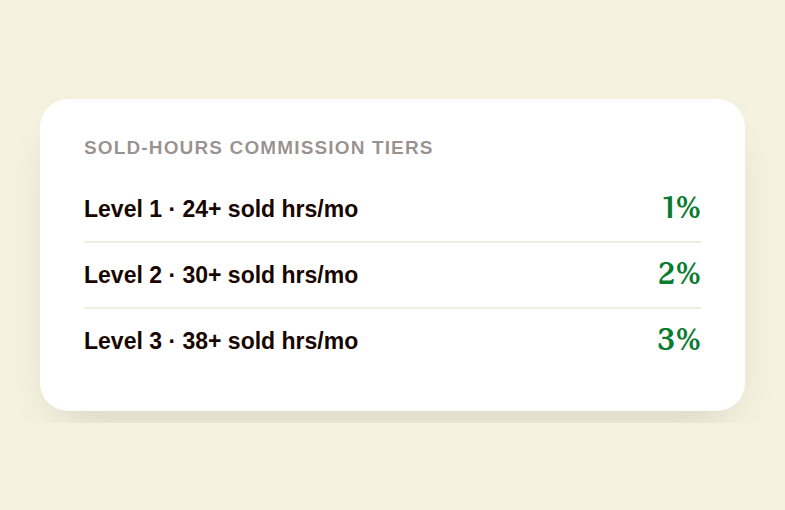
From there, the plan added real separation between performance levels. Level one starts at 24 sold hours and pays 1%. Level two requires 30 sold hours and pays 2%. Level three, reserved for the strongest producers, requires 38 sold hours and pays 3%. Each step up is a deliberate, visible jump, not a rounding error.
The spacing between the tiers mattered as much as the tiers themselves. Six sold hours separate level one from level two, and eight more separate level two from level three. Close enough that a technician sitting just below a line can see exactly what it would take to cross it, but wide enough that reaching the next tier still means something. A plan with tiers stacked too close together turns into a flat rate with extra steps. Spaced too far apart, and it turns back into the same unreachable ceiling the company was trying to get away from.
None of the three tiers were picked arbitrarily. Before the new structure went live, the company ran the proposed rates against several months of actual completed jobs to see what real technicians would have earned under each version, adjusting the thresholds until the numbers felt both affordable for the business and genuinely motivating for the crew. That modeling step is easy to skip when a plan feels intuitively fair, and it is exactly the step that catches a threshold set too high before a single paycheck goes out wrong.
The owner also kept full control over finalizing every payout. Each pay period, the numbers run through ShareWillow's portal, and the owner reviews and approves the results before anything goes out. If a technician disputes a number or a job needs a second look, that review step catches it before payday instead of after.
Why Sold Hours Beat a Flat Percentage
Sold hours work well for a home services company because they capture something a flat revenue percentage misses: the difference between a technician who closes big-ticket jobs occasionally and one who stays consistently busy and productive all month. Tying pay to sold hours rewards the second kind of technician just as much as the first, which is exactly the behavior most owners actually want more of.
There is a scheduling benefit here too, one the owner had not fully anticipated going in. Once bonus pay was tied to sold hours instead of raw revenue, technicians had a reason to care about how their day was routed, not just which jobs they landed. A tightly scheduled day with several smaller jobs can produce more sold hours than a single big-ticket job with a lot of drive time in between. That gave the dispatch team a more engaged audience for routing decisions, since the crew now had skin in the game on efficiency, not just on closing the sale.
Profit sharing
made simple.
Give your team a stake in the company’s success. ShareWillow helps you create and manage profit-sharing programs that motivate employees and drive business results.
The Result: A $3,000 Paycheck the Whole Crew Could See
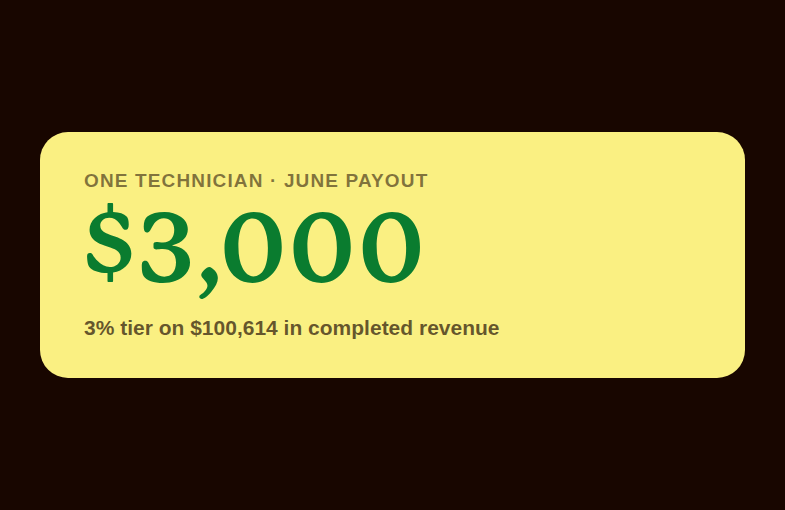
The first pay period under the new structure produced a number the owner could actually put in front of the team. One technician, working at the top 38-hour tier, earned $3,000 in a single month on $100,614 in completed revenue. That is not a hypothetical projection. It is a real payout, calculated from real closed jobs, sitting in a real paycheck.
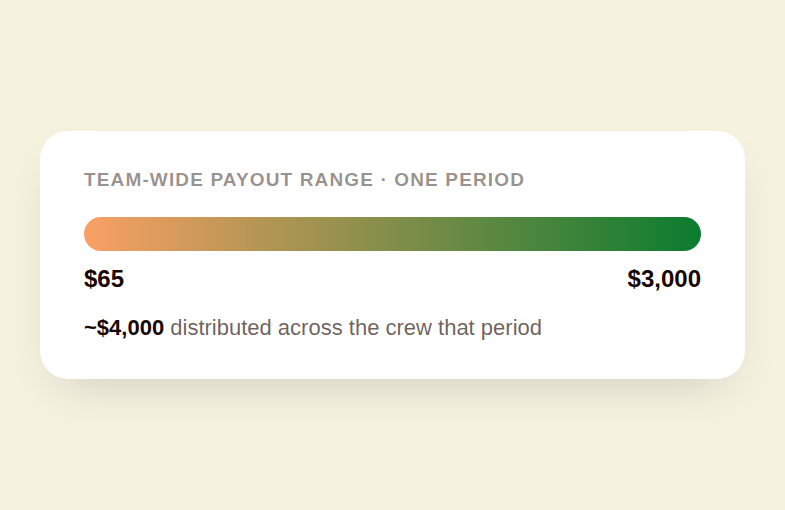
Across the rest of the crew, payouts for that period ranged from about $65 up to that $3,000 top result, with roughly $4,000 distributed in total. That spread is not a flaw. It is the entire point. A plan where the spread between the highest and lowest payout is enormous is a plan that is actually measuring something real about performance, instead of handing out the same number to everyone regardless of effort.
What made the number land, according to the owner, was that it was visible and specific enough to be motivating rather than abstract. A vague promise of "better pay for better work" does not move anyone. A real technician earning a real $3,000 check, on real completed jobs, in front of a crew that can see it, does.
The owner's plan was simple: hand that technician the paycheck in person and let the rest of the crew hear about it directly instead of through a memo. That kind of moment is hard to manufacture and easy to undercut. A pay plan nobody trusts gets talked about in whispers. A pay plan that just produced a real $3,000 result gets talked about at lunch, unprompted, by the people who watched it happen.
What This Means for Your Crew
- A threshold nobody can reach is not an incentive. If your top tier requires production levels that almost none of your technicians ever hit, you are not running a performance plan. You are running a plan that pays out to nobody and demotivates everyone who can see the gap.
- Small changes to the entry point can matter more than big changes to the payout rate. Moving this company's floor from 26 to 24 sold hours brought several technicians into a tier they could actually reach, which did more for engagement than raising any single percentage would have.
- A wide spread in payouts is a feature, not a problem. If your best performer and your average performer earn close to the same bonus, the plan is not distinguishing between them, and neither will your crew's effort.
- Owner review before payout builds trust. Keeping a manual approval step in the process meant every number could be checked and explained, which matters more than automation alone when a crew is still getting used to a new structure.
- A visible top result is worth more than the plan document itself. One technician's $3,000 paycheck did more to sell the rest of the crew on the new plan than any explanation of the tiers ever could.
- Revisit pay plans on a schedule, not just when something breaks. This plan drifted for years simply because nobody had a reason to look at it again. Put a recurring check on the calendar so a good original idea does not quietly become an outdated one.
None of this required exotic software or a finance degree to pull off. It required someone willing to look honestly at whether the existing plan was doing its job, and a system that could run the new tiers against real job history before a single dollar changed hands. That combination, an honest look plus a real test, is usually the whole difference between a pay plan that sits in a drawer and one that ends up handed to a technician in person.
You do not need five technicians or a home services shop specifically to run into this problem. Any field service business with a flat, one-size-fits-all bonus structure is likely leaving the same motivation on the table. For a look at how a similar plan builds in commission around trade-specific complexity, see how a multi-trade plumbing and electrical company caught a $76,000 blind spot in its own commission plan.
Related reading
- The Week a Technician "Worked" 200 Hours
- The $440 Bug Hiding in a New Hire's First Bonus
- Incentives, Commissions, and Bonuses: What’s the Difference and Why It Matters
- 9 Bonus Structure Examples Employees and Employers Love
- Technician Pay Plans: How One Home Services Company's Techs Earned Up to 55% More on Commission Than Hourly
Conclusion
If your bonus plan pays out about the same no matter what a technician produces, it isn't really an incentive plan. ShareWillow models tiered commission against your own job history before it touches a paycheck, so every tier is one your crew can actually reach. Reach out to see what your data shows.
Create incentives
that
drive results
You shouldn't need complex equity plans to align your team. ShareWillow makes it simple to create transparent profit-sharing programs that motivate employees and grow your business.

Incentive plans to help
small businesses thrive.
.png)
"I was able to leverage the knowledge of the ShareWillow team to learn how other companies were designing their bonus plans. The template was extremely helpful."

Brian Tustin
Owner, First Rate Movers
