
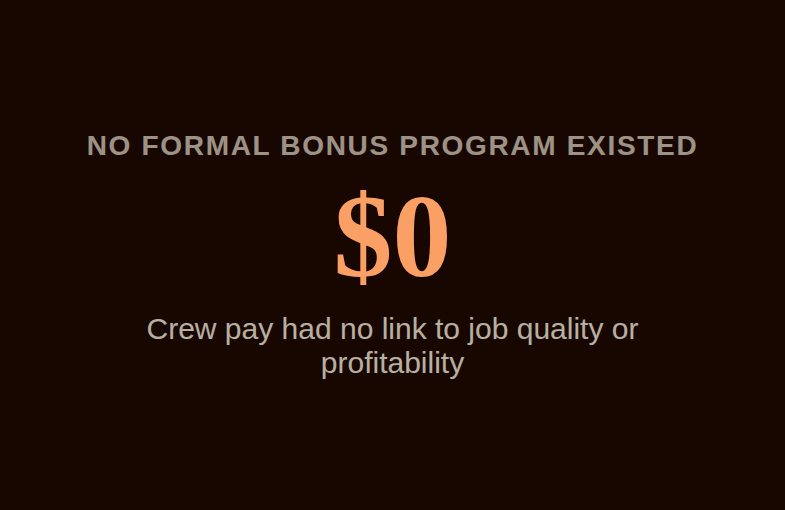
A residential and commercial painting company with an epoxy-flooring division had no formal bonus program, and leadership worried a skeptical crew would not trust a new one. Here is the quality-gated plan that changed their minds, and why it got extended to a second division.
The Hardest Part of a Bonus Plan Isn't the Math
A residential and commercial painting company, with a growing epoxy-flooring division running alongside its core painting crews, had never had a formal bonus program. No structured incentive, no established rule for rewarding a job well done beyond the paycheck everyone already expected. That is a common enough starting point for a lot of specialty trade businesses. What made this company's situation worth paying attention to was not the absence of a plan, it was the reason leadership had been hesitant to build one.
They were not worried about the formula. They were worried about the reaction. Specifically: how do you introduce a bonus program to a crew that has never had one, without it landing as either a gimmick or, worse, a trap? Painters and flooring installers have seen plenty of "incentive" programs that turn out to be thinly disguised ways to withhold pay for reasons nobody fully understands. A skeptical crew is a rational crew. Winning that trust back takes more than a good spreadsheet.
The question was never whether the math would work. It was whether the crew would believe it.
Underneath that trust problem sat two real structural gaps. First, there was no systematic way to check job quality or callbacks before a bonus got paid out. A bonus program that pays out on a job that later turns into a rework nightmare is worse than no bonus program at all, because it rewards exactly the wrong behavior and teaches the crew that speed matters more than doing it right the first time. Second, field supervisors, the people actually responsible for day-to-day profitability on every job site, had no incentive of their own. The crew doing the physical work was the obvious focus for any new bonus plan, but the supervisors steering the ship day to day were being left out of the conversation entirely.
This is a more common gap than it looks like from the outside. A lot of specialty trade businesses grow past the point where flat hourly pay is enough to keep top performers engaged, but the leap to a formal bonus program keeps getting delayed because nobody wants to be the one who rolls out a plan the crew does not trust. The technical part of building a bonus formula is genuinely the easy half. The harder half is making sure the people earning it believe the numbers are real before they ever see a check.
Painting and flooring work adds its own wrinkle to that trust problem. Quality issues in this trade do not always show up on the day a job wraps. A rushed paint job can look fine at handoff and start peeling within weeks. A flooring installation can look flawless the day the crew leaves and develop bubbling or separation once it cures fully under real foot traffic. Any bonus plan that pays out the moment a job closes, without waiting to see whether the work actually holds up, is effectively betting the company's money that nothing will go wrong. That is precisely the kind of bet a careful bonus program should never make.
Building a Bonus Plan Around Quality, Not Just Speed
The plan that got built here solved the trust problem by solving the quality problem first. Nothing about it rewards a fast job that falls apart two weeks later.
A Closed-Job Bonus Gated on Real Results
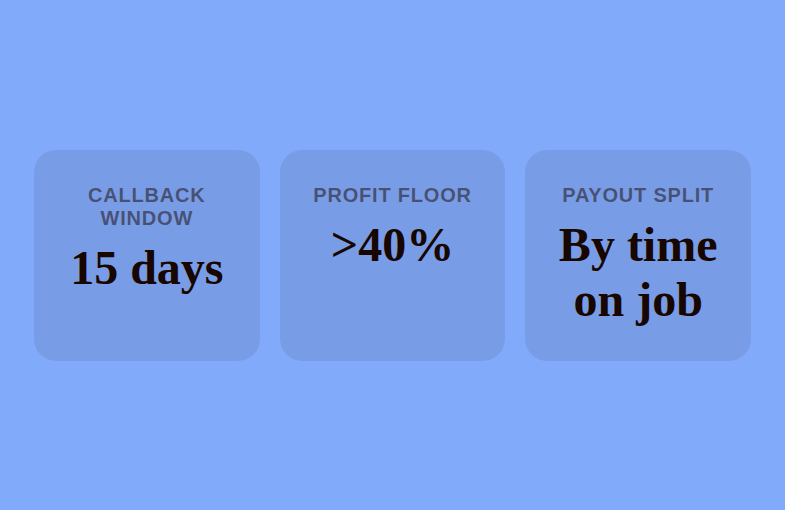
The core mechanism is a closed-job bonus that only calculates once two conditions are met. First, a job has to clear a 15-day callback review window, meaning no rework request came in during that period. Second, the job has to hit greater than 40% gross profit. Only after both conditions are satisfied does the bonus get calculated at all, and it is then split among the crew based on each person's percentage of time on that specific job.
That two-part gate is what makes the whole plan trustworthy. A crew cannot rush a job, collect a bonus, and leave the callback problem for someone else to deal with, because the callback window has to clear first. And a job cannot trigger a bonus just because it moved fast if the margin on it was thin, because the profit threshold has to clear too. The plan rewards exactly what the business actually wants: work that is fast, good, and profitable, in that combined sense rather than any one of those alone.
Layering in Sales and Supervisor Incentives
On top of the closed-job bonus, the plan added a 2%-of-revenue sales bonus, triggered once a job clears 35% gross profit, a slightly lower bar than the crew bonus since it is rewarding a different part of the business. And to close the gap that had been bothering leadership from the start, a monthly field-supervisor bonus got proposed: roughly $400 to $500, split 40% on revenue, 30% on labor efficiency, and 30% on expense control. That split matters because it mirrors the actual levers a supervisor controls day to day. A supervisor who drives revenue but lets labor and expenses run wild is not actually protecting profitability, and a bonus formula weighted only on revenue would have missed that entirely.
Winning the Crew's Trust Before Launch
Here is the piece that solved the original trust problem. Before rolling the plan out, the team built a hypothetical payout report showing exactly what each crew member would have earned on a set of recent, real jobs under the new formula. Concrete, specific numbers, not abstract percentages: one job producing a modest bonus, another splitting a slightly larger amount between two crew members, real examples pulled from work the crew had actually done days or weeks earlier.
That single move did more for adoption than any explanation of the formula could have. A skeptical crew does not need a lecture on gross profit margins. They need to see, in plain dollars, tied to jobs they remember doing, that the plan pays out on real work under real conditions. Showing your team the math before asking them to trust it is one of the more underrated moves in rolling out any new incentive pay structure, and it is exactly the kind of step that gets skipped when a plan is designed in a back office and announced in a memo.
Profit sharing
made simple.
Give your team a stake in the company’s success. ShareWillow helps you create and manage profit-sharing programs that motivate employees and drive business results.
The Result: A Second Division Wanted In
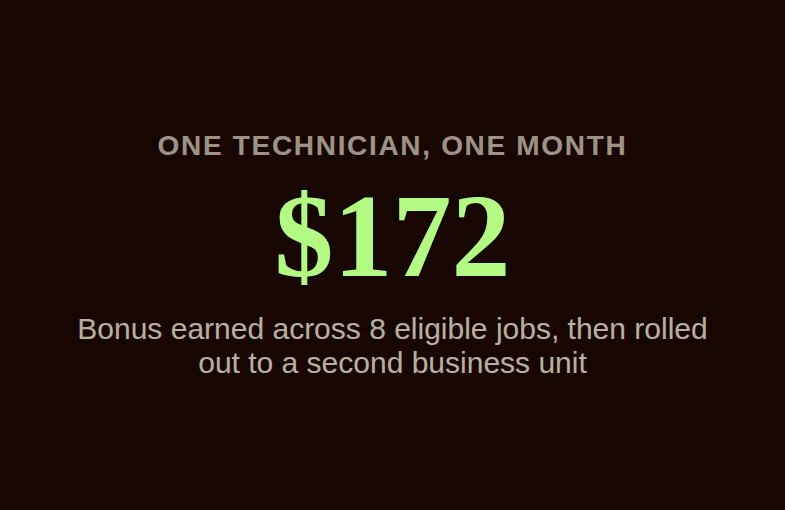
The clearest sign that this plan worked is not a single dramatic number. It is what leadership decided to do next. Confident in how the closed-job bonus was performing for the painting crews, the company extended the identical bonus structure to its epoxy-flooring division, a second business unit running on the same ShareWillow account. That is not a new sale or a new customer. It is an existing customer choosing to hand the same playbook to a completely different part of their operation, which is about as strong a vote of confidence as a compensation plan can earn.
The dollar figures behind that confidence were real, if modest in scale so far. One technician earned a documented $172 bonus across 8 eligible jobs in a single monthly close, each one having cleared both the callback window and the profit floor before a cent got calculated. That is not a life-changing number on its own. It is a consistent, trustworthy signal, month after month, that the plan pays out fairly when the work is good, which is exactly what a crew that has never had a bonus program needs to see before they fully buy in.
It is worth being honest about what this story is and is not. It is not a case where a bonus plan single-handedly transformed the business overnight. It is a case where a well-gated plan, launched carefully with real numbers shown up front, earned enough trust from a skeptical crew that leadership felt comfortable expanding it. In a lot of ways, that is a more durable outcome than a single flashy payout, because it means the underlying mechanism, the callback gate, the profit floor, the time-on-job split, is holding up under real, repeated use.
The supervisor bonus is worth watching too, even though it was still in the proposal stage as of the most recent update. Extending a results-based incentive to the people managing jobs day to day, on top of the crew already earning theirs, closes a loop that a lot of bonus programs leave open. A crew incentivized on quality and a supervisor incentivized on the same underlying profitability tend to reinforce each other instead of pulling in different directions, which is exactly the kind of alignment a growing multi-division business needs as it adds more crews, more supervisors, and more jobs running at once.
What This Means for Your Crew
A few things here generalize well beyond one painting and flooring company:
- Gate your bonus on quality, not just speed or revenue. A callback review window and a profit floor together protect the plan from rewarding the wrong behavior, and they are what make the plan defensible when a crew member asks why a bonus did or did not pay out.
- Don't forget the people who aren't swinging the hammer or the roller. Field supervisors control real levers on profitability. Leaving them out of the incentive structure leaves a gap in accountability right where the business needs it most.
- Show the math before you ask for trust. A hypothetical payout report built on real, recent jobs does more to win over a skeptical crew than any explanation of the formula ever could.
- Split supervisor bonuses across the levers they actually control. Revenue, labor, and expenses each deserve their own weight, because rewarding only revenue can quietly undercut the other two.
- Let results earn their own expansion. The strongest sign a bonus plan is working is not a single big payout, it's when leadership trusts it enough to hand the same structure to another part of the business.
You do not need to run a painting and epoxy-flooring business to have some version of this problem. Any specialty trade business weighing whether to introduce its first formal bonus program is really weighing the same question this company faced: not whether the formula works, but whether the crew will believe it does.
Related reading
Conclusion
If your crew has never had a formal bonus program, or you have one that nobody quite trusts, the fix usually starts with the same question this painting company had to answer: can you show your team the math before you ask them to believe it? ShareWillow works with painting, flooring, and other specialty trade businesses to build quality-gated bonus plans your crew can actually verify, then keeps the numbers running automatically every month after that. Reach out to see what a plan like this could look like for your team.
Create incentives
that
drive results
You shouldn't need complex equity plans to align your team. ShareWillow makes it simple to create transparent profit-sharing programs that motivate employees and grow your business.

Incentive plans to help
small businesses thrive.
.png)
"I was able to leverage the knowledge of the ShareWillow team to learn how other companies were designing their bonus plans. The template was extremely helpful."

Brian Tustin
Owner, First Rate Movers
