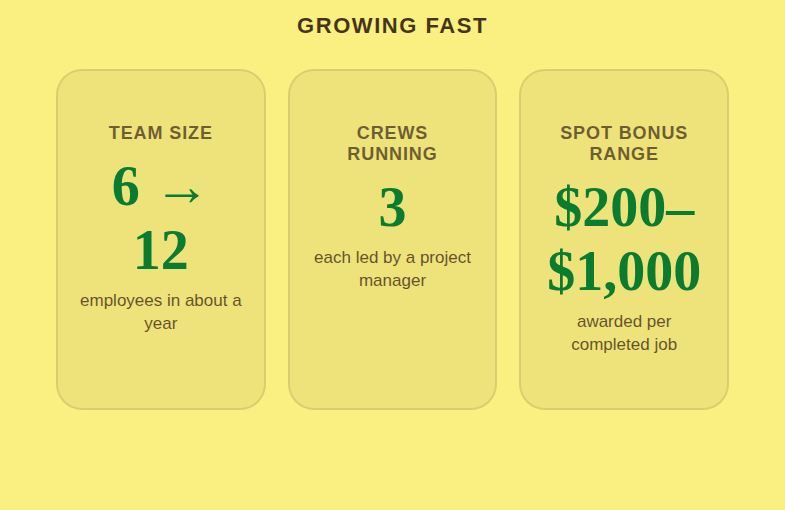
A residential painting company grew from six employees to twelve in about a year. The old monthly bonus cycle couldn't keep up, so the owner switched to weekly payouts and per-job spot bonuses. Here's what changed.
Growing Fast Is Its Own Kind Of Problem
Growth is supposed to be the good problem. More crews, more jobs, more revenue. But growth also multiplies every small crack in how a business runs, and pay is usually the first place those cracks show up. A residential painting company that grew from six employees to twelve in about a year, now running three separate crews under individual project managers, found that out the hard way. What worked fine for six people running loosely off a shared calendar started breaking down almost as soon as a third crew came online.
Quick facts
- Residential painting company, grew from 6 to 12 employees in roughly a year
- Structure: 3 crews, each run by a project manager
- Old bonus cadence: monthly, finalized and paid once a month
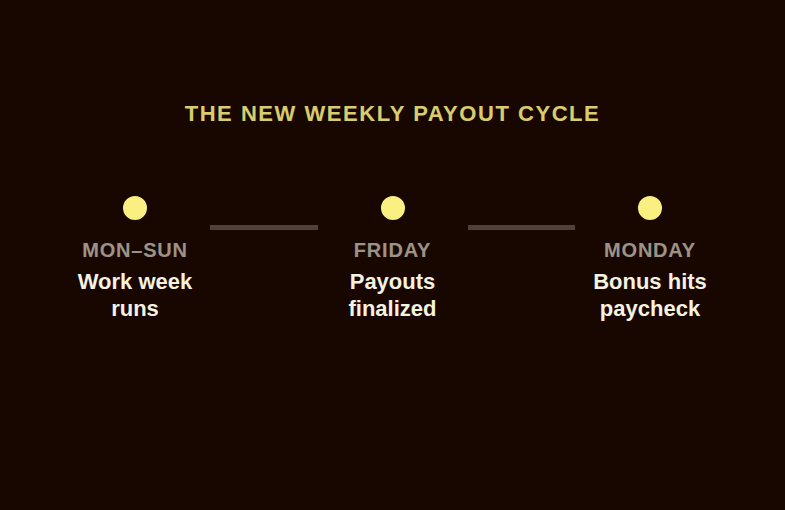
- New bonus cadence: weekly, work week Monday through Sunday, finalized Friday, paid the following Monday
- Also added: project-based spot bonuses per completed job, ranging from $200 to $1,000
Before the fix, bonuses ran on a monthly cadence: work happened all month, and payout landed once, at the end. That gap between doing the work and getting paid for it doesn't sound like much on paper. In practice, it meant crew leads were pinging the owner constantly, asking some version of the same question. Was this review bonus hit? Did that job count? Nobody could see the answer until the month closed, so everybody just kept asking.
The owner was candid about where the business had come from. Before adopting a proper CRM and a real incentive system, operations ran closer to chaos than process: jobs tracked loosely, bonus math done by memory, nothing visible to the crews doing the actual work. “This is where we are right now, quite frankly, is 1,000 times better than where we were last year with not having a CRM, with being crazy disorganized,” is how he described the turnaround, and that context matters. The payout cadence fix wasn't a nice-to-have layered onto a business that already had its footing. It was one piece of a company actively rebuilding its operations while still growing.
Weekly Instead Of Monthly, By Design
The fix itself is simple to describe and harder to actually run without the right system behind it. Instead of one bonus cycle a month, the company moved to a weekly cadence: the work week runs Monday through Sunday, payouts get finalized every Friday, and the bonus shows up in the following Monday's paycheck. That's a turnaround measured in days instead of weeks.
On top of the faster cadence, the company also introduced project-based spot bonuses, awarded per completed job rather than bundled into a single end-of-month number. In one month alone, two technicians received spot awards of $200 and $1,000 respectively, tied directly to specific finished projects rather than a blended performance score. A crew member can now connect a specific job to a specific reward, close in time and close in cause and effect. That link is much harder to feel when the bonus arrives thirty days after the work and gets folded into a single lump sum.
“I totally get it that the best time to reward your employees is as soon as you can after the job. It made me realize we need to be giving that bonus out right away.”
That's the owner, describing the realization that pushed the change. It's a simple idea, obvious in hindsight, and still easy to miss when you're running payroll manually and a weekly cycle sounds like four times the work of a monthly one. The actual overhead didn't scale that way, because the system finalizing the numbers each Friday is automated rather than hand-built in a spreadsheet every time.
Profit sharing
made simple.
Give your team a stake in the company’s success. ShareWillow helps you create and manage profit-sharing programs that motivate employees and drive business results.
What Changed, And What's Still Being Worked Out
The clearest result is qualitative but real: the constant did-I-get-paid pressure from crew leads eased once payouts started landing weekly instead of monthly. The owner credited the shift directly to how visible the bonus system had become. “I have seen a benefit from the transparency of the bonus system,” he said, describing less friction and fewer status-check conversations pulling him away from actually running the business.
Worth being honest about: this isn't a story where every problem disappeared. The same conversation that surfaced the payout win also surfaced real growing pains. With the team now at twelve people spread across Jobber, QuickBooks, a handful of spreadsheets, and ShareWillow, the owner openly questioned how much longer manual data entry support would stay worth it once his own team could absorb more of that work directly. That's not a failure. It's what healthy growth actually sounds like: a business outgrowing its early-stage crutches one at a time, in the right order, instead of pretending everything is solved.
A quick way to check your own payout cadence
- How many days pass, on average, between a job finishing and the bonus for it showing up in a paycheck?
- If a crew lead has to ask whether a bonus was earned, is the answer visible to them without asking you?
- Would a spot bonus, tied to one job, land better than a blended number at the end of the month?
If the honest answer to the first question is anything close to thirty days, that gap is worth closing before it grows into a bigger trust problem. Faster feedback loops are one of the more underrated levers in incentive pay: the reward doesn't have to be bigger to land harder, it just has to arrive closer to the work that earned it. Explore ShareWillow's incentive plan features to see how a weekly or per-job payout cycle gets built, or read how another painting company protected margin while still paying real bonuses for a related angle on the same trade.
Related reading
Conclusion
The size of a bonus matters less than how fast it shows up after the work that earned it. Shrinking that gap from a month to a week changed the whole conversation.
Create incentives
that
drive results
You shouldn't need complex equity plans to align your team. ShareWillow makes it simple to create transparent profit-sharing programs that motivate employees and grow your business.

Incentive plans to help
small businesses thrive.
.png)
"I was able to leverage the knowledge of the ShareWillow team to learn how other companies were designing their bonus plans. The template was extremely helpful."

Brian Tustin
Owner, First Rate Movers