An 11-person painting company had never had a formal bonus structure, and the owner worried that adding one would quietly push up workers' compensation costs. Here is how a 35 percent margin floor let the company reward great work without putting profitability at risk, and what the first live payout period actually looked like.
An 11-person residential painting company, along with a separate garage-floor epoxy coating division under the same ownership, had never had a formal bonus structure of any kind. Painters were paid a straightforward hourly rate, somewhere between $19 and $27 an hour depending on experience. The field estimator, the person responsible for pricing and closing jobs, was on salary only, with no upside tied to how well those jobs actually performed once they were built and painted. When a customer left a 5-star review, someone on the team might hand out a $25 gift card, but there was no consistent policy behind it, just an occasional, informal thank-you.
That absence of structure wasn't from a lack of data. The company's job-costing software was already tracking margin on every job that went through the shop. The information the owner needed to build a real incentive plan was sitting right there. It just wasn't connected to anyone's paycheck.
It's a common gap in residential painting specifically. The trade doesn't have the same built-in per-unit metrics a service-call business has, no single obvious number like a diagnostic fee or a flat-rate repair price to build commission around. Margin on a painting job depends on paint quantity, prep time, crew size, and how cleanly the job matched the original estimate, all of which live inside job-costing software that most owners check for accounting purposes and rarely think to connect to compensation. The data existing and the data being used for pay are two different problems, and this company had only solved the first one.
The Real Worry Wasn't The Bonus. It Was Workers' Comp.
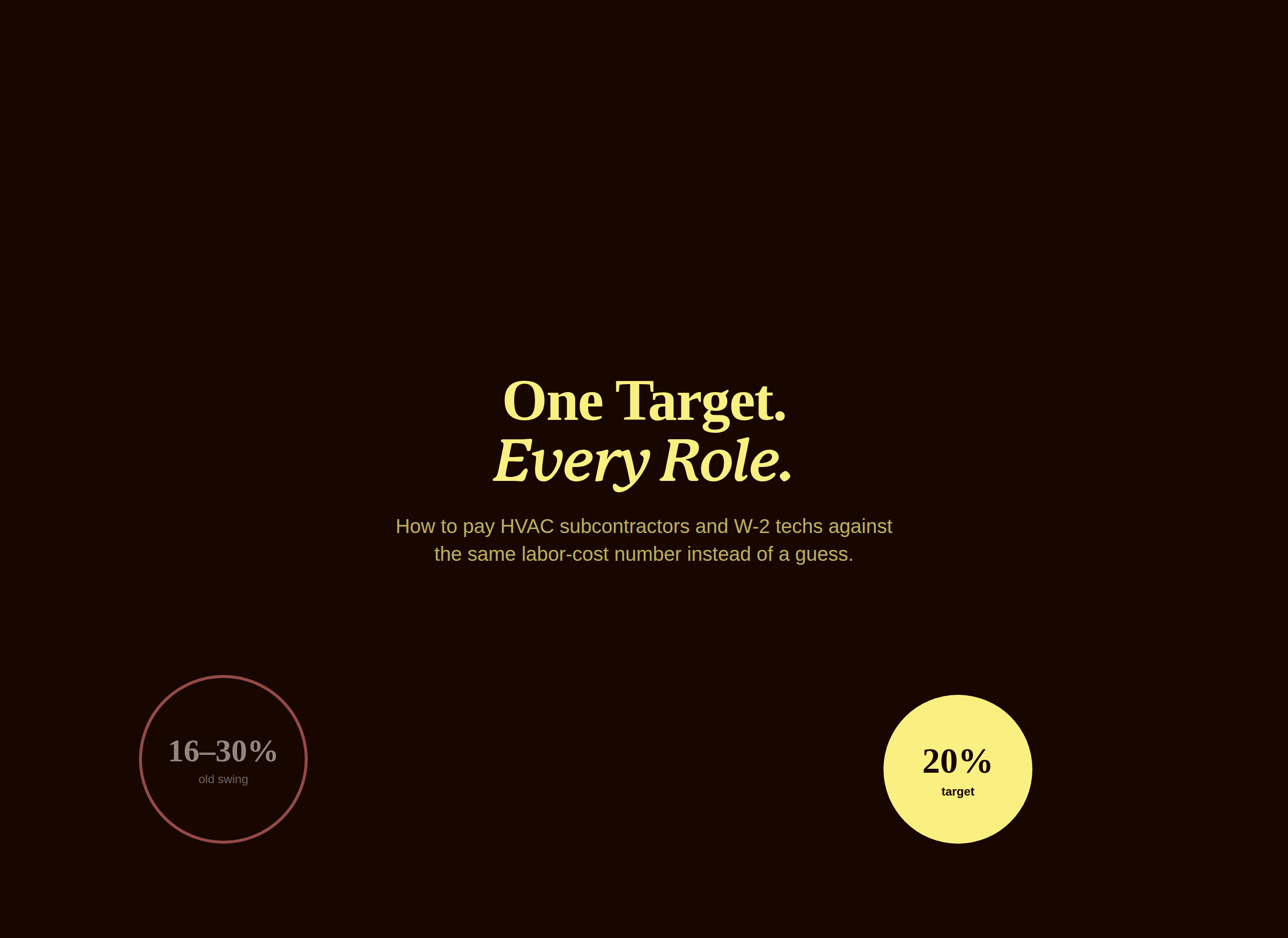
Most owners hesitate to add an incentive plan because they're not sure it will motivate anyone. This owner's hesitation was more specific and, frankly, more sophisticated: he was concerned that raising labor pay to fund new incentives would push up his workers' compensation costs without a clear, data-backed way to confirm it wouldn't quietly erode profitability. That's not a small consideration for a painting company. Workers' comp is calculated as a percentage of payroll, and this business was already carrying a real annual workers' comp expense of $1,819,000. Any structural change to how the crew gets paid needed to be checked against that number before it went anywhere near a rollout, not after.
That's a more disciplined way to approach an incentive plan than most companies take, and it's worth naming directly: a bonus structure that boosts morale but quietly increases fixed costs faster than it increases profit isn't actually a win. Before this company added a single dollar of new incentive pay, the plan had to be checked against the real cost structure of the business, not just the feel-good story of paying people more for good work.
Building The Plan Around A Real Margin Floor
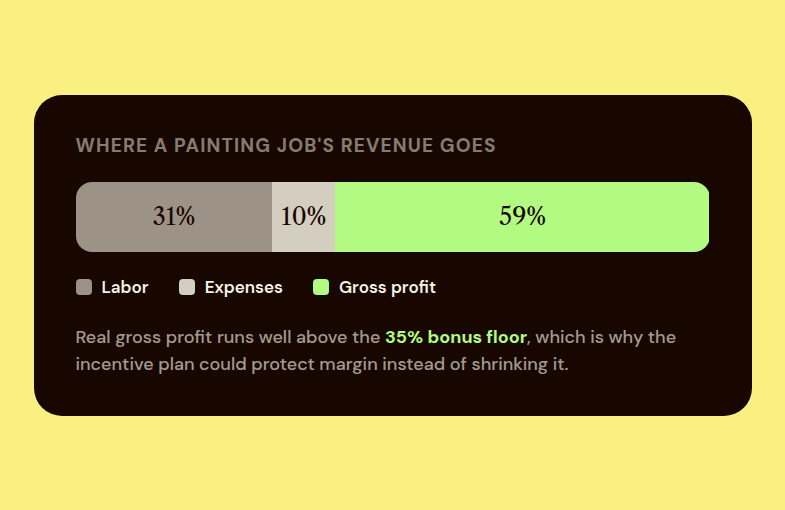
The plan ShareWillow built starts with a number pulled straight from the company's own job-costing history: baseline labor was running at roughly 31 percent of revenue, with expenses around 10 percent, yielding historical gross profit near 60 percent. Against that real baseline, the plan sets a 35 percent minimum profit-margin target on every job. Only revenue above that floor becomes eligible for bonus payouts, which means the incentive structure literally cannot pay out on a job that isn't protecting the company's margin. The bonus and the business's profitability move in the same direction by design, not by hope.
Giving The Estimator Real Upside For The First Time
The field estimator's compensation changed the most. Instead of a salary with no connection to outcomes, the role moved to a $40,000 base salary plus 3 percent commission on sales that clear the 35 percent margin bar, with monthly sales targets set directly with the owner. That last detail matters: the commission isn't paid on every sale regardless of quality, it's paid on sales that protect the company's margin, which means the estimator now has a direct financial reason to price jobs accurately rather than simply chase volume to hit a number. An estimator who underprices a job to win it faster is, under this structure, working against their own paycheck, not just the company's bottom line.
On top of the base salary and commission, the plan adds an upsell commission of 1 to 5 percent for on-site add-ons, the extra doors, patches, and scope additions that come up once a crew is already on location. That's real incremental revenue that used to have no incentive attached to it at all. A painter or estimator who notices an obvious add-on opportunity and simply doesn't bother to mention it, because there was never a reason to, now has one.
A Simple Fix For The Informal Review Bonus
The occasional $25 gift card for a 5-star review became a standardized $10 bonus per 5-star review, paid consistently rather than handed out when someone happened to remember. It's a smaller dollar figure than the old gift card, but a far more reliable one, and reliability is usually what actually drives behavior. A painter who knows a 5-star review means a guaranteed $10, every time, has a clearer reason to ask for that review than one who might occasionally get recognized with a gift card if the timing works out.
Crew Structure And A Separate Track For Epoxy
The plan also had to account for the fact that painting jobs are rarely done by one person alone. Crew-lead and helper commission splits were discussed at either a 60/40 or 70/30 division, weighting more of the bonus toward the lead who carries more responsibility and accountability for the finished result, while still giving the helper a real, meaningful share rather than treating them as incidental to the job.
Because the company also runs a separate garage-floor epoxy coating division, that side of the business got its own bonus program rather than being folded into the painting structure. Epoxy jobs have a different risk profile, different materials, different failure modes, and the plan reflects that with its own eligibility window: a job has to clear a callback-eligibility period, enough time for any coating defect to surface, before it counts toward payout. That single design choice turned out to matter more than expected once the plan actually went live.
The lead/helper split matters for a similar reason. Painting is one of the trades where the gap between a lead's responsibility and a helper's responsibility can be large even on the same job: the lead is making the color-match calls, managing the client relationship on site, and owning the finished result, while a helper is executing tasks the lead assigns. A flat, equal split between the two would either shortchange the lead for carrying that responsibility or fail to give the helper a real enough stake in the outcome to care about quality. Landing on a weighted split, rather than an even one, was a small design decision that reflects a real difference in what each role is accountable for.
Profit sharing
made simple.
Give your team a stake in the company’s success. ShareWillow helps you create and manage profit-sharing programs that motivate employees and drive business results.
What The First Live Payout Actually Showed
The plan's first monthly close produced real, if early, numbers. One painter had 8 eligible jobs that together generated a $172 bonus. A second painter had 4 jobs on the books for the same period but received $0, not because of a system error or an unfair calculation, but because none of that painter's jobs had yet cleared the callback-eligibility window built into the plan. Once that window closes, those jobs become eligible in a future period. It's a real, if awkward, discovery from a first live rollout: a timing gap between when a job is completed and when it's safe to count toward payout, surfaced by actual data instead of theory.
That kind of gap is exactly the sort of thing a pilot period is supposed to catch. Finding it in month one, on a handful of jobs, is a far better outcome than finding it a year in, once dozens of painters have gotten used to a payout timeline that quietly doesn't match what they were told to expect.
Two Real Problems The Live Data Surfaced
Going live also surfaced two operational issues that only show up once real jobs and real refunds start flowing through a real system. A job that had to be fully refunded created a negative bonus balance for the technician associated with it, an edge case nobody had fully mapped out in the planning stage. And the owner found himself needing to click into each employee's numbers individually to check performance, when what he actually needed was a consolidated, easy-to-read report covering the whole crew at once. Neither issue is a flaw in the underlying plan design. Both are the kind of practical, fixable friction that only becomes visible once a plan is running against real jobs instead of a spreadsheet model, and both are far cheaper to fix while the incentive dollars involved are still small.
Why This Approach Fits Painting Companies Specifically
Painting is a trade where margin can look deceptively healthy on the estimate and then quietly erode by the time a job actually closes: extra coats, callback touch-ups, a scope conversation that didn't get billed. A flat commission on sale price, without a margin floor underneath it, can end up rewarding exactly the jobs that turned out to be the least profitable once all the real costs landed. Tying bonus eligibility to a real, verified margin threshold protects against that in a way a simple percentage of revenue never could.
For other painting companies sitting on job-costing data that already knows their real margins but has never connected that data to pay, this account is a useful example of the sequence that works: check the real financial baseline first, including cost categories like workers' comp that are easy to overlook, set the bonus floor above that baseline rather than below it, and expect the first live payout period to surface a few rough edges worth fixing rather than a perfect result on day one. A plan built around real numbers earns trust faster than one built around good intentions, even when, especially when, the first month's numbers aren't uniform across the whole crew.
The company's epoxy division and its separate eligibility window are also worth noting for any trades business running more than one type of work under one roof. Treating every service line as if it carries the same risk and the same payout timeline is a common shortcut, and it's usually the wrong one. Reviewing real case studies from multi-service trades businesses is a reasonable next step before assuming one bonus structure fits every line of work a company does.
Related reading
Conclusion
A painting crew that had never had a formal bonus moved to a plan protected by a real 35 percent margin floor, with the field estimator finally earning upside on a $40,000 base plus 3 percent commission. The first live payout period paid one painter $172 on 8 eligible jobs, while a second painter's jobs simply hadn't cleared the plan's callback window yet, a real timing gap the pilot caught early rather than a plan flaw.
Create incentives
that
drive results
You shouldn't need complex equity plans to align your team. ShareWillow makes it simple to create transparent profit-sharing programs that motivate employees and grow your business.

Incentive plans to help
small businesses thrive.
.png)
"I was able to leverage the knowledge of the ShareWillow team to learn how other companies were designing their bonus plans. The template was extremely helpful."

Brian Tustin
Owner, First Rate Movers