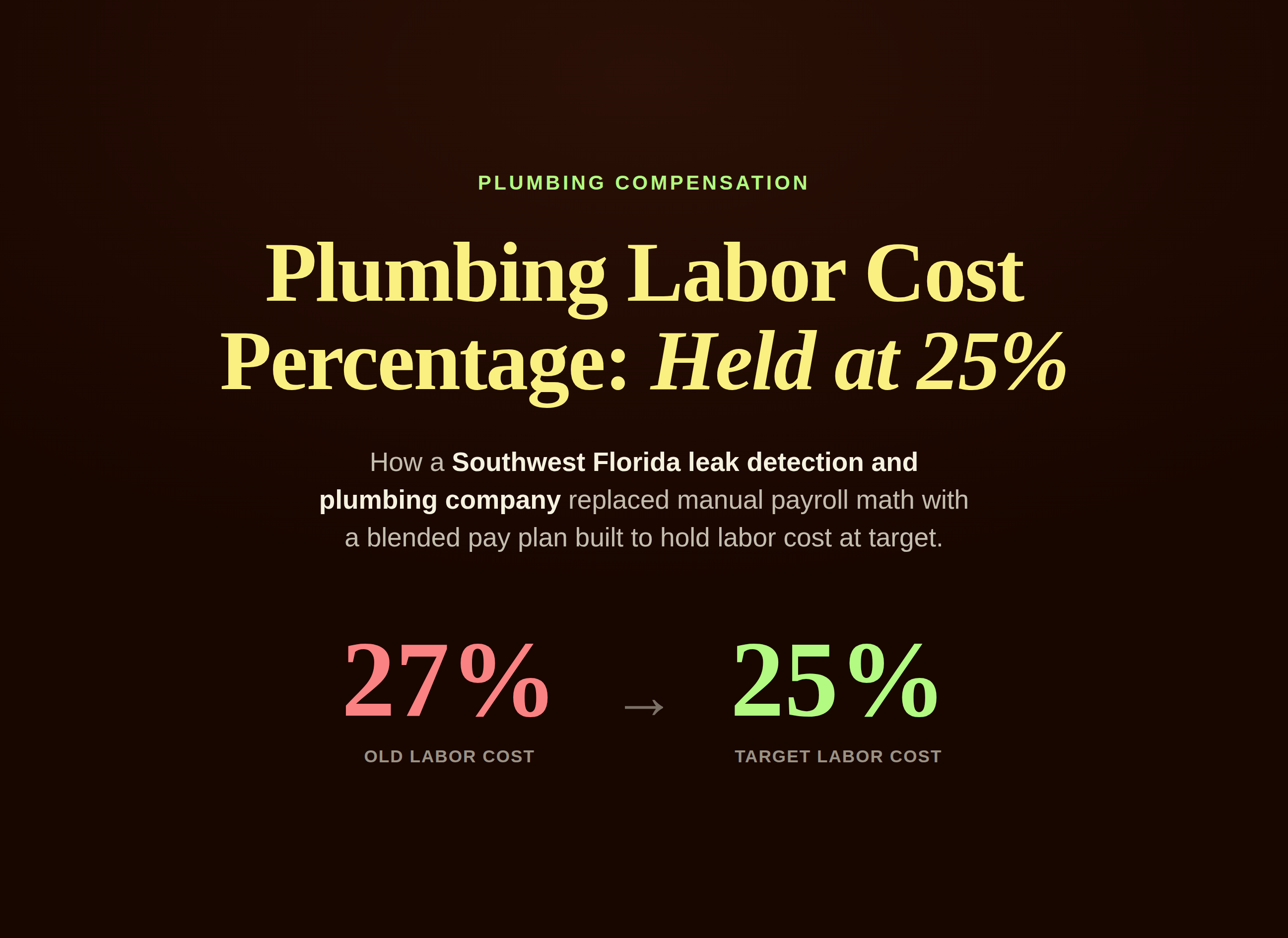
A pest control technician bonus plan with tiered commission and a fixed callback deduction keeps weekly technician pay steady between $1,700 and $2,400.
A pest control technician bonus plan only works if it survives a slow week, a fast week, and everything in between. Flat commission percentages look simple on a whiteboard, but in the field they create wild swings in take-home pay, and they rarely protect the business when a job runs long or a callback eats the margin right back out of the job that earned it.
That is the exact wall a small wildlife and pest control company hit. Their crew of field technicians was paid on a straight commission percentage of revenue, with no adjustment for how long a job actually took versus how long it was sold for, and no mechanism to account for callbacks. The plan was easy to explain, but it was not actually protecting the company, and it was not giving technicians a predictable number to plan a paycheck around.
The Problem With a Flat Percentage on Every Job
On paper, a flat commission rate feels fair: sell more, earn more. In practice, it ignores two things that determine whether a job was actually profitable. The first is time. A technician who wraps a job in half the estimated hours and one who runs three hours over both get paid the same commission on the same invoice, even though one of those jobs made the company money and the other one barely broke even. The second is rework. Every callback costs the company a truck roll, a technician's time, and often a discount or a free follow-up visit, none of which shows up as a deduction against the commission that was already paid out on the original job.
For a company this size, that gap does not show up as a dramatic, single bad month. It shows up as a slow leak: a payroll number that never quite matches the margin the owner expected, and technicians whose weekly pay bounces around in a way that makes it hard to trust the plan, even when it is working in their favor.
The company needed a plan that paid technicians for the outcome the business actually needed, not just the invoice total, and that held up whether a week was fast, slow, or full of callbacks.
Building a Pest Control Technician Bonus Plan Around Real Weekly Numbers
Working with ShareWillow, the company rebuilt its pay plan around two changes. The first was a job-qualification step that compares the actual time a job took against the hours it was sold or estimated for. A job that runs within its estimated window qualifies cleanly for commission. A job that runs significantly over does not get penalized against the technician outright, but it does feed into how the company tracks efficiency and where coaching happens, instead of silently rewarding overruns the same as a clean job.
The second change was splitting the technician team into two different, purpose-built commission structures based on role:
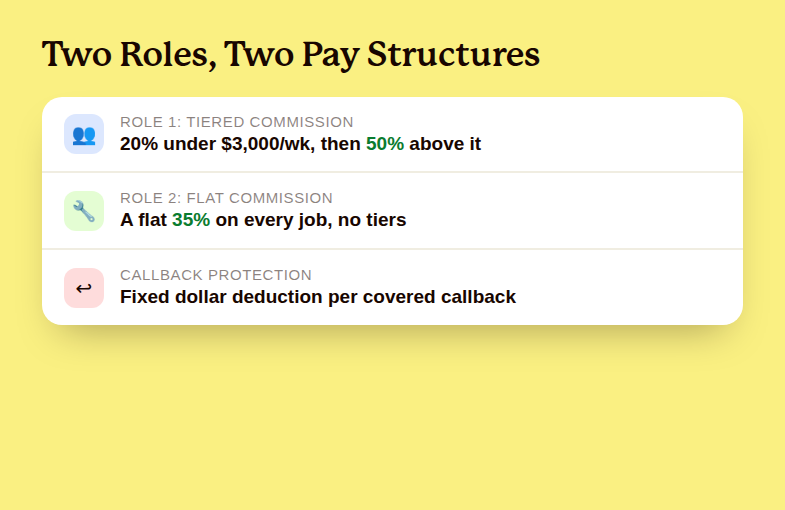
- A tiered commission structure for technicians in one role: 20 percent commission on weekly revenue under $3,000, stepping up to 50 percent commission on everything above that $3,000 weekly threshold.
- A flat 35 percent commission for a second role, where the more variable, spot-treatment nature of the work made a single flat rate the simpler, more predictable fit.
That tier threshold was not picked arbitrarily. It came from looking at what a typical productive week actually generated for that role, so the jump to 50 percent kicks in right where extra effort starts producing real marginal revenue for the company, not before it. A technician having an average week still earns a solid, predictable commission. A technician having a strong week gets rewarded meaningfully more, because the marginal dollars above $3,000 are, in almost every case, dollars the company would not have captured otherwise.
Protecting Margin With a Callback Deduction, Not a Penalty
The other piece of the redesign addressed callbacks directly, and it is the part that usually gets skipped when companies build a technician bonus plan from scratch. Instead of leaving callback cost as an invisible drag on margin, the plan added a callback-deduction field: a fixed dollar deduction applied against commission whenever a technician has to return for a covered callback on a job they already got paid for.
This is a small mechanical change with an outsized effect on trust. Technicians are not punished for doing quality work and having the rare legitimate callback slip through. But the plan no longer treats a callback as a free event for the business to absorb while commission on the original job stays untouched. The deduction is fixed and known in advance, so it shows up as a predictable line item rather than a surprise adjustment technicians have to take on faith.
Put together, the redesign gave this pest control company three things a flat commission rate never had:
- A job-level check comparing time sold to time worked, so efficiency is visible instead of hidden inside a lump commission payout.
- A tiered commission structure for technicians that pays more for the marginal revenue that actually moves the business forward, without changing the base rate on an average week.
- A callback deduction that protects margin on rework without turning every callback into a dispute over pay.
None of this required cutting anyone's opportunity to earn. It required being specific about what the company was actually paying for, then building the plan around that instead of a single number applied to every invoice regardless of context. This is the same principle behind ShareWillow's broader approach to incentive plan design: a good plan does not just move a percentage up or down, it changes what behavior gets rewarded.
How to Pay Pest Control Technicians Without Guessing
Owners running a pest control or wildlife control company can apply the same three questions this company answered, regardless of how many technicians are on the crew:
- What does a typical productive week actually generate? Use that number, not a guess, to set the tier threshold where a higher commission rate kicks in.
- Does the plan reward speed and quality, or just revenue? Comparing sold hours to actual job time surfaces overruns without requiring a manager to review every single ticket by hand.
- What happens to commission when a job comes back? If the answer is "nothing," the plan is quietly paying full commission on jobs that cost the company money the second time around.
These questions matter just as much for a facility manager running an in-house pest program or a small operator with two trucks as they do for a larger regional company. The mechanics scale up and down. What does not change is the underlying logic: pay for the outcome, not just the invoice total.
Profit sharing
made simple.
Give your team a stake in the company’s success. ShareWillow helps you create and manage profit-sharing programs that motivate employees and drive business results.
What the Numbers Looked Like Once the Plan Went Live
Once the tiered and flat-rate structures were both live and reconciled against real payroll, the results were not a dramatic before-and-after swing. They were something arguably more useful for a small business: predictability. The technician on the flat 35 percent commission settled into an average of roughly $2,000 a week, with actual weeks ranging from about $1,700 to $2,400 depending on the job mix, a tight enough band that the technician could plan around it and the owner could forecast payroll with real confidence.
The tiered structure for the other role is being tuned toward a similar kind of stability, with a target of around $2,500 a week once volume in that role normalizes. Because the tier threshold was built from real revenue data instead of a guess, hitting that target does not require the company to change how work gets sold or dispatched. It just requires technicians to keep doing what they were already doing, now with a pay structure that actually reflects it.
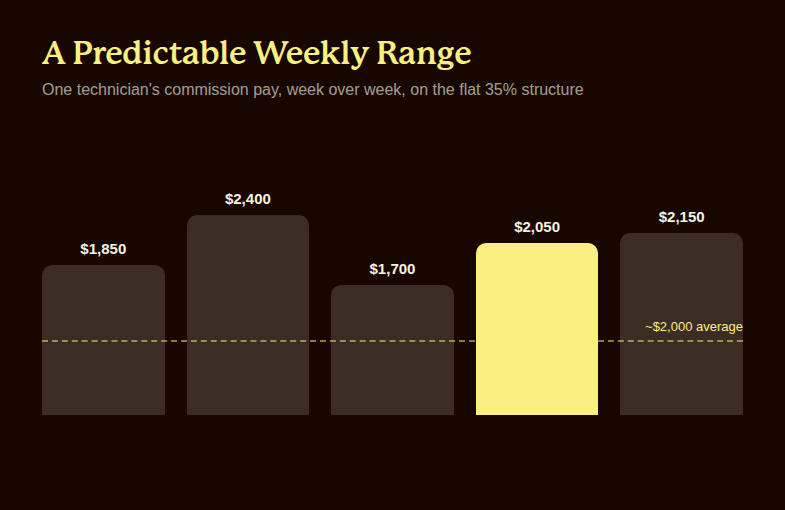
That predictability is the real payoff of a well-built pest control technician bonus plan. Owners often assume the goal of redesigning commission is to cut cost. More often, as it was here, the goal is to make the number the company already pays out actually correspond to the work and the margin behind it, so nobody, technician or owner, is surprised by the check at the end of the week.
Applying This to Your Own Team
This same approach shows up across ShareWillow's work with pest control companies, and it echoes lessons from two related rebuilds worth reading if you are staring down a similar plan. One company stopped paying technicians to stretch out routine jobs and built a compliant attendance bonus plan instead of an informal one that was quietly encouraging clock-padding. Another rebuilt its plan specifically to reward quality over speed, which is the same instinct behind adding a callback deduction here. If you want the broader playbook on tier design outside of pest control specifically, this roundup of bonus structure examples is a good next stop.
How do you calculate a tiered commission structure for technicians?
Start by finding the revenue a typical technician generates in a normal, productive week using real payroll and job data, not a guess. Set your base commission rate to cover that normal week comfortably, then set a higher rate that kicks in only above that threshold. The jump should reward the marginal revenue that would not otherwise get captured, not the whole week's pay.
Should pest control technicians be paid commission or a flat rate?
Either can work, and this company runs both at once for two different roles. Commission tends to fit roles with variable, sales-influenced work well, while a flat percentage can be simpler and more predictable for more routine, spot-treatment style visits. The right choice depends on how much the role's earnings should track effort and upsells versus routine volume.
How do you stop callbacks from costing you commission twice?
Add a fixed dollar deduction against commission that applies whenever a technician has to return for a covered callback on a job they were already paid for. Keeping the deduction fixed and disclosed up front, rather than a case-by-case penalty, keeps the plan feeling fair instead of arbitrary.
Related reading
- How a Pest Control Company Designed Pay That Rewards Quality, Not Just Speed
- The Pest Control Company That Stopped Paying Techs to "Milk the Clock" and Built a Compliant Bonus Plan Instead
- 9 Bonus Structure Examples Employees and Employers Love
- Pest Control Commission Structure: How One Company Traded Guesswork for a Plan Techs Could Predict
Conclusion
A tiered commission plan and a fixed callback deduction turned unpredictable pay into a steady $1,700 to $2,400 a week, without cutting anyone's opportunity to earn.
Create incentives
that
drive results
You shouldn't need complex equity plans to align your team. ShareWillow makes it simple to create transparent profit-sharing programs that motivate employees and grow your business.

Incentive plans to help
small businesses thrive.
.png)
"I was able to leverage the knowledge of the ShareWillow team to learn how other companies were designing their bonus plans. The template was extremely helpful."

Brian Tustin
Owner, First Rate Movers