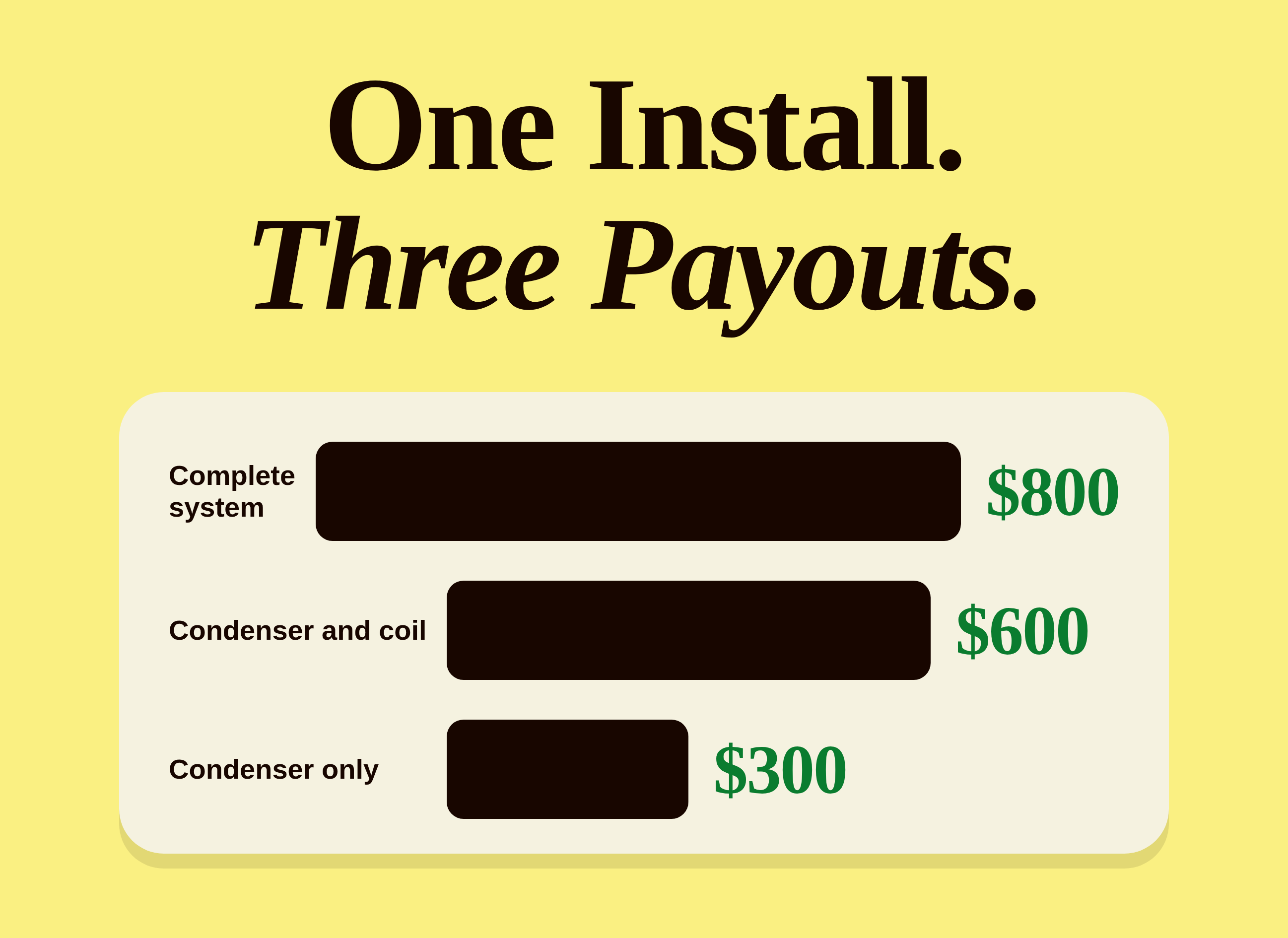
A 10 to 12 technician plumbing and electrical company had a pay problem hiding in plain sight: flat hourly rates that rewarded showing up, not performing. Here's how the owner modeled a move to performance pay and fixed the data gaps that had to be closed before the plan could launch fairly.
A plumbing and electrical company in the Jacksonville, Florida area had all the surface markings of a well-run shop. Ten to twelve technicians, steady work, none of the obvious chaos you see at businesses that size. But underneath that calm was a problem the owner could feel every single week and couldn't quite name: a chunk of the team was coasting, and everyone around them knew it.
When the owner sat down to talk through what was actually going wrong, the diagnosis wasn't about skill. It was about motivation. As he described it, the business's real failure wasn't the technicians' ability to do the work, it was their desire to do it. Some techs were grossly underperforming, not because they couldn't handle the job, but because flat hourly pay gave them no reason to push past the bare minimum. They were totally content collecting the same check regardless of how much they got done.
A Culture Where Coasting Had No Cost
The symptoms were small on any given day but added up fast over a month. Lunches that were supposed to run thirty minutes stretched into an hour or more. Technicians made stops for gas or snacks that had nothing to do with getting to the next job. On two-person calls, it wasn't unusual for one tech to do the actual work while the other stood around. None of it looked like a fireable offense in isolation. It looked like a slow leak, the kind of thing an owner senses in the numbers before he can pin it on any one person or any one day.
The part that made it worse was that the strongest performers on the team saw all of it happening in real time. Lead technicians worked side by side with the underperformers. They knew exactly who was pulling weight and who wasn't. But they stayed quiet, because nobody wants to be the guy who reports a coworker over a long lunch. Nobody wants to be a snitch. So the top performers ended up quietly carrying the weaker ones, working harder to make up the difference, and getting paid the exact same hourly rate for it as the guy standing around.
The Root Cause Wasn't the People, It Was the Pay Structure
Here's the thing about flat hourly pay in a field service business: it removes the financial signal that tells a technician more output means more money. A tech who closes five jobs in a day earns the same as a tech who closes two, as long as both clocked the same hours. There's no upside for hustling and no real downside for coasting. Over time, that structure doesn't just fail to reward your best people, it actively teaches your average performers that effort and pay have nothing to do with each other.
That's the environment ShareWillow walked into. Not a company full of bad technicians, but a pay system that had quietly trained good technicians to do less than they were capable of, while giving the company's actual top performers zero financial reason to keep carrying the team. The owner didn't want a tweak. He wanted a structure where doing more work meant earning more, and then more again, with a real penalty built in for coasting. He wasn't precious about the exact mechanics of the plan, either. He said he didn't care how it was structured as long as his top performers ended up being his top earners.
Modeling Two Paths to Performance Pay
ShareWillow's team built out two options for the owner to compare side by side, both modeled against the company's actual payroll history rather than guessed at from scratch. The first was a hybrid structure: a lower base hourly rate paired with an incentive layer tied to performance, so technicians kept a safety net but had real upside for doing more. The second was a pure performance-pay option, starting at 20% of revenue generated by each technician, with no hourly floor underneath it.
Modeling both against real history mattered because it let the owner see, in dollars, what each structure would have paid out over actual past weeks, not a hypothetical average week. That's a very different conversation than eyeballing a percentage and hoping it works out. It also surfaced a problem that had nothing to do with which pay model was better: the underlying data wasn't clean enough to run either one fairly yet.
Why Plumbing and Electrical Had to Be Split Apart
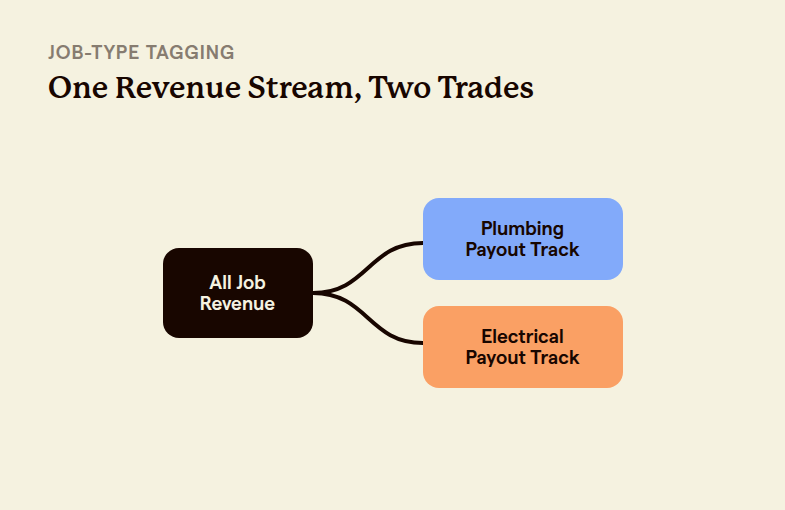
This company runs both plumbing and electrical work, and those two trades don't have the same margins or the same job economics. A percentage of revenue that makes sense on an electrical job can be way off on a plumbing job, and vice versa. Paying every technician the same flat percentage of revenue across both trades, without separating the two, would have either overpaid on one side or underpaid on the other, and either way it wouldn't have been defensible to the team.
So the build included new job-type tagging inside the company's field service software to separate plumbing revenue from electrical revenue at the source. On top of that, the team added two more tags that turned out to be just as important as the revenue split:
- A tag for no-call/no-show incidents, so unexcused absences could be tracked consistently instead of relying on memory or informal notes
- A tag for sick days, so attendance-linked pay adjustments were based on actual recorded data rather than a manager's judgment call after the fact
Without that attendance data, any performance-pay structure would have run into the same fairness problem the flat-pay system already had, just in a new form. A technician who no-call/no-showed twice in a month and a technician with a clean attendance record need to land in different places on a performance plan, and you can't do that consistently if the underlying data doesn't capture the difference.
Profit sharing
made simple.
Give your team a stake in the company’s success. ShareWillow helps you create and manage profit-sharing programs that motivate employees and drive business results.
From Guesswork to a Number You Can Defend
It's worth being straight about where this story stands right now. This isn't yet a "revenue went up X percent" case study. It's a data-integrity and process-readiness story, and that's the honest, more useful version of what happened here.
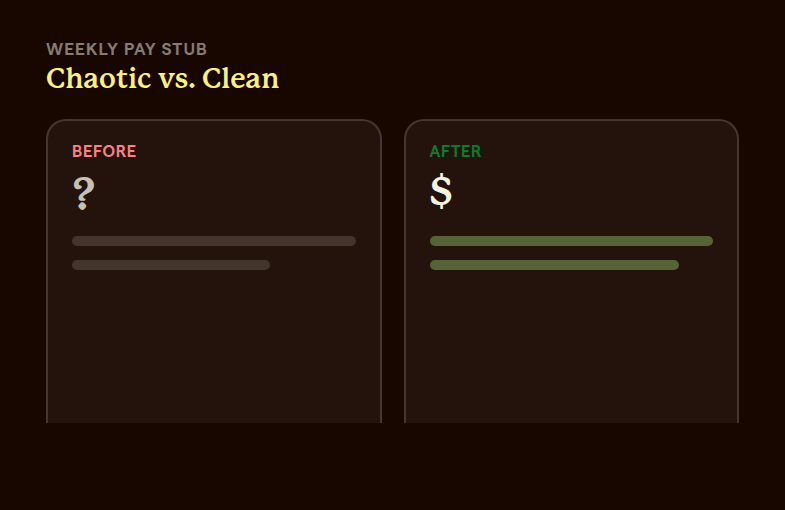
Before the new system, pay under the old ad hoc process swung by $400 to $1,000 week to week for reasons nobody could fully explain. Not because performance was actually swinging that much, but because tracking was inconsistent and pay decisions came down to judgment calls made in the moment. On top of that, the company's office manager was spending roughly two hours a week manually reconciling payroll, cross-referencing job data, hours, and pay by hand across multiple sources just to get numbers that were close to right.
Once the plumbing and electrical job-type tagging went in, along with the no-call/no-show and sick-day tags, those were the two specific problems the new system was built to eliminate: the unexplained weekly pay swings and the manual reconciliation overhead sitting behind them. The result is that the owner now has a fully modeled, ready-to-launch performance-pay structure, validated against real payroll history instead of guessed at, sitting ready to replace a flat-pay system that had been quietly rewarding complacency for years.
That's the groundwork. The launch and the results that follow are the next chapter, but they're being built on a foundation that can actually hold weight, which is more than the old system could say.
What This Means for Your Shop
You don't need 12 technicians or a plumbing-and-electrical mix to have this exact problem. Flat hourly pay creates the same complacency risk in any field service business, and most owners can't see it clearly until they go looking. A few questions worth asking yourself this week:
- Do your best technicians already know who on the team is coasting, and are they staying quiet about it because nobody wants to be the one who says something?
- Does your weekly payroll ever swing by a few hundred dollars for reasons you couldn't explain if someone asked you to?
- How many hours a week does someone in your office spend manually reconciling pay against job data by hand?
- If a technician doubled their output tomorrow, would their paycheck actually reflect it, or would it look almost the same?
If any of those questions made you wince a little, that's usually a sign the pay structure needs a look before the culture problem gets blamed on the wrong thing. ShareWillow's plan design tools are built for exactly this kind of modeling, comparing hybrid and pure performance-pay structures against your real payroll history before you commit to anything. And if you run a plumbing or electrical shop where job economics differ by trade, that segmentation isn't optional, it's what makes the whole plan fair.
Related reading
Conclusion
Flat hourly pay doesn't just fail to reward your best people, it quietly trains everyone else to do less, and the fix starts with data clean enough to trust.
Create incentives
that
drive results
You shouldn't need complex equity plans to align your team. ShareWillow makes it simple to create transparent profit-sharing programs that motivate employees and grow your business.

Incentive plans to help
small businesses thrive.
.png)
"I was able to leverage the knowledge of the ShareWillow team to learn how other companies were designing their bonus plans. The template was extremely helpful."

Brian Tustin
Owner, First Rate Movers