
A Southwest Florida pool and plumbing company was losing top performers to a commission plan nobody could explain, so it diagnosed every leak and rebuilt pay from the ground up. Here is what that rebuild actually looks like, target numbers included.
When a Bonus Plan Becomes Background Noise
Every field service business eventually builds some kind of incentive plan. A percentage here, a spiff there, a bonus tied to hitting a number. The intention is always good: pay people more when they perform, keep your best techs from walking, keep the business healthy. But a plan that nobody actually understands isn't an incentive. It's just background noise on a paycheck stub, and it can quietly cost you your best people while looking, on paper, like it's doing its job.
That's roughly where a roughly 10-person pool and plumbing service company in Southwest Florida found itself earlier this year. The shop runs three distinct lines of work under one roof: leak detection and inspection, general plumbing, and pool service and repair. Seven field technicians split their time across those categories, and for a while, pay was tied to a commission structure that looked reasonable on a spreadsheet but felt like a mystery from the truck.
A Commission Structure Nobody Could Explain
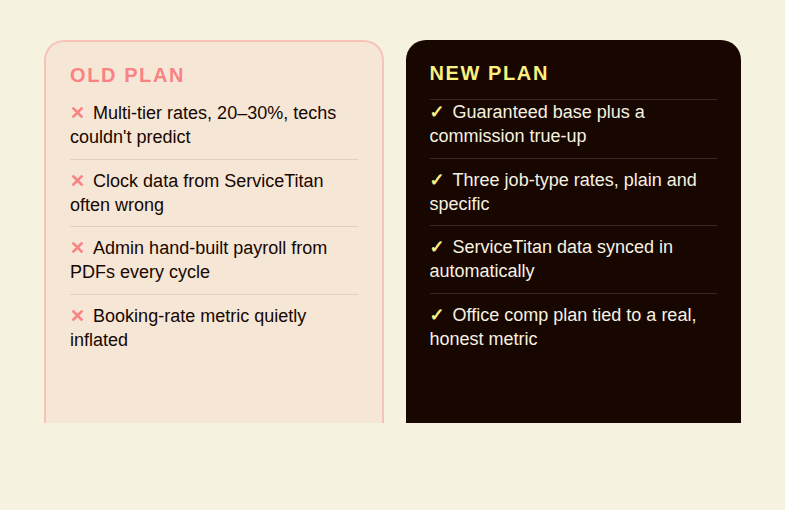
The old plan ran technicians through a set of tiers, somewhere between 20% and 30% commission depending on experience level and, in some cases, the day of the week. On paper, that's a flexible, performance-driven structure. In practice, almost nobody on the crew could tell you, without checking, what percentage they were actually earning on a given job. That gap between what the plan says and what a technician believes they're earning is exactly where trust in a pay plan quietly erodes.
It showed up in two ways. First, in plain dissatisfaction: technicians grumbled about pay without a clear target to work toward, because the target kept shifting under different rules depending on the job. Second, and more seriously, in turnover. The company lost a top-producing technician during this period, along with another experienced tech, and that departure did more than open a slot on the schedule. It knocked out real earning capacity at the top commission tiers, the kind of production that's hard to replace quickly. Months later, the remaining team was still struggling to picture hitting the revenue numbers that departed technician used to hit solo.
Losing one top performer didn't just create an open slot on the schedule. It erased the production the whole plan had quietly been leaning on.
Data Problems Hiding Inside the Payroll
The commission structure wasn't the only issue. The clock-in and clock-out data coming out of the company's field service software was unreliable enough that jobs regularly appeared to take far longer than they actually did. That sounds small until you realize payroll math runs directly off it. Inflated hours corrupt commission calculations, distort labor-cost reporting, and make it nearly impossible for an owner to trust the numbers in front of him when he's deciding whether pay is actually aligned with performance.
Then there was the process itself. Every single pay period, an office admin pulled PDF exports out of the system and hand-built a payroll spreadsheet from scratch. No integration, no automation, just a recurring block of hours spent reconciling numbers by hand, pay period after pay period. That's a hidden cost a lot of shop owners never actually calculate. It doesn't show up as a line item on a P&L. It's an admin's afternoon, twice a month, forever, and it's exactly the kind of quiet time drain that eats margin without ever showing up as a number you can point to.
On top of that, there was a data-integrity problem on the office side too. The office manager overseeing incoming leads was found to be excusing certain leads from her own booking-rate metric, which had the effect of making her performance look better than it actually was. A metric that can be quietly gamed stops being a metric at all. Between confusing commission math, unreliable clock data, a fully manual payroll process, and a self-reported number that couldn't be trusted, this business had four separate leaks in the same boat. None of them showed up as one dramatic event. They showed up as a slow, steady drag on margin and morale, the kind that's easy to normalize because "that's just how payroll works here."
Rebuilding Pay From the Ground Up
Fixing a pay plan like this isn't about tweaking a percentage here or there. It's about rebuilding the whole structure around two questions: can a technician explain, in one sentence, how they get paid, and does the company actually know what it's paying before the checks go out? The redesign built for this pool and plumbing company answered both.
A Guaranteed Base Plus a Commission True-Up
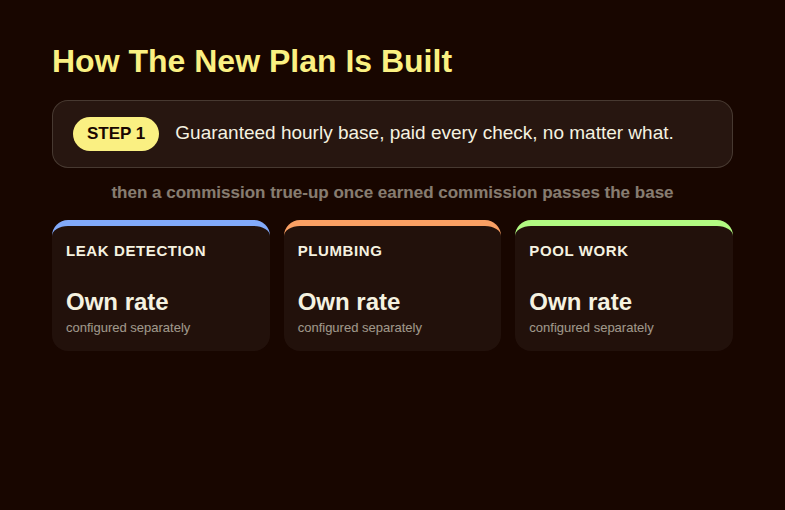
The centerpiece of the new plan is a guaranteed hourly base wage. Every technician earns a set hourly rate no matter what, full stop. Commission then kicks in as a true-up: once a technician's earned commission for a period exceeds what the hourly base already paid them, they get the difference on top. It's a structure that protects the business from wage-and-hour risk while still rewarding the technicians who are actually producing above their base pay.
The team modeled this at a few different hourly levels, including scenarios at $15, $20, and $25 an hour, with the higher tier paired with time-and-a-half overtime at $37.50. That range matters, because a guaranteed base only works as an incentive tool if it's set high enough to feel like real security, without being so high that commission stops meaning anything on top of it.
Three Job Types, Three Separate Rates
The old one-size-fits-all tier system also got replaced with something more specific: three separate commission categories, one each for leak detection and inspection, plumbing, and pool work, each with its own configurable rate. That might sound like a small change, but it matters more than it looks. Leak detection, plumbing, and pool service carry different margins, different job lengths, and different skill requirements. Paying all three off the same blended tier structure was always going to under-reward technicians who happened to be strong in a lower-margin category and over-reward others almost by accident. Splitting commission by job type lets the compensation match the actual economics of the work.
A Real Target: 25% of Revenue
Underneath all of it sits a single number the whole plan is built around: getting total payroll cost down to 25% of revenue, compared to the company's actual historical average of around 27%. That's a real, specific target modeled around a top technician earning roughly $90,000 a year on $360,000 in annual sales, which works out to about $13,846 per two-week pay period.
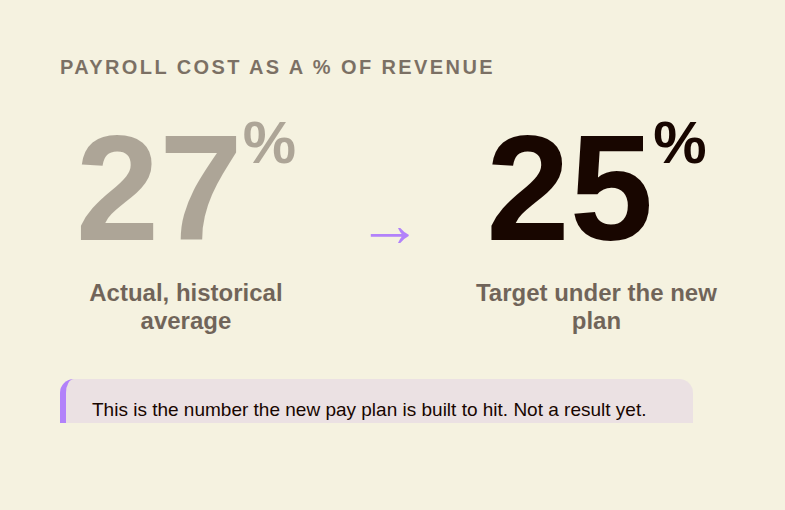
It's worth being precise about what that number is and isn't. As of the most recent conversation on file, this plan had not yet gone live. The owner was still reviewing the finalized model before rolling it out to the full team. So 25% is a target the plan is designed to hit, not a result that's already landed. That distinction matters. A lot of comp-plan case studies quietly blur the line between "we built this to work" and "this worked," and the more useful, honest version of this story is the one that keeps that line clear: here is a real, specific, carefully modeled target, built from real historical payroll data, that a business is about to put to the test.
Profit sharing
made simple.
Give your team a stake in the company’s success. ShareWillow helps you create and manage profit-sharing programs that motivate employees and drive business results.
Fixing the Office Side of the Ledger, Too
A pay-plan rebuild that only touches field technicians misses half the problem. The office manager whose booking-rate numbers couldn't be trusted needed a new plan too, and a new person in the seat. The redesigned role comes with a base salary of around $65,000, with a real path to roughly $80,000 through incentives tied to an 85% booking-rate target, one that can't be quietly manipulated the way the old self-reported number could. Getting the office-side incentive right matters just as much as getting the field-side incentive right. If the person managing leads is being measured on a number she also controls unsupervised, that's a structural problem, not a personality problem.
Taking the Manual Work Out of Payroll
The other half of the fix had nothing to do with commission math and everything to do with time. Instead of an admin manually pulling PDF exports and rebuilding a spreadsheet every pay period, the plan calls for direct ServiceTitan-to-ShareWillow integration, syncing payroll and sales data automatically. That one change removes the recurring hours of manual reconciliation that had been quietly taxing the office every two weeks, and it closes the gap between what the field is actually doing and what payroll is calculating, so unreliable clock data has a lot less room to hide inside a spreadsheet nobody has time to audit closely.
What This Shop Expects Once the Plan Goes Live
Because this plan hadn't launched as of the most recent update, there's no clean payout number to report yet, and it wouldn't be honest to pretend otherwise. What the company does have is a specific, well-built structure sitting on real historical data: a guaranteed base that protects technicians and the business, commission categories that actually match how the work breaks down, an office incentive built on a number that can't be gamed, and a payroll process that no longer depends on one person's afternoon every other week. Once it's live, the numbers to watch will be straightforward: does payroll cost actually move from that 27% baseline toward the 25% target, does turnover among top performers slow down, and does the admin who used to spend hours on spreadsheets get that time back for something else.
Auditing Your Own Comp Plan for the Same Leaks
You don't have to run a pool and plumbing shop in Florida to have some version of this problem. Multi-tier commission plans, unreliable time data, and manual payroll processes show up across HVAC, electrical, and general field service businesses constantly. A few questions worth asking about your own plan:
- Can every technician on your team explain, without checking a spreadsheet, exactly how their pay is calculated?
- Do you actually trust the hours your field service software is reporting, or do you quietly discount them?
- How many hours does someone on your team spend building payroll by hand each pay period, and what would happen if that time went back to something else?
- Is anyone on your team being measured on a number they also have the ability to influence unsupervised?
- Have you lost a top performer in the last year partly because pay felt unpredictable, not just because the offer elsewhere was better?
If more than one of those questions makes you wince a little, that's usually a sign the plan needs a rebuild, not a patch. Commission tiers that accumulate small adjustments over the years tend to drift away from what the business actually needs, and by the time an owner notices, it's often because a good technician already walked. Businesses in pool and spa services in particular tend to run multiple job types under one roof, which makes a single blended commission rate even more likely to quietly misfire in one direction or another.
The version of this story worth remembering isn't "labor costs dropped." It's "here's what a careful diagnosis and a properly modeled rebuild look like before the results are even in." That's often the harder, less glamorous half of fixing a broken incentive plan, and it's the half most businesses skip.
Related reading
- From Pennies to a $3,000 Bonus: One Plumbing Company's Incentive Plan Rebuild
- The $76,000 Mistake Nobody Caught: How a Multi-Trade Shop Fixed Its Commission Blind Spot
- Incentives, Commissions, and Bonuses: What’s the Difference and Why It Matters
- Companies with Profit Sharing: Who They Are & What They Offer
Conclusion
If your team's commission plan has grown more confusing than motivating, or your payroll process still runs through PDFs and a spreadsheet, it might be time for the same kind of audit. Reach out to ShareWillow to see what a rebuilt plan could look like for your shop.
Create incentives
that
drive results
You shouldn't need complex equity plans to align your team. ShareWillow makes it simple to create transparent profit-sharing programs that motivate employees and grow your business.

Incentive plans to help
small businesses thrive.
.png)
"I was able to leverage the knowledge of the ShareWillow team to learn how other companies were designing their bonus plans. The template was extremely helpful."

Brian Tustin
Owner, First Rate Movers
