A pool service and construction company launched a revenue-per-hour incentive plan calibrated off one noisy month, and every technician missed it. Rebuilding the benchmark against three months of real data got the whole crew to a validated, team-wide launch.
An incentive plan's first live month is supposed to prove the concept. Technicians hit some tiers, miss others, and everyone gets a feel for where the bar actually sits. It is a much worse first month when the answer is nobody, not one technician on the entire crew, cleared the bar at all.
That is exactly what happened at a pool service and construction company running field crews on outdoor residential routes, using time-tracking software to log hours against each stop. The company had rolled out a tiered revenue-per-hour commission plan, the kind of structure that rewards a technician for working efficiently rather than just clocking hours, and set the entry threshold at 110 dollars of revenue per hour. When the first month closed out, the number came back company-wide: zero technicians had reached it. Not the newest hire, not the most experienced tech on the route. The entire incentive budget for that month paid out to nobody.
A Threshold Built on One Month That Was Never Representative
The instinct when a bonus plan produces a result that extreme is to assume the team underperformed. The more useful instinct, and the one this company's leadership followed, is to ask whether the number itself was ever fair in the first place. A closer look at the underlying time-tracking data turned up two specific problems, both quiet, both compounding, and neither visible unless someone went looking for them after the fact.
The first was misattributed time. Technicians moving between stops on a route were, in a meaningful number of cases, having their hours logged against the wrong customer job entirely, an easy mistake to make in a time-tracking app when a crew is jumping between addresses on a tight schedule, but one that quietly corrupts the revenue-per-hour math for every job it touches. A technician who actually ran an efficient job could still show a poor number if a chunk of their productive time got attributed somewhere else, and there was no way to tell the difference between a genuinely slow job and a misattributed one just by looking at the report.
The second was how the time-tracking software counted drive time and other unproductive stretches. Time spent moving between stops, or waiting on a gate code, or dealing with an access issue that had nothing to do with the technician's actual skill, was being counted as billable hours in the denominator of the revenue-per-hour calculation. That inflates the hours side of the ratio without adding any revenue to match it, which drags the number down for reasons entirely outside a technician's control. Between misattributed job time and drive time counted as billable, the 110 dollar-per-hour threshold was never actually measuring what it was supposed to measure. It was measuring a mix of real technician efficiency and data noise, and the noise was winning.
Fixing the Benchmark Before Fixing the Team
The temptation after a month like that is to lower the threshold and move on. ShareWillow's approach instead was to fix what the threshold was measuring before deciding whether the number itself was right. The team built a validation step, a deviation report comparing the time-tracking software's logged hours against the underlying job records, specifically designed to catch misattributed time and separate real drive time from billable work before any revenue-per-hour number gets used to calculate a bonus.
Just as important, the company stopped calibrating the tiers off a single month. One month of data, especially a first month under a brand-new tracking process, is close to the worst possible sample to set a threshold from, since it captures every startup wrinkle in the system alongside whatever the team's real performance looks like. The rebuilt benchmark pulled from July through September, three full months, giving the plan enough range to smooth out the kind of one-off noise, a slow week here, a stretch of unusually difficult jobs there, that had wrecked the original single-month number.
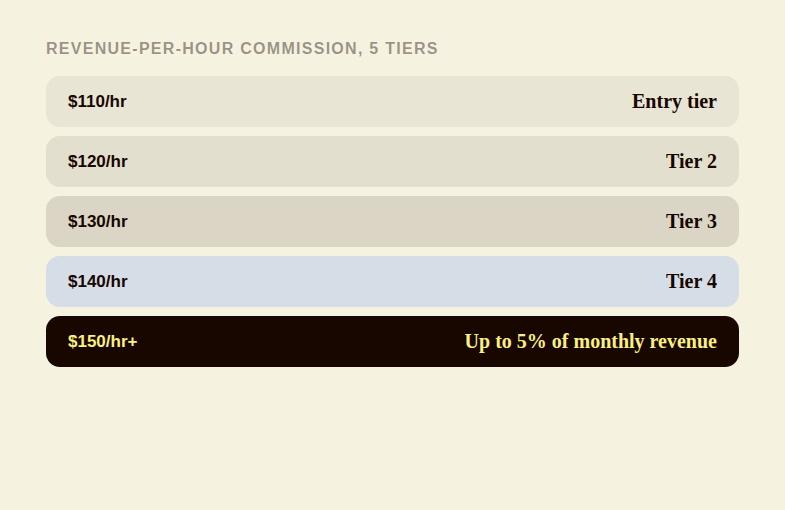
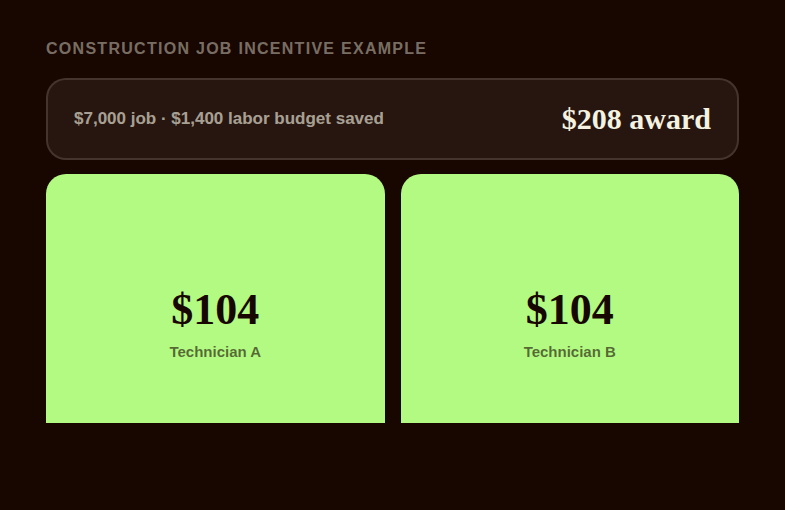
Against that corrected, multi-month baseline, the team built a five-tier revenue-per-hour structure running from 110 dollars up through 150 dollars and above per hour, paying out up to 5 percent of monthly revenue at the top tier. A separate incentive covers construction jobs specifically, worth 10 percent of whatever labor budget the crew comes in under, split proportionally by hours worked. One real example from the rollout: a job carrying a 208 dollar labor-budget savings paid out 104 dollars each to the two technicians who ran it, a clean, proportional split tied directly to the value the crew actually created. On top of both structures, a flat 15 dollar bonus rewards every five-star customer review, giving service quality its own line in the plan rather than leaving it as an assumed byproduct of hitting a revenue number.
Profit sharing
made simple.
Give your team a stake in the company’s success. ShareWillow helps you create and manage profit-sharing programs that motivate employees and drive business results.
From Zero Qualifiers to a Validated, Team-Wide Launch
The most important outcome of this rebuild is not a single dollar figure, it is a status change. Under the original single-month benchmark, the plan had a 0 percent qualification rate across the entire crew, a number that effectively meant the incentive plan did not exist in practice no matter what it said on paper. Under the rebuilt, multi-month-validated structure, the plan reached a formal soft-launch approval, the internal milestone confirming the tiers, the deviation-report validation step, and the underlying time data had all been checked and were ready for a full team rollout.
That is a meaningful before-and-after even without a specific payout percentage attached to it yet, because the alternative to fixing the benchmark was not a modestly disappointing incentive plan. It was a plan that had already proven, in its first month, that it would never pay out to anyone under the conditions it was built on. A tiered commission structure that nobody can reach does not fail quietly. It fails completely, and it does so in a way that is far more visible and more damaging to trust than a plan that simply pays out a smaller amount than hoped.
What Changed, Concretely
- A deviation report now validates time-tracking data against real job records before any revenue-per-hour number is used to calculate a bonus.
- The benchmark moved from a single, unrepresentative month to a three-month range, July through September, smoothing out the kind of noise that had wrecked the original threshold.
- A five-tier revenue-per-hour structure now runs from 110 dollars up through 150 dollars and above per hour, paying up to 5 percent of monthly revenue.
- A separate construction-job incentive pays 10 percent of the saved labor budget, split by hours worked, on top of the revenue-per-hour tiers.
- A flat $15 bonus rewards every five-star review, independent of the revenue-based tiers.
- The plan moved from a 0 percent team-wide qualification rate to a validated, soft-launched structure ready for full rollout.
The Benchmarking Mistake Worth Checking Before You Launch
Any owner rolling out a new incentive plan built around a data source the team has not used long enough to trust, a new time-tracking app, a newly adopted field-service platform, a freshly configured job-costing report, is exposed to some version of this same risk. The threshold feels reasonable when it is set. It is only once real payouts start calculating that hidden problems in how the underlying data gets logged start to surface, and by then a team has already lived through a demoralizing first month of an incentive plan that quietly failed everyone.
A few questions worth asking before any new bonus threshold goes live: has the underlying data source, whatever is generating the hours or revenue figures the plan depends on, been validated against an independent record, or is the threshold trusting the raw export at face value? Is the benchmark calibrated off enough time to smooth out a single unusually good or unusually bad stretch, or does it rest on one month that happened to be whatever month the software went live? And if the first live cycle produced a surprising result, would your team's instinct be to investigate the data, or to assume the crew simply underperformed?
Pool service and construction companies weighing a similar rollout can see how ShareWillow structures field-verified incentive pay plans that validate the underlying time and job data before any tier gets calculated, rather than trusting a raw export the first time a new tracking system goes live.
The lesson underneath the zero-percent first month is not that this crew needed to work harder. It is that a threshold is only as fair as the data measuring it, and a single unrepresentative month is never enough to know whether a number is calibrated correctly. Checking the data before blaming the team is what turned a demoralizing launch into a plan the whole crew is now working under.
Related reading
Conclusion
A bonus threshold nobody can hit isn't a stretch goal, it's a benchmarking mistake wearing a stretch goal's clothes.
Create incentives
that
drive results
You shouldn't need complex equity plans to align your team. ShareWillow makes it simple to create transparent profit-sharing programs that motivate employees and grow your business.

Incentive plans to help
small businesses thrive.
.png)
"I was able to leverage the knowledge of the ShareWillow team to learn how other companies were designing their bonus plans. The template was extremely helpful."

Brian Tustin
Owner, First Rate Movers