A pool construction and maintenance company built its commission tiers off one benchmark month. When that month closed, not one technician hit the minimum, and the whole team earned nothing. Here is how the threshold got rebuilt before the next payout.
Zero technicians hit the minimum. That was the result when a pool construction and maintenance company closed out the first month it used to benchmark a brand-new commission plan, and it meant the entire incentive pool for that month paid out exactly nothing, even though the crew had been out running real jobs the whole time. The company, which runs a field crew of roughly a dozen people building and servicing pools, had built a tiered commission structure worth up to 5 percent of monthly revenue, gated by revenue-per-hour tiers starting at 110 and climbing to 150 and above. July was chosen as the benchmark month for setting those tiers. When July's numbers actually came in, not one technician cleared the 110 floor.
It is worth sitting with how that happens, because it is not really a story about technicians falling short. The crew was doing the same work it always does, building and maintaining pools, running real jobs, generating real revenue. The plan simply set its floor using one month of data that turned out not to represent a typical month, and once that floor was locked in, the entire structure sitting above it became unreachable. A commission plan is only as good as the benchmark it is built on, and a single month, however carefully chosen, is a thin foundation for a number the whole team's pay is about to depend on.
What Was Actually Broken Under The Surface
The zero-payout month also surfaced problems that had been sitting underneath the revenue-per-hour number the whole time, invisible until a real payout depended on getting it right. Technicians were sometimes clocked into the wrong customer's job, which meant hours worked on one property were being credited to a different address entirely. Unproductive time and drive time between jobs were being counted as billable hours by default, quietly inflating the hours side of the revenue-per-hour ratio and dragging the number down even on jobs that went well. And invoices created without a job explicitly linked to them carried no technician attribution at all, meaning that revenue simply vanished from the calculation rather than landing on anyone's number, right or wrong.
Any one of these issues would distort a revenue-per-hour target on its own. Together, they meant the 110-per-hour floor was never really measuring what it was supposed to measure in the first place. Fixing the benchmark month without fixing the attribution problems underneath it would have just produced a differently wrong number, so the team treated both as part of the same job.
Pool construction work makes these attribution problems worse than they might be for a company running shorter, more uniform service calls. A single pool build can stretch across days or weeks, moving through excavation, plumbing, structural work, and finish stages that might involve different combinations of the same crew members on different days. Every one of those handoffs is a chance for a technician to get clocked into the wrong job, for drive time between a finishing job and a new excavation to blur into billable hours, or for an invoice to get generated before anyone has gone back and confirmed exactly who worked which stage. None of that is unusual for the trade. It is just the reason a revenue-per-hour number in this kind of business needs more scrutiny before anyone builds a commission tier on top of it, not less.
Two Fixes: The Benchmark And The Bonus Structure
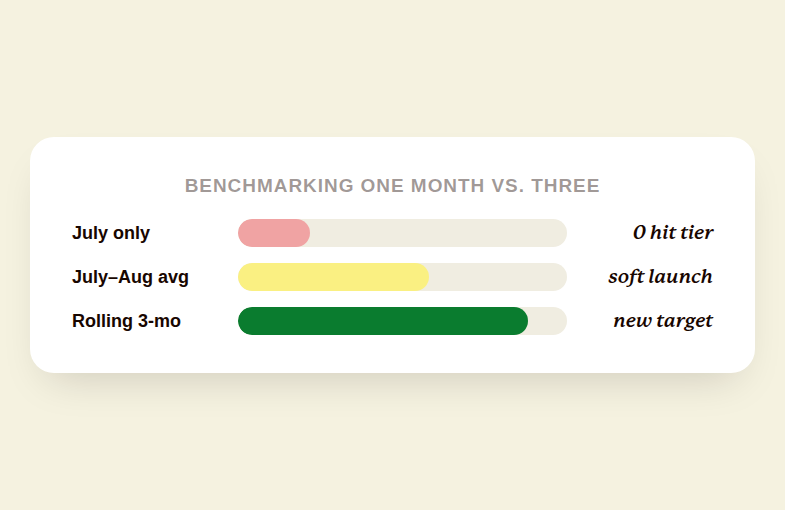
The first fix was philosophical as much as technical. Instead of locking tiers to a single benchmark month, the team agreed to average revenue-per-hour across July, August, and September before setting the targets that would actually govern pay. A rolling multi-month average absorbs the kind of one-off variance, a slow week, a run of unusually complex jobs, a stretch of bad weather, that can make any single month look artificially weak or artificially strong. It is a small change in method with an outsized effect on whether a threshold ever produces another zero-payout month like July.
A Second Way To Earn, So One Metric Isn't The Whole Story
The second fix did not touch the revenue-per-hour tiers at all. It added a separate way for the crew to earn that did not depend on hitting a single number. A new construction award pays 10 percent of the labor budget a crew saves on a job, split evenly by hours worked among whoever was on that job. The first one paid out at $208, split $104 and $104 between two technicians on a completed job. A $15 bonus per five-star review was added on top, along with tenure-based PTO accrual tiers, starting at 0.77 hours for every 40 hours worked in a technician's first year and rising to 2.31 hours per 40 for anyone past four years with the company.
That $208 is a modest number next to a $0 month, and it would be dishonest to dress it up as anything bigger than what it is: the first real, verified payout under a redesigned structure, on one completed job, split between two people. What it demonstrates is not the size of the opportunity but the shape of the fix. A team's pay no longer depends entirely on clearing one revenue-per-hour bar calculated from data with known attribution problems. It also depends on completing jobs under budget, on customers leaving five-star reviews, and on tenure, three additional paths to real money that did not exist when the plan was a single all-or-nothing threshold.
The construction award in particular fits how pool building actually works better than a single revenue-per-hour number ever could. A crew that finishes a build under its labor budget has demonstrably saved the company real money, independent of whatever that same job's revenue-per-hour ratio happens to work out to once mileage, drive time, and multi-day scheduling are all factored in. Splitting that 10 percent savings evenly by hours worked also sidesteps a subtler problem: on a multi-day build, it is not always obvious which technician's individual hours drove the savings, since efficient plumbing on day two can make excavation on day one look better in hindsight than it actually was. An even split by hours worked rewards the whole crew for the outcome without pretending anyone can cleanly attribute which specific hour saved the money.
The tenure-based PTO tiers and the five-star review bonus round out the plan with paths that reward two things revenue-per-hour cannot measure at all: sticking with the company and treating the customer well enough that they say so publicly. A $15 review bonus is a small number by itself, but it puts a real dollar behind the exact behavior, a technician taking the extra few minutes to make sure a customer is happy before driving to the next job, that a pure efficiency metric has no way to reward and every incentive to discourage.
Soft-Launching Before Anyone's Paycheck Is On The Line
Rather than flipping the corrected plan on for the whole field team at once, the company chose to soft-launch it to back-office users first, watching how the numbers behave before a single field technician's paycheck depends on them. That caution turned out to be justified almost immediately. One technician's revenue-per-hour came back showing $3,634 an hour, an obvious anomaly rather than a real number, the kind of distortion that a mis-coded time entry or a misattributed job can produce even after the bigger structural fixes are in place. Catching it during a soft launch, with no field paycheck riding on the number, is a very different outcome than catching it after the fact, once someone has already been shorted or overpaid.
Profit sharing
made simple.
Give your team a stake in the company’s success. ShareWillow helps you create and manage profit-sharing programs that motivate employees and drive business results.
Why This Story Is Worth Telling Before It Has A Big Number
Most stories about incentive plans get told after the fact, once there is a clean, impressive number to lead with. This one is being told in the middle, before anyone knows exactly how the rolling three-month average will settle or how large the construction awards will get once the anomalies are fully cleared out of the data. That is deliberate. A $0 month is exactly the kind of result that gets quietly buried rather than published, and burying it is how the same mistake, benchmarking a commission plan off one unverified month, ends up repeated at the next company that tries to stand up a similar plan without checking its own data first.
The honest version of this story is that a pool construction company built a commission plan, watched it pay out nothing in its first real month, diagnosed exactly why, and is now three weeks into carefully proving out the fix before trusting it with the full team's pay. $208 is a small number. Zero technicians clearing a threshold that was supposed to reward the exact work they were already doing is a bigger problem than any single payout can fix on its own, and the real story here is the process: average the benchmark instead of trusting one month, add earning paths that don't depend on a single metric, and validate the corrected numbers with people who aren't waiting on a paycheck before turning it loose on everyone else.
There is also a seasonal wrinkle here that makes the single-month benchmark decision look worse in hindsight than it did at the time. Pool construction and maintenance work does not run at a flat pace across the year. Build volume, crew utilization, and even the mix of new construction versus routine service shift from month to month depending on the season, which means any single month, no matter how carefully picked, is really a snapshot of one point in a curve rather than a stable baseline. A rolling average across July, August, and September at least spans enough of the season to smooth out some of that natural variation, though even three months will not fully capture how different February looks from June in a business this seasonal. That is one more reason the team is treating this as an ongoing calibration rather than a problem that gets solved once and left alone.
Where This Goes From Here
The company has a checkpoint meeting scheduled to review a full month of soft-launch data, confirm the anomalous revenue-per-hour figures have been resolved, and decide when the corrected plan is ready for the full field team. Whether the rolling three-month average produces a threshold every technician can realistically clear, the way the original single-month benchmark could not, is the open question this piece cannot answer yet. What is already clear is that the fix did not require a bigger commission percentage or a more generous plan. It required admitting that one month of data was never enough to build a threshold on, and building in more than one way to earn while the numbers get sorted out. Pool and field service companies setting revenue-per-hour or similar thresholds for the first time can see how ShareWillow structures multi-month benchmarking and job-level awards on the product features page, or look at what a typical pool and spa incentive plan covers. Companies that recognize their own thresholds might be quietly excluding part of the crew, the same underlying problem in a different form, can read how one home services company found and fixed that exact issue, or start with a free incentive plan audit before locking in a benchmark of their own.
Related reading
Conclusion
After a single benchmark month left commission thresholds so high that the entire team earned zero, this pool construction company rebuilt its plan around a rolling three-month average and paid out its first construction award, $208 split between two technicians, while soft-launching the fix before the full field team's pay depends on it.
Create incentives
that
drive results
You shouldn't need complex equity plans to align your team. ShareWillow makes it simple to create transparent profit-sharing programs that motivate employees and grow your business.

Incentive plans to help
small businesses thrive.
.png)
"I was able to leverage the knowledge of the ShareWillow team to learn how other companies were designing their bonus plans. The template was extremely helpful."

Brian Tustin
Owner, First Rate Movers