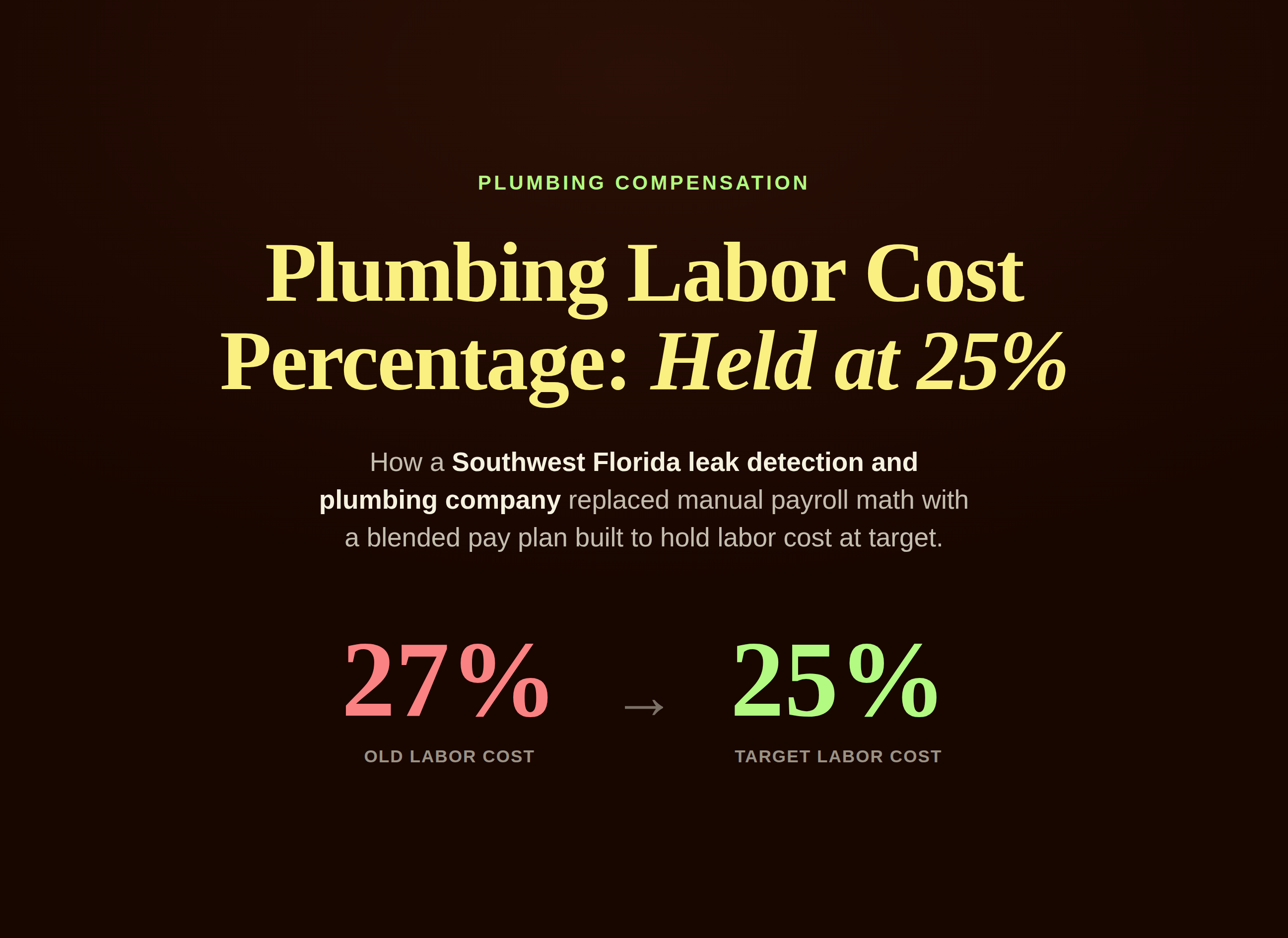
A residential property management company's payroll pipeline started double-syncing the same billing records, briefly inflating one technician's hours from roughly 1.7 to 137.49, an 80x error that surfaced the same week the billing coordinator was out. Here is how a same-day repull-and-resync habit, a source-level fix to a parts-versus-labor mixup, and a standing technician huddle brought the numbers back in line overnight, and kept them there.
Picture a residential property management company that runs its own in-house maintenance and repair team: the leaky faucets, the broken AC units, the after-hours plumbing calls that come with managing a portfolio of rental properties. The crew is lean, the properties are real, and every hour a technician logs against a work order eventually has to reconcile with what payroll actually pays out. Most pay periods, that reconciliation is routine. This one wasn't.
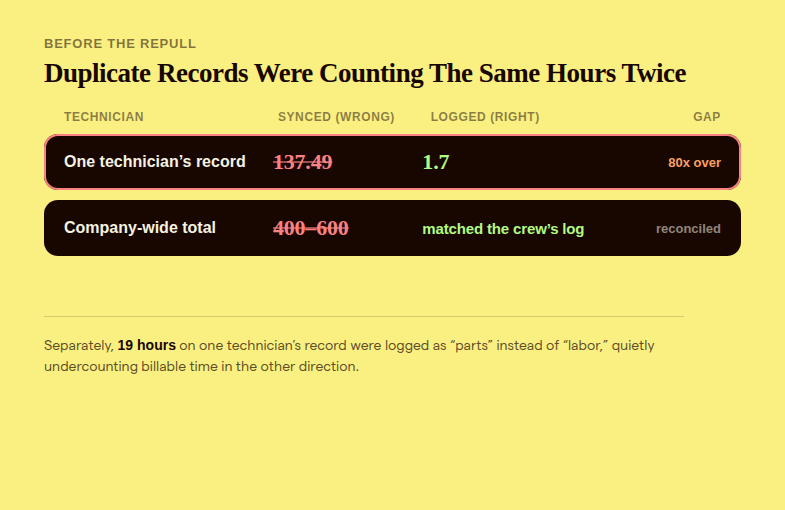
The trouble started quietly, the way data bugs usually do. Somewhere in the pipeline that pulls billing and labor data from the company's field service records into its incentive pay calculations, the same records started getting synced more than once. Not obviously, not with an error message anyone would notice, just a double-count that crept into the numbers a little at a time until the totals stopped making sense. By the time anyone looked closely, one technician's hours for the pay period were showing as 137.49, a number that, on its face, looked like someone had been putting in double shifts every day of the month. What he had actually logged for that period was roughly 1.7 hours. The synced number was inflating his real time by nearly 80 times.
Multiply that kind of error across a whole crew and the math stops being a rounding error and starts being a real problem. Company-wide, the month's total hours spiked into the 400-to-600 range, a figure that bore no resemblance to what the crew had actually clocked. For a business running any kind of hours-based profit-sharing plan, numbers like that don't just look wrong, they threaten to pay out real dollars against work that got counted once and billed as if it happened five times over.
The timing made it worse. The week the inflated numbers surfaced was the same week the company's regular billing coordinator, the person who normally catches this kind of thing before it becomes a fire drill, happened to be out. That left the property manager himself running point on reconciling the numbers, comparing what the system said against what he knew, from experience and from talking to his crew, had actually happened on the ground. For a company running a home services operation with real payroll deadlines, that's not a comfortable position to be in a day or two before checks are supposed to go out.
What made the diagnosis harder was that the sync bug wasn't the only thing wrong with the numbers, it was just the loudest one. Running in the opposite direction, quietly and separately, was a classification problem: technicians were inconsistently marking billed work as "parts" instead of "labor" on the underlying job records. Every time that happened, the hours behind that work fell out of the labor total entirely, undercounting billable time instead of inflating it. One technician alone had 19 hours misclassified this way on a single record, hours that had genuinely been worked and billed but that the labor report never saw. So the property manager wasn't reconciling one clean error. He was reconciling a system that was simultaneously overcounting in one place and undercounting in another, with no obvious way to tell, at a glance, which number to trust.
When Duplicate Records Start Compounding
The root cause, once it was traced, was almost mundane: the same underlying records were getting pulled and synced into the payroll pipeline more than once. Each duplicate pass added its hours on top of the last, so a technician's real, modest shift of an hour and change could balloon into triple digits without a single new hour actually being worked. It's the kind of failure that's easy to miss in the moment, because nothing throws an error and nothing crashes. The numbers just quietly stop matching reality, one duplicate sync at a time, until someone with a reason to check the totals against what they know is true actually looks.
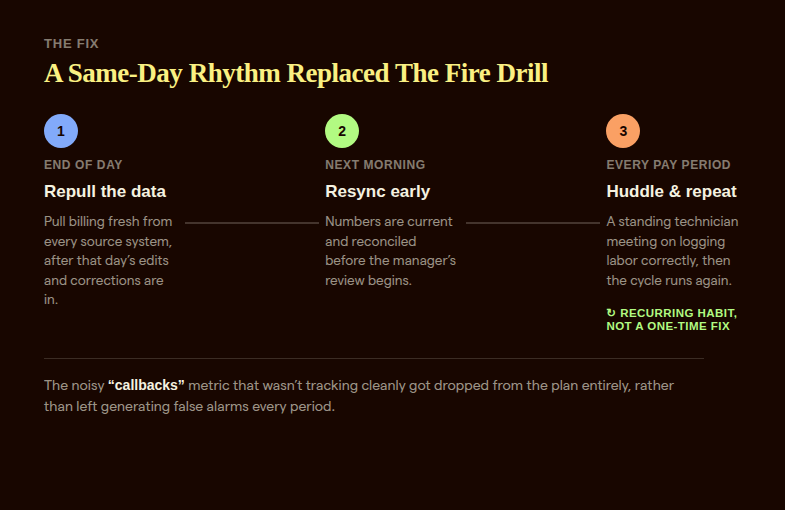
Untangling a mess like this called for more than a one-time correction. If duplicate syncs had crept into the pipeline once, there was nothing stopping them from doing it again next pay period, and a business running an incentive pay plan off of these numbers needs more than a lucky catch every few months. The fix that got built was a rhythm, not a patch: pull the billing data fresh from every source system at the end of each day, after that day's edits and corrections were already in, then resync it again early the next morning so the numbers were current and reconciled before anyone sat down to review them.
The logic behind the timing matters. Pulling data at the end of the day means the pull happens after technicians have closed out their tickets and any same-day corrections have already landed, so the raw numbers going into the system are as clean as that day's work allows. Resyncing early the next morning, rather than leaving the pull to simply sit there overnight, means that by the time the property manager sits down to review the numbers, the report reflects the freshest possible version of reality instead of a snapshot from whenever the last sync happened to run. It's a small structural change, repull at end of day, resync first thing the next morning, but it closes the exact gap that let duplicate records compound unnoticed in the first place.
Fixing What the Sync Bug Didn't Cause
There's a reason the fix took the shape of a repeatable rhythm instead of a one-off correction pushed out on a Friday afternoon. A lean crew and a property manager who's already wearing several hats don't have room for a fix that only works once. Building the repull-and-resync habit into the actual weekly workflow, rather than treating it as a cleanup project to revisit if the numbers ever look strange again, means the next duplicate-record glitch gets caught the same overnight cycle it happens, instead of festering for a full pay period before anyone notices. That's the real value of turning a fix into a habit: it doesn't rely on someone happening to look closely at the right moment.
The duplicate-sync problem and the parts-versus-labor misclassification needed two different fixes, because they were two different problems wearing the same "the numbers are wrong" costume. The repull-and-resync rhythm addressed the duplication. The misclassified record, the one where 19 hours of genuinely billed labor had been logged as parts, got corrected directly at the source, in the underlying job record, so the fix would flow through cleanly on the very next pull instead of requiring a manual patch every pay period going forward.
Not every metric on the plan survived the cleanup. A "callbacks" metric that had been part of the plan wasn't tracking cleanly, generating noise more than signal, and rather than leave it in and hope the tracking improved on its own, the team pulled it from the plan entirely. That's a small decision, but it says something about the underlying philosophy here: a metric that can't be trusted is worse than no metric at all, because it either erodes confidence in the whole plan or, worse, quietly pays out or withholds money based on numbers nobody can actually stand behind.
The last piece of the fix wasn't technical at all. The team held a meeting with the technicians themselves to walk through exactly how billed work should be logged going forward, parts versus labor, what belongs where, and why the distinction needs to get made correctly at the point of entry rather than caught and corrected after the fact. That's the piece that keeps the same misclassification pattern from quietly recurring every pay period. A repull-and-resync habit fixes the pipeline. A technician who understands why the parts-versus-labor line matters fixes the input going into that pipeline in the first place, which is the only way to actually stop refighting the same fire every month.
Profit sharing
made simple.
Give your team a stake in the company’s success. ShareWillow helps you create and manage profit-sharing programs that motivate employees and drive business results.
Numbers That Finally Matched
The proof that the fix worked showed up within a single overnight cycle. After the first end-of-day repull and next-morning resync, the wildly inflated numbers came back in line with what the crew had actually logged, and they stayed there. The clearest evidence wasn't just that the totals looked reasonable again, it was how closely two independently run counts agreed with each other once the pipeline was fixed. For one technician, one count came out to 107.93 hours and a separately run count came out to 106.86, a gap under one hour and well under one percent. That kind of agreement between two independent methods is about as strong a signal as a property manager can get that the underlying data, not just the report sitting on top of it, is finally trustworthy.
That distinction matters more than it might seem. A single count that looks reasonable can still be wrong in a way that's internally consistent, wrong for a reason nobody's caught yet. Two independently run counts landing within an hour of each other, technician after technician, is a much harder thing to fake or accidentally stumble into. It's the kind of check that separates "the numbers look fine" from "the numbers are actually right," and for a company about to run payroll or fund a bonus pool off those numbers, that's the distinction that actually matters.
What replaced the fire drill wasn't a single fix, it was a habit. The end-of-day repull and next-morning resync became a recurring rhythm rather than a one-time correction, and the technician huddle on how to log labor correctly became a standing meeting rather than a single conversation after a problem surfaced. A follow-up operations review is already booked for the first week of next month, specifically to keep checking that the numbers stay honest rather than assuming that one clean pay period means the problem is permanently solved.
What This Means If You Run Your Own Crew
Facility managers and property operators who run an in-house maintenance team, rather than outsourcing every repair to a third-party vendor, carry a specific kind of exposure that a lot of field service businesses don't have to think about in quite the same way: the same technician is often logging time against a work order, a billing system, and a payroll or incentive calculation all at once, and any one of those systems can drift out of sync with the others without anyone noticing until a number looks obviously, almost comically wrong. An 80x inflation is loud enough to catch. A quieter version of the same bug, a 10 percent overcount here, a slow undercount there, can run for months against a real bonus pool before anyone thinks to check two counts against each other.
The practical takeaway isn't complicated, even if it's easy to skip when everything seems to be running fine. Pull the data fresh, close to when it actually needs to be reviewed, rather than trusting a stale sync from days earlier. Resync it again before anyone acts on it. Watch for technicians logging billed work under the wrong category, since a mistake in either direction, counting something twice or missing it entirely, moves real money for home services teams as much as it does for anyone else. And if a metric on your incentive plan isn't tracking cleanly, don't leave it running out of inertia. Pull it, the way this company pulled callbacks, rather than let it quietly generate noise that erodes trust in every other number on the plan.
None of this requires exotic tooling. It requires treating payroll and incentive data with the same skepticism a good technician brings to a diagnostic call: check it, then check it again, and don't assume last week's numbers are still true today. If you're running your own maintenance or repair crew and haven't looked closely at how your billing data actually reconciles with what gets paid out, this is as good a prompt as any to go run that check before a number like 137.49 shows up on someone's payroll report and nobody around the table can explain why.
Related reading
Conclusion
A duplicate-record sync bug once inflated one technician's hours by nearly 80 times, from about 1.7 hours to 137.49, and pushed the company's total hours into the 400 to 600 range before anyone caught it. A same-day repull-and-resync rhythm, a source-level fix to a parts-versus-labor misclassification, and a recurring technician huddle brought the numbers back in line within a single overnight cycle. The clearest proof came from two independently run counts landing within about an hour of each other per technician, a gap under one percent, with a follow-up operations review already booked to keep the numbers honest going forward.
Create incentives
that
drive results
You shouldn't need complex equity plans to align your team. ShareWillow makes it simple to create transparent profit-sharing programs that motivate employees and grow your business.

Incentive plans to help
small businesses thrive.
.png)
"I was able to leverage the knowledge of the ShareWillow team to learn how other companies were designing their bonus plans. The template was extremely helpful."

Brian Tustin
Owner, First Rate Movers