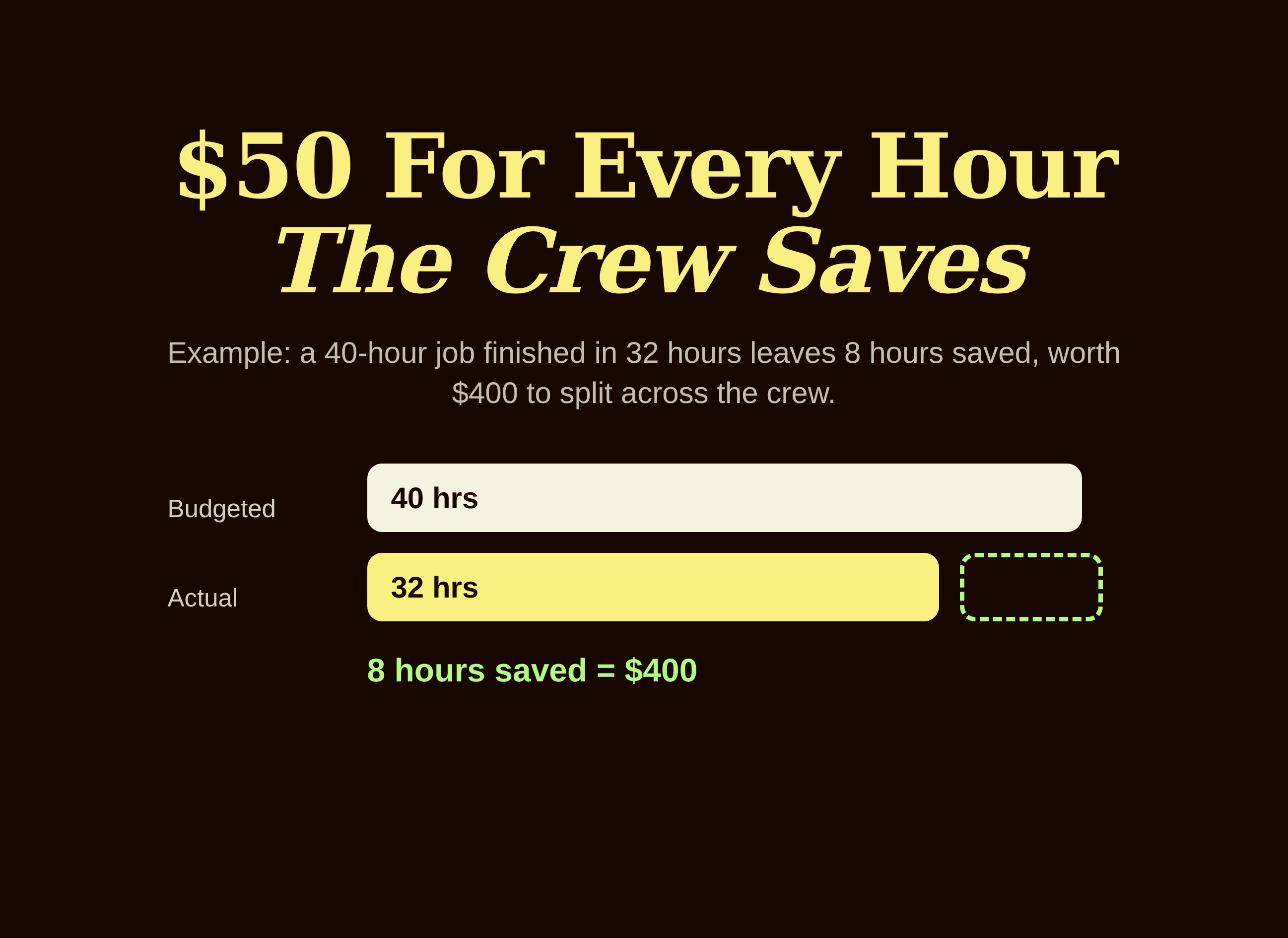
A radon mitigation crew turned its labor budget into the bonus pool, closing a ten-point gap between target and actual labor cost, one job at a time.
Most owners in home services can tell you their revenue for the month without opening a report. Fewer can tell you what a single job actually cost in labor once it was done, versus what it was supposed to cost when it was scheduled. That gap between budgeted labor and actual labor is where margin quietly disappears, and it is almost never visible until someone builds a system that makes it visible on purpose.
A radon mitigation and home environmental services company ran into exactly that gap this year. It is a small, owner-operated business, the kind where the owner still knows every crew chief by name and still reviews jobs personally when something looks off. For a long time, that hands-on style was enough to keep things running. But as the company grew, direct labor crept up to 30 percent of revenue, well past the 20 percent target the owner had in mind, and there was no system in place to explain why, job by job, that gap existed.
The number nobody could see until it was already spent
Crew chiefs were salaried, working fixed hours with no incentive tied to how efficiently a job actually ran. A crew that finished early and a crew that ran long cost the same amount on paper, which meant there was no built-in reward for speed or skill, and no real penalty for a job that dragged. Field technicians clocked their status through a phone app, tapping between "on my way" and "start job," but those taps were inconsistent enough that the owner could not reliably reconstruct how many labor hours a specific job had actually consumed. Multiply that uncertainty across a full month of jobs, and a ten-point gap between target and actual labor cost becomes something you can feel in the bank account but cannot point to on a spreadsheet.
This is a common trap for owner-operated home service companies: the person running the business is close enough to the work to sense when something is off, but too stretched to build the tracking system that would prove it. Revenue numbers get watched closely because they show up automatically in accounting software. Labor cost per job, the number that actually determines whether a job was profitable, often lives nowhere except a technician's memory of how long the truck was parked in the driveway.
It is worth pausing on why this particular gap is so easy to miss. Revenue is a single number that lands in a bank account and gets reconciled automatically, so it gets attention almost by default. Labor cost per job requires someone to multiply hours by wage, per technician, per job, and then compare that number against what the job was quoted to cost. Nobody does that math by hand across a full month of jobs unless they have a specific reason to, and by the time a slow leak in labor efficiency shows up in the company's overall margin, it has usually been running for months. The radon company's ten-point gap between a 20 percent target and a 30 percent actual did not appear overnight. It accumulated one inconsistent phone-app status tap and one slightly-too-long job at a time, invisible in isolation and expensive in aggregate.
Turning the labor budget into the bonus pool
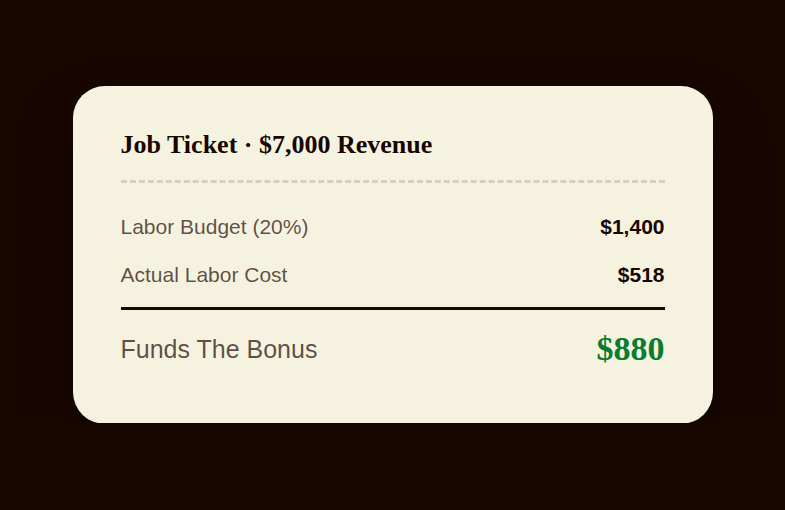
The fix started with a simple reframe: instead of treating labor cost as an expense to control after the fact, the company built it into a job-costing incentive plan where the budget itself becomes the source of the bonus. Every job now carries a labor budget set at 20 percent of that job's revenue. When actual labor comes in under that budget, the difference funds a piece-rate bonus for the techs who did the work. When it does not, there is no bonus to pay out, and the shortfall is visible immediately instead of getting absorbed into a monthly average nobody looks at closely.
A real example from the rollout makes the mechanism concrete: a $7,000 job carried a $1,400 labor budget under the 20 percent rule. The crew actually completed it for $518 in labor, an $880 swing between what was budgeted and what was spent. That $880 did not just disappear back into general revenue. It became available to fund bonus payouts for the technicians who ran the job efficiently, which means the incentive is directly and visibly tied to the thing the owner actually wants more of: jobs that come in under budget without cutting corners.
The crew chief role changed alongside the field bonus. Instead of a flat salary with no upside, crew chiefs moved to a capped monthly bonus, up to $400, gated on hitting at least an 80 percent "efficient" job rate across everything their crew ran that month. That cap matters as much as the target does. An uncapped bonus tied to efficiency can quietly push a crew chief to cut corners on quality to hit the number. A capped bonus gives a crew chief a clear, achievable target without turning speed into the only thing that matters.
The 80 percent threshold does real work here too. It is deliberately not 100 percent, because a hard requirement that every single job come in under budget would punish a crew chief for one unusually difficult job in an otherwise strong month, the kind of job that takes longer because a customer's crawl space is harder to access or an install turns up an unexpected complication. Setting the bar at 80 percent gives a crew chief room to have a genuinely hard job without losing the entire bonus over it, while still requiring the clear majority of jobs to run efficiently. That kind of threshold design, generous enough to survive real-world variance but strict enough to still mean something, is usually the difference between an incentive plan that motivates people and one that quietly gets resented within a few pay periods.
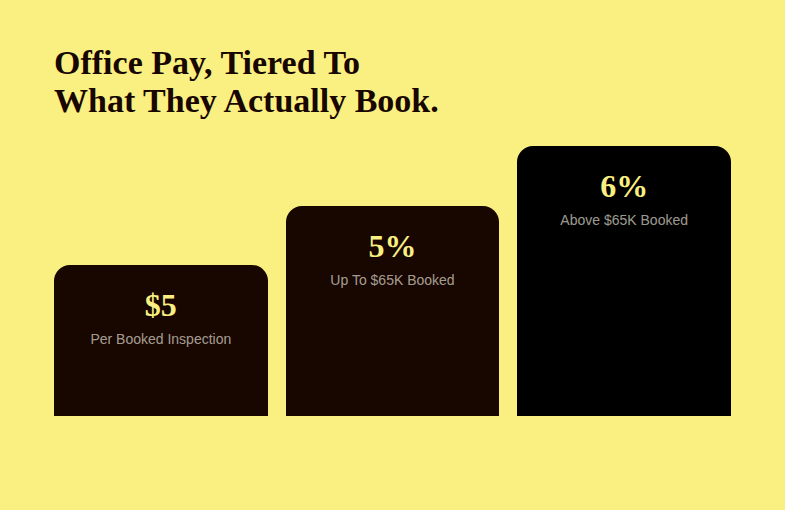
The office side of the business got its own version of the same logic. Phone sales staff moved onto a commission structure paying 5 percent on booked revenue up to $65,000 a month, and 6 percent above that, plus a flat $5 for every booked inspection regardless of whether it converted into a full job. That flat per-inspection piece matters more than it looks like on paper. It rewards the office team for generating pipeline, not just for closing revenue, which keeps the phone team motivated to book appointments even during a slower stretch when close rates dip for reasons outside their control.
What the plan is actually built to prove
The explicit target is closing that ten-point gap, moving direct labor from 30 percent of revenue back down toward the original 20 percent goal. That is a meaningful swing for a services business where labor is usually the single largest controllable cost. A ten-point improvement in labor-as-percent-of-revenue on a company doing even modest annual revenue translates into real dollars flowing to the bottom line instead of leaking out through jobs nobody was tracking closely enough.
What makes this approach different from a generic "work faster" push is that it does not ask anyone to guess what efficient looks like. The 20 percent labor budget on every job gives crews a specific number to beat, visible at the job level rather than buried in a monthly report two weeks after the fact. A technician finishing a job under budget can see, in near real time, that the difference funded part of their next paycheck. That kind of immediate, visible connection between effort and pay is usually the missing piece in home service companies that already have good technicians but no system translating their good work into predictable bonus dollars.
Building the same system in your own shop
You do not need a radon mitigation business or a specific software platform to apply the same logic. The underlying framework works for home services companies broadly, from HVAC to electrical to any trade where a crew's time is the main cost driver on every job:
- Set a labor budget as a percentage of revenue for every job type you run, not just an average across the whole month.
- Track actual labor hours against that budget at the job level, not the payroll-period level, so nothing gets averaged away.
- Fund a bonus pool directly from the gap between budgeted and actual labor, so the incentive is tied to real savings rather than an arbitrary number picked by ownership.
- Cap any efficiency-based bonus so speed never becomes more important than doing the job right the first time.
- Give office and sales roles their own incentive tied to pipeline, not just closed revenue, so their motivation does not evaporate during a slow booking week.
The incentive pay platform ShareWillow built for this company handles the job-level tracking automatically, pulling from the same field data technicians already generate instead of requiring a separate manual log. But the underlying idea does not require new software to start testing. Any owner who can pull job-level revenue and rough labor hours can build a version of this on a spreadsheet for a single crew, see whether the incentive changes behavior, and then formalize it once it proves out.
The company's own before-and-after captures why this kind of system tends to outperform a vague "let's be more efficient" directive: a crew chief on a flat salary has no reason to notice an $880 swing on a single job. A crew chief with 80 percent of a monthly bonus riding on efficiency notices every one of them.
Profit sharing
made simple.
Give your team a stake in the company’s success. ShareWillow helps you create and manage profit-sharing programs that motivate employees and drive business results.
Why office incentives usually get built last, and shouldn't
It is tempting to treat the field crew as the whole story here, since they are the ones physically doing the work that either comes in under budget or does not. But the office team's incentive redesign is arguably the more transferable lesson for a broader range of businesses, including plenty that have nothing to do with radon mitigation. Phone staff and CSRs are usually the last group in a home services company to get any kind of performance-based pay, often because ownership assumes booking calls is a fixed-effort task that does not vary much person to person. In practice, the difference between an average phone rep and a strong one, measured in booked revenue per month, is often larger than the difference between an average technician and a strong one.
The tiered commission structure here, 5 percent up to $65,000 booked per month and 6 percent above that, does two things at once. It gives the office team a straightforward number to chase, and it rewards the highest performers slightly more once they clear a meaningful monthly threshold, without requiring a complicated multi-tier ladder that nobody can do the math on in their head. The flat $5 per booked inspection sitting underneath that structure protects against a specific failure mode: a slow month where fewer calls convert into paid jobs for reasons entirely outside anyone's control, like a seasonal dip or a run of price-sensitive callers. Without that flat per-inspection piece, a phone rep working just as hard during a slow month would see their incentive pay collapse for reasons that have nothing to do with their actual effort, which is exactly the kind of disconnect that makes an incentive plan feel unfair rather than motivating.
Put together, the field and office pieces of this plan share the same underlying philosophy: pay should track something the person receiving it can actually see and influence, at a frequency close enough to the work that the connection stays obvious. A technician sees the $880 swing on the job they just finished. A crew chief sees their efficiency rate accumulate job by job across the month. A phone rep sees their booked total climb call by call. None of those signals require waiting for a quarterly report or trusting an owner's word that things are going well. The number is right there, and it is the same number the incentive pay is calculated from.
Related reading
- The Restoration Crew Chasing a $200-an-Hour Labor Target to Cut Costs From 30% of Revenue Toward 20%
- How a Restoration Company Replaced Color-Coded Spreadsheets With One Automated Bonus Plan
- HVAC Profit Margins 101: Benchmarks and Proven Ways to Boost Your Bottom Line
- Companies with Profit Sharing: Who They Are & What They Offer
Conclusion
When the labor budget becomes the bonus pool, efficiency stops being a suggestion.
Create incentives
that
drive results
You shouldn't need complex equity plans to align your team. ShareWillow makes it simple to create transparent profit-sharing programs that motivate employees and grow your business.

Incentive plans to help
small businesses thrive.
.png)
"I was able to leverage the knowledge of the ShareWillow team to learn how other companies were designing their bonus plans. The template was extremely helpful."

Brian Tustin
Owner, First Rate Movers