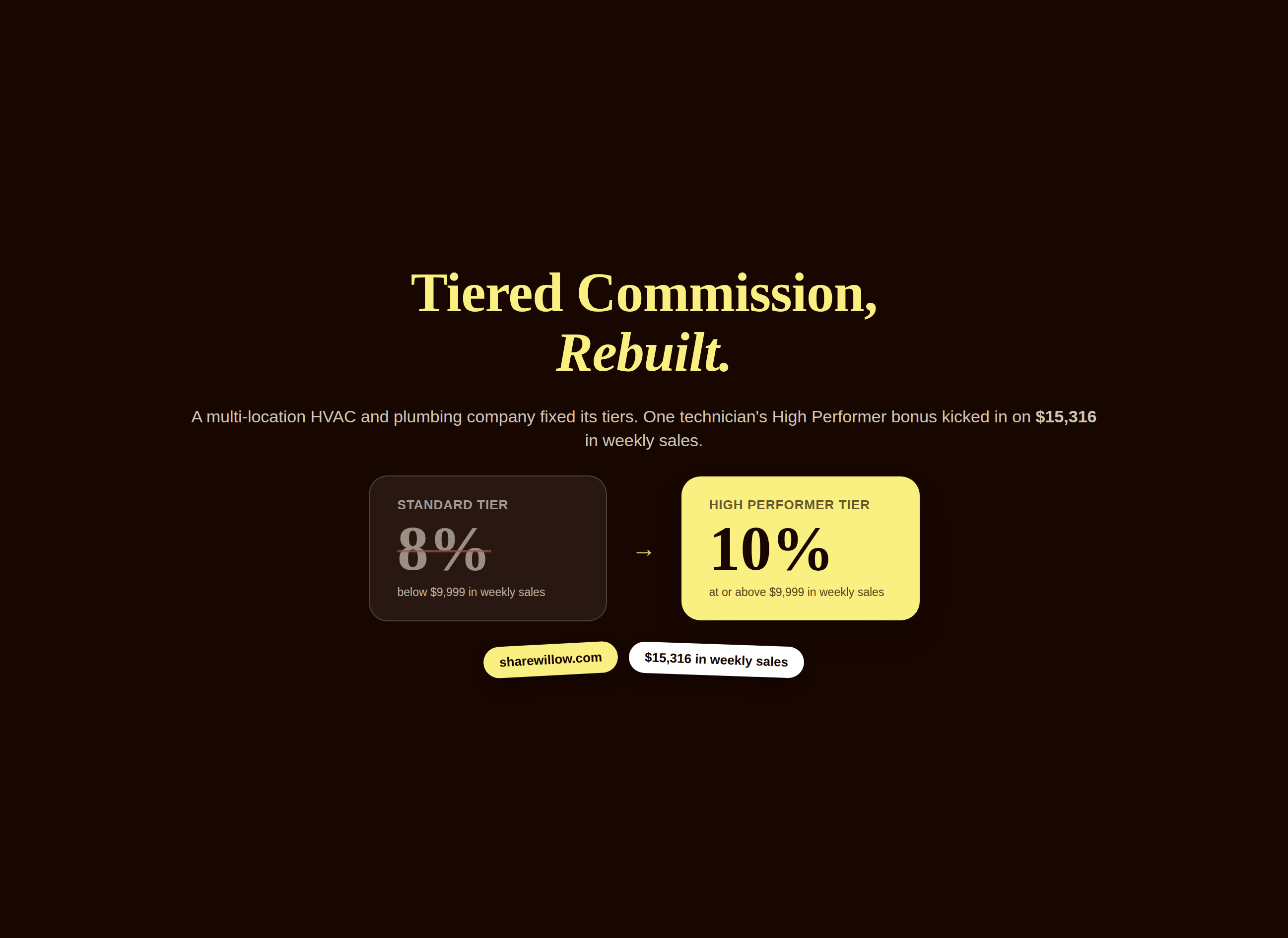
A 5-person mold remediation and restoration crew in Colorado was running direct labor at 30% of revenue against a 20% target, with a salaried crew chief earning the same bonus regardless of how efficiently a job ran. A labor-budget bonus tied to billed hours is closing that gap one pay period at a time.
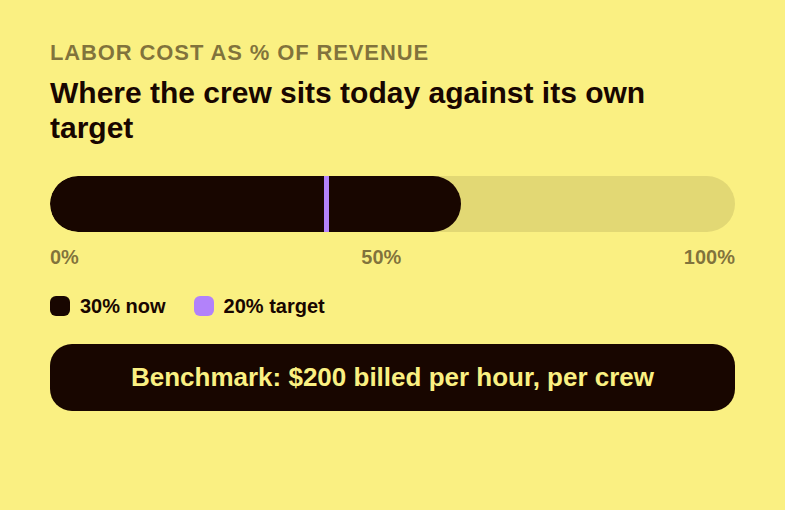
A five-person mold remediation and restoration crew in Colorado had a labor cost problem that was easy to describe and, for a while, hard to actually see clearly enough to fix. Direct labor was running at roughly 30% of revenue, against a target of 20%. That ten-point gap is not a rounding error. On a business this size, it is the difference between a comfortable margin and one that leaves almost nothing left over once materials, overhead, and everything else gets paid.
The harder problem sitting underneath that number was structural. The crew chief responsible for running jobs was salaried, working a fixed schedule, with no per-job incentive attached to how efficiently any given job actually went. A job that took six hours paid the crew chief the same as a job that should have taken six but took nine, because the salary did not know the difference. There was no defined per-job labor budget in the first place, which meant nobody, not the crew chief, not the owner, had a clean number in front of them while a job was running to know whether it was on track or quietly burning through the margin. Cost versus profit on any individual job was something you found out after the fact, if at all, not something anyone could see and react to while the work was happening.
That combination, a flat salary with zero connection to job efficiency, and no real-time labor budget to measure against, is exactly the kind of setup that lets a labor-cost problem grow slowly and invisibly until someone finally sits down and calculates the percentage across a stretch of jobs and realizes it has drifted ten points higher than it should be.
Why "Just Tell the Crew Chief to Work Faster" Was Never Going to Work
It is tempting to treat a labor-cost problem like this as a management conversation: sit the crew chief down, explain the target, ask them to be more efficient going forward. That approach fails for a simple reason. A salaried crew chief with no per-job incentive has no mechanism connecting a faster, cleaner job to anything that shows up in their own paycheck. Asking someone to change behavior with no corresponding change in how they are paid is asking for a temporary bump in effort at best, not a durable shift in how jobs get run day after day.
What the labor cost target actually needed was a number the crew chief could see and chase on every single job, tied to real money, not a policy reminder that fades within a few weeks of being said out loud.
A Revenue-Per-Hour Target Built Into the Pay, Not Bolted On After
ShareWillow built the plan around a specific labor-rate benchmark: $200 in billed revenue per hour, per crew, calibrated to hit the 20% labor-cost target directly. Field technicians earn piece-rate bonuses tied to clearing that revenue-per-hour threshold, so the incentive to work efficiently is attached to the same number the business actually needs to move. The salaried crew chief role got a monthly bonus pool, capped at $400, with eligibility gated at technicians classifying 80% or more of jobs as efficient. That eligibility gate matters just as much as the bonus cap: it means the crew chief's bonus depends on the crew's efficiency broadly, not on a single favorable job dragging the average up.
On the office and sales side, the plan added commission tiers of 5% up to $65,000 a month and 6% above that threshold, plus a flat $5 per booked inspection, so the incentive structure reaches beyond the field crew into the people generating the work in the first place. A labor-budget incentive that only touches the technicians misses half the equation. Getting more efficient jobs in the door does not help the labor-cost percentage if the pipeline behind those jobs is not also being rewarded for keeping the schedule full.
Why the Crew Chief's Cap Matters as Much as the Field Bonus
The $400 monthly cap on the crew chief's bonus is a small number relative to a salary, and that is intentional. The point of this particular bonus is not to replace a meaningful share of the crew chief's income. It is to attach a real, felt consequence to the efficiency of the crew they are running, without restructuring their entire compensation around a metric that is still being refined. The 80% efficient-job threshold gating that bonus does the actual work here: it means the crew chief cannot hit their number by having one or two jobs run unusually well while the rest of the crew's work stays inefficient. The bar is set across the whole crew's output, which is exactly where a crew chief's actual influence sits.
This is a useful pattern for any small business nervous about layering a bonus onto a role that is used to a flat salary. Start with a cap modest enough that the person is not suddenly gambling their household budget on a new and unfamiliar metric, gate it on a threshold broad enough that gaming a single job does not work, and let the number grow over time as trust in the underlying data grows alongside it. A crew chief bonus that started at a much larger, more aggressive number would have created more anxiety than motivation in the first few months, before the time-tracking habits and job-efficiency data underneath it had a chance to stabilize.
Why the Office and Sales Commission Tiers Belong in the Same Plan
It would have been simple to build this as a field-only incentive plan and stop there. That would have missed something important: a restoration and mold remediation business's labor-cost percentage is a function of both sides of the business, how efficiently jobs get done and how consistently the pipeline of jobs stays full enough to keep a crew's schedule dense rather than patchy. A crew sitting half-idle between jobs looks inefficient in the labor-cost math even if every job they do run is handled perfectly, simply because fixed costs get spread across fewer billed hours.
The 5% commission up to $65,000 a month, stepping to 6% above that, plus the flat $5 per booked inspection, gives the office and sales side a direct stake in keeping that pipeline full and growing rather than treating booking as a task disconnected from the labor-cost goal the field crew is being measured against. A tiered commission that increases past a monthly threshold also does something specific: it rewards pushing past a plateau rather than coasting once a comfortable baseline is hit, which matters for a small business where a single strong month of bookings can meaningfully change the crew's schedule density for the following month.
What the Early Payout Data Actually Shows, Including the Parts That Aren't a Clean Win Yet
It would be easy to write this story as a straightforward before-and-after. It would also be dishonest. Confirmed biweekly crew bonus payouts across roughly six pay periods came to about $1,749.69 total for the two-person field crew tracked, and the trend across those periods actually declined, from roughly $484 in an early period down to about $6.43 in the most recent period sampled. That is worth sitting with rather than glossing over.
Part of the explanation traces back to the operational review conducted partway through the plan's early run, which flagged that time-tracking discipline was still being trained during this exact window. Technicians were still working through confusion between different time-logging methods and missing the "finish" tap that closes out a job's tracked time correctly. Incomplete or inconsistent time data narrows the labor-savings pool available to fund the bonus, which is a very different problem than the crew simply becoming less efficient. A bonus plan built around billed-hour efficiency is only as accurate as the underlying time data feeding it, and a crew still learning a new time-tracking workflow will show noisier, lower numbers for a stretch before the habit solidifies.
The honest framing here matters. The 20% labor-cost target is the company's own stated goal from its operational review, and the $200-per-hour benchmark is the mechanism built to reach it. Neither is a claim that the goal has already been achieved. What the plan has done, concretely and verifiably, is put a real number in front of the crew chief and the field techs that did not exist before, tied to actual bonus dollars, while the time-tracking foundation underneath that number is still being reinforced. That is a meaningfully different, and more honest, story than claiming a ten-point margin improvement that the data does not yet support.
Why Tracking the Rough Patch Matters More Than Hiding It
A lot of incentive-plan case studies skip straight from "here is the problem" to "here is the win," and skip past the messy middle where a new plan runs into exactly the kind of friction this one did. That middle stretch is not a failure of the plan. It is what adopting any new operational system inside a real, still-running business actually looks like. Technicians learning a new time-tracking habit while jobs keep coming in, a crew chief adjusting to a bonus structure that did not exist a few months earlier, an owner watching a number that has not moved as quickly as hoped yet: none of that is unusual, and none of it means the underlying design is wrong.
What it does mean is that a labor-cost incentive plan needs accurate time data to function at all, which is a lesson worth internalizing before rolling one out rather than after. If technicians are not consistently and correctly starting and stopping time tracking on every job, the revenue-per-hour number the entire plan is built around will be unreliable no matter how well-designed the bonus tiers underneath it are. Getting that foundational habit solid is not a footnote to the incentive plan. For a business this size, it may be the actual prerequisite the whole plan depends on.
What Other Small Crews Watching Their Labor Percentage Should Take From This
If your own labor cost as a percentage of revenue has crept higher than you would like, and the person responsible for running jobs efficiently is on a flat salary with no connection between their pay and how tightly any given job actually runs, that disconnect is very likely a meaningful part of the problem, not just a symptom of it. The fix is not a stricter conversation about efficiency. It is a real per-job or per-hour benchmark, tied to actual pay, for the person and the crew closest to the work.
It is also worth taking the messier half of this story seriously rather than skipping past it. A revenue-per-hour or labor-budget incentive plan is only as good as the time and job data underneath it, and if your team does not yet have a clean, consistent way of tracking time against each job, that is the place to start, before layering a bonus structure on top of data nobody is confident in yet. For a restoration or remediation business watching its own labor percentage creep in the wrong direction, the sequence that matters is: get the time data trustworthy first, then build the incentive on top of it, the way one HVAC team fixed its own labor cost problem without losing the technicians it depended on. Skip that order and even a well-designed bonus plan will spend its first several pay cycles fighting bad data instead of rewarding good work.
Profit sharing
made simple.
Give your team a stake in the company’s success. ShareWillow helps you create and manage profit-sharing programs that motivate employees and drive business results.
Related reading
Conclusion
Replacing a flat salary with a labor-budget bonus tied to a $200-per-billed-hour target gave this restoration crew a real number to chase toward its 20% labor-cost goal, and gave its crew chief a reason to care how efficiently every job actually runs.
Create incentives
that
drive results
You shouldn't need complex equity plans to align your team. ShareWillow makes it simple to create transparent profit-sharing programs that motivate employees and grow your business.

Incentive plans to help
small businesses thrive.
.png)
"I was able to leverage the knowledge of the ShareWillow team to learn how other companies were designing their bonus plans. The template was extremely helpful."

Brian Tustin
Owner, First Rate Movers