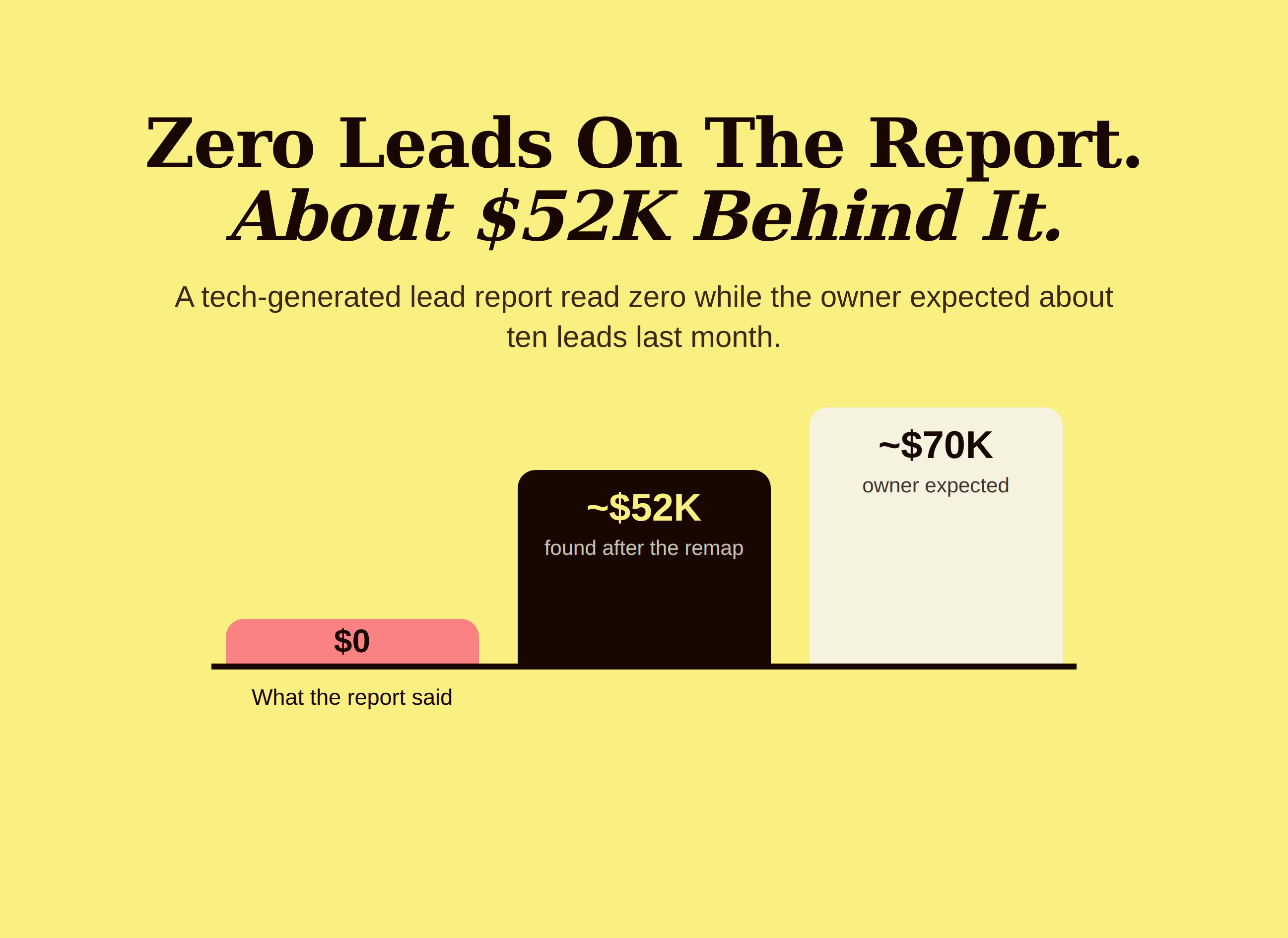
A crew bonus plan that pays $50 per hour saved, gated by daily logs and zero callbacks. See how an outdoor living company is building it on JobTread.
A crew bonus plan starts with one question: how long should this job take?
A good crew bonus plan answers a simple question before anyone swings a hammer: how many hours should this job take? Once you have that number, you can pay the crew for beating it. The catch is that most small contractors never write the number down in a form the payroll system can read, and that is where a lot of well-meant bonus ideas stall.
An outdoor living company with three field crews is working through exactly this right now. The owners want crews that finish jobs efficiently and document their work, and they want to understand true labor cost and overhead on every project. Their field teams are small, two or three people each, and they run their jobs on JobTread. This post walks through the plan they settled on, the gates they added so it cannot be gamed, and the data gaps they hit on the first review. The plan is still being validated, so this is a look at the design work, not a victory lap.
The plan: $50 for every hour the crew saves
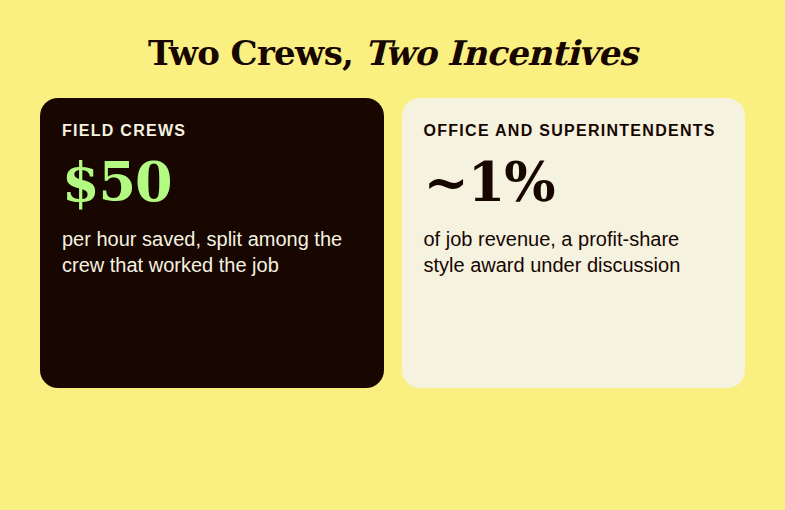
The structure they chose for field workers is a fixed award based on hours saved. Each completed job has a budgeted number of labor hours from the bid. If the crew finishes in fewer hours than budgeted, the company pays $50 for each hour saved, split among the crew that worked the job.
Here is the math on an example job. Say a patio build is budgeted at 40 labor hours and the crew finishes it in 32. That leaves 8 hours saved, so the award is $400. A three-person crew splits that into roughly $133 each. A two-person crew would take $200 apiece. The crew can see the reward in plain dollars, and the company only pays when it has already banked the labor it would have spent.
The flat dollar figure is deliberate. A percentage of job revenue rewards the crew for selling bigger projects, which they do not control. A fixed rate per hour saved rewards the one thing they do control: how efficiently they work. We compared this kind of approach with other designs in our guide to bonus structure examples, and the labor-saved model fits field crews well because the target is concrete and visible on the job.
The office side gets a different structure. For superintendents and office staff, the company discussed a profit-share style award of about 1% of job revenue. On a $30,000 job, that would be $300. It is not final, and it makes sense: the people who schedule, order, and coordinate do not log hours on site, so a revenue-linked share rewards the outcome they influence.
Three gates before any award is paid
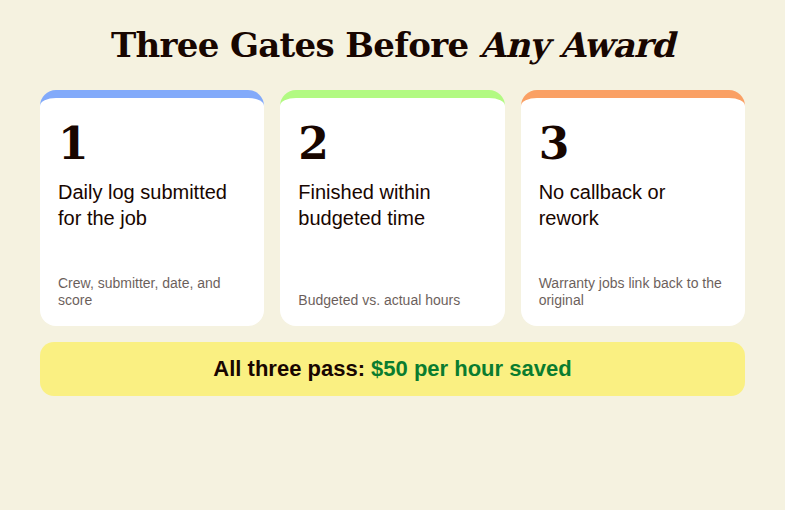
A bonus that only checks hours will quietly reward rushed work. To protect quality, the company set three conditions that every job must meet before the award pays out:
- A submitted daily log. The log captures the date, the crew or subcontractors on site, who submitted it, a score, and file uploads. It also tells the system which crew worked the job, which is how the award gets split correctly.
- Completion within the budgeted time. This is the hours-saved test itself.
- No callback or rework. A job that comes back as a warranty visit does not qualify.
Together these turn a simple hours bonus into a quality-and-documentation bonus. The crew that finishes early but skips the daily log earns nothing, and so does the crew that finishes early and leaves a punch-list item the homeowner has to call about. If you want to see how a similar trio of rules keeps incentives honest, our story on two install crews with a 20% productivity gap shows what happens when the clock, not opinion, decides who is ahead.
What the first data review exposed
The design was the easy part. The first review of the real data surfaced three gaps, and each one is common enough that you should check for it before you launch your own crew bonus plan.
Budgeted hours were blank. Labor estimates live in the bids as crew-rate line items, but those hours were not flowing into the field that the report compares against actual hours. A bonus based on hours saved cannot run without the budget side of the equation. The company is now checking how its labor catalog items, manual labor entries, and scheduling map into budgeted hours, and it will not set a go-live date until an example week reconciles.
Actual hours are entered by hand. The crews punch in and out through a time clock with GPS boundaries, but it tracks the employee, not the job. Actual job hours are keyed in from timesheets, which means a crew that forgets to clock in understates its hours and overstates its savings. The company plans manual review in the meantime. Any plan that pays for time saved is only as strong as the time record underneath it. For a different way to tie crew pay to labor, see our roofing company labor-rate story.
Callbacks have no native home. JobTread does not have a warranty or callback workflow, and a closed job cannot be reopened cleanly. So the company creates a new job with the word warranty in the name. ShareWillow can then find those jobs, link each one to the customer's most recent completed job, and mark the original as a callback. It is a workaround, but a consistent naming rule is all the plan needs.
One more limit is worth naming. Photo uploads sit behind a general upload function at the bottom of the daily log, and they cannot be reported reliably yet. Rather than let photo compliance block the plan, the company is considering a separate yes or no field or a manual check. Perfect data can wait. A rule that is simple and consistent should not.
Profit sharing
made simple.
Give your team a stake in the company’s success. ShareWillow helps you create and manage profit-sharing programs that motivate employees and drive business results.
How to set up a crew bonus plan without paying for bad data
The lesson from this rollout is not the dollar amount. It is the order of operations. If you want a crew bonus plan that holds up, build it in this sequence:
- Fix the budget first. Make sure every job carries a budgeted hours number in a place your reports can read. No budget, no bonus.
- Decide how you will measure actual hours. Job-level time beats a general punch clock. If you cannot get it yet, plan for a manual review.
- Write the eligibility rules in plain words. Daily log, within budget, no callback. Anyone on the crew should be able to recite them.
- Run an example week before launch. Compare what the plan would pay against what you would have paid by hand, and fix the gaps while the numbers are still theoretical.
- Pick a rate you can afford at your thinnest margin. Our walkthrough of how to calculate bonus pay shows how to test a rate before you commit.
Crews that see their own number tend to protect it. A painting company that moved to weekly payouts found its crew grew without breaking the plan, which we covered in how a painting company tripled its crew. The point is the same here: a crew bonus plan works when the reward is close to the work and the rules are boring. Software like ShareWillow can pull jobs, daily logs, and time entries into a single report so the award is calculated from the same record everyone can see.
Frequently asked questions
How do you structure a crew bonus plan?
Start with a budgeted number of labor hours for each job, then pay a fixed amount for each hour the crew saves. This company uses $50 per hour saved, split among the crew that worked the job, with eligibility gates for a daily log, on-time completion, and no callbacks.
Should office staff be included in a crew bonus plan?
They can be, but with a different measure. People who coordinate jobs do not log hours on site, so a small share of job revenue, such as the 1% under discussion here, ties their reward to the outcome they influence instead of the crew's hours.
How do you stop a crew from rushing to earn the bonus?
Add quality gates. Requiring a submitted daily log and no callback or rework means a crew only earns the award when the work is documented and holds up after it is done.
Related reading
Conclusion
Pay crews for hours saved only when the budget is real, the clock is trustworthy, and the work comes with a daily log and no callback.
Create incentives
that
drive results
You shouldn't need complex equity plans to align your team. ShareWillow makes it simple to create transparent profit-sharing programs that motivate employees and grow your business.

Incentive plans to help
small businesses thrive.
.png)
"I was able to leverage the knowledge of the ShareWillow team to learn how other companies were designing their bonus plans. The template was extremely helpful."

Brian Tustin
Owner, First Rate Movers