A 6-person restoration crew built a revenue-share plan with a 30 percent quality holdback. Four months later, the same team's monthly bonus had nearly doubled.
A callback means something different for a company that drives across town than it does for one that travels. For a small specialty restoration and repair crew working mobile jobs across a wide service area, a callback is not a quick trip back down the street. It is a truck, a crew, and a half day of drive time spent fixing something that should have been right the first time. When this six-person company started talking to ShareWillow about building an incentive plan, the owner said as much almost immediately: since the team is traveling, a callback can be extremely expensive, and any bonus plan that pushed technicians to chase revenue without protecting quality was going to cost more than it paid out.
Restoration work has a rhythm most home service trades don't deal with. A job might sit two counties away, and if the crew has to come back a second time because something wasn't done right, that trip does not just cost materials and labor. It costs an entire day nobody can bill anywhere else. Any incentive plan for a team like this has to account for that reality, or it risks paying people more to create the exact problem it was supposed to prevent.
That single constraint shaped everything that came next. The company wanted to grow revenue and wanted its team financially invested in that growth, but not at the cost of rushed jobs and expensive return trips. Most revenue-based bonus plans are built around one number: hit the target, get the payout. This one needed a second layer, something that gave the crew a reason to slow down and do the job right even while they were chasing a bigger number.
A Team Bonus Built To Survive A Bad Callback
ShareWillow worked with the owner to design a five-person team revenue-share plan running on a monthly period. The mechanics were simple to explain: the team sets a revenue threshold, and once actual monthly revenue clears that bar, the team earns a percentage of the pool tied to how far past the target they landed. What made the plan different was the payout split. Rather than paying the full bonus the moment the numbers cleared, ShareWillow structured it as a 70/30 split: 70 percent paid out right away, and the remaining 30 percent held back in a deferred account.
That holdback is the piece that answered the owner's original worry. A crew chasing revenue with no quality check has every incentive to move fast and skip corners. A crew that knows 30 percent of every bonus sits in reserve, tied to how the account performs over time, has a very different set of incentives. The revenue number still drives the payout, but the holdback gives the company room to protect against exactly the kind of expensive callback that started the conversation in the first place. It is a small structural choice, and it is also the reason this plan could safely reward growth without quietly encouraging the crew to cut corners to get there.
Two Payout Numbers, Four Months Apart
The plan's first fully confirmed month was February, and the numbers were modest by design. The team billed $121,022 in monthly revenue against a $120,000 target, clearing the bar by less than one percent. That is not a dramatic result on its own, but it is exactly what a new plan's first confirmed month should look like: proof the mechanics work, without a number so large it raises questions about whether the target was set too low. The team's confirmed payout for February came to $2,420.43.
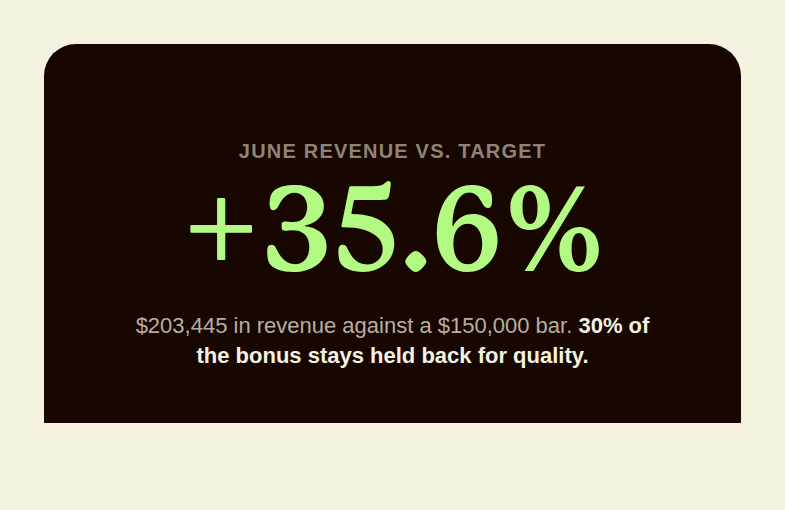
As the business grew, ShareWillow and the owner raised the monthly target by 25 percent, from $120,000 to $150,000. By April, the team was already clearing the new, higher bar: $150,884 in revenue against the $150,000 target, a confirmed payout of $3,017.67. Two months later, in June, the same five-person team posted $203,445 in monthly revenue against that same $150,000 bar, beating it by more than 35 percent. The confirmed team payout that month reached $6,103.35, just over double what the team earned in April and roughly two and a half times February's number, on a bar that was 25 percent higher than where the plan started.
Why The Holdback Mattered More Than The Split
It would be easy to read this story as a straightforward revenue win: bar goes up, team works harder, payout climbs. That part is true, but it misses the more interesting design decision. A 70/30 split with a deferred holdback is not the most exciting thing to put in front of a crew that just beat its number by 35 percent. It is, however, the thing that let the owner say yes to a revenue-based plan at all. Before ShareWillow, the fear was not that the team wouldn't hit a number, it was that they would hit it the wrong way: skipping a step, rushing a job, taking a shortcut that shows up three weeks later as an expensive trip back to the same address.
The holdback turns that fear into a built-in check instead of a hope. Thirty percent of every bonus sits behind the work holding up over time, which means the team's financial interest in a job stays alive well past the day it gets marked complete. For a company built around a single, obvious incentive-plan risk, callbacks that cost a full day of travel, that is a far more useful guardrail than a stricter revenue formula would have been. It let the owner build a plan aggressive enough to actually motivate the team, without needing a separate quality-control system bolted on top of it.
Before the plan ever went live, the owner asked ShareWillow to run the numbers both ways: a worst-case scenario where revenue came in soft and a best-case scenario where the team blew past target. That kind of modeling is easy to skip when a plan feels exciting on paper, and it is exactly the step that keeps a bonus plan from becoming a liability six months in. Testing both ends of the range before committing the team to a number meant the owner knew what a bad month would cost and what a great month would pay out, long before either one actually happened. By the time the plan launched, there were no surprises left to find, just a target the team understood and a payout structure the owner had already stress-tested against the numbers actually going wrong.
Raising The Bar Without Breaking The Plan
The other detail worth noticing is what happened when the target moved. A 25 percent jump in a monthly revenue bar, from $120,000 to $150,000, is the kind of change that can quietly kill a bonus plan's credibility if the team never adjusts to it. Crews that feel like the goalposts moved on them tend to disengage instead of pushing harder. That is not what happened here. The team cleared the new $150,000 bar in the very first month it applied, then beat it by more than a third two months after that.
Part of why that worked is timing. The target only moved once the team had already proven, in February, that the mechanics of the plan were sound and the payout was real. Raising the bar on a plan the crew already trusts reads differently than raising it on a plan still proving itself. ShareWillow's incentive plan software made the adjustment itself simple: the target field changed, the same reporting kept running, and the team could see the new number the same way they saw the old one. Nothing about the mechanics of how the bonus got calculated or paid had to change for the target to move.
Profit sharing
made simple.
Give your team a stake in the company’s success. ShareWillow helps you create and manage profit-sharing programs that motivate employees and drive business results.
What A Revenue Number Can And Can't Prove
Four confirmed months is not a full year of data, and it would be overselling this story to call a 25 percent bar increase and a doubled payout a permanent growth rate. Some months will land closer to target than others, the way any revenue-driven number moves with job volume, weather, and how many trucks are on the road on a given week. What four months of clean, confirmed payout data does prove is that the structure holds up under real pressure: a target that moved substantially, a team that had to adjust to it, and a holdback quietly doing its job in the background the entire time without anyone needing to think about it month to month.
For a company whose biggest operating risk is the cost of driving back out to fix something, that kind of proof matters more than a single flashy number would. A field service business built around mobile crews and long drive times cannot afford a bonus plan that quietly rewards speed over quality, and this one was built specifically so it wouldn't. Companies weighing a similar structure, a growth incentive paired with a quality holdback, can start with a free incentive plan audit to see whether their own revenue data already supports a plan shaped this way.
There is also a simpler lesson in here for any owner nervous about tying pay to a number that can move on them. The instinct is often to keep the bonus small and the formula conservative, so a bad month doesn't hurt too much. That approach also caps how much a great month can pay, which is exactly the ceiling this restoration crew avoided. Pairing a real, meaningful revenue share with a holdback did more to protect the business than a smaller, more cautious bonus ever would have, because the protection came from the payout structure itself rather than from keeping the number small.
Where This Goes From Here
The company is now watching whether June's 35 percent margin over target holds as the new normal, or whether it settles back closer to the smaller gap the team posted in April. Either outcome is fine. The plan was never designed around hitting a specific number every month, it was designed to reward real growth while making sure that growth doesn't come at the expense of the next call that crew answers. Four months in, with revenue climbing from just over $121,000 to just over $203,000 against a bar that rose 25 percent in between, the team has already shown the plan can do both at once. That is the part an owner running a revenue-share program for a mobile crew actually needs to see before trusting the model with a bigger number next quarter.
Related reading
Conclusion
A revenue-share plan with a 30 percent quality holdback took this restoration crew from $2,420 to $6,103 in confirmed monthly team payouts across four months, even as the revenue bar rose 25 percent along the way.
Create incentives
that
drive results
You shouldn't need complex equity plans to align your team. ShareWillow makes it simple to create transparent profit-sharing programs that motivate employees and grow your business.

Incentive plans to help
small businesses thrive.
.png)
"I was able to leverage the knowledge of the ShareWillow team to learn how other companies were designing their bonus plans. The template was extremely helpful."

Brian Tustin
Owner, First Rate Movers