
A residential plumbing company untangled a blended service-and-install bonus that nobody could explain, splitting it into two clear pay buckets and piloting the new structure on one technician before rolling it out company-wide.
Ask a technician to explain his own bonus and watch what happens when the plan blends two different kinds of work into one number. He can tell you roughly what he made last month. He usually cannot tell you why, or what he'd need to do differently to make more next month. That gap between earning a bonus and understanding it is where trust in a comp plan quietly dies, and it's exactly where one residential plumbing company found itself after years of running install and service crews under a single blended incentive.
The company runs both sides of the business the way most full-service plumbing shops do: technicians who install water heaters, repipes, and fixtures, and technicians who handle service calls, diagnostics, and repairs. For years, both types of work fed into one combined bonus calculation. On paper it looked simple. In practice it created three separate problems that compounded each other, and by the time ShareWillow got involved, the company's leadership already knew the plan wasn't working. They just weren't sure why it kept producing confusion instead of motivation.
One Bonus Number, Two Very Different Jobs
Service work and install work are not the same business inside the business. A service call might run a few hundred dollars with a technician diagnosing and fixing on the spot. An install can run into five figures, involve permits and subcontractors, and take days instead of minutes. Paying both out of the same bonus pool meant a technician's number moved for reasons he couldn't isolate. Did that month's bump come from closing more service calls, or from landing one big install? Nobody could say with confidence, including the office staff calculating the checks.
That ambiguity showed up constantly in job classification. Take a water heater replacement, one of the most common tickets a residential plumbing company runs. Is that a service call because a technician showed up to fix a failed unit, or is it an install because the job ends with a new water heater in the ground? Under the old plan, the answer depended on who was categorizing the job and how they felt about it that day, not on a consistent rule. A technician doing the identical job twice in the same week could see it paid two different ways, and there was no written definition anyone could point to that settled the argument before it started.
Multiply that ambiguity across dozens of technicians and hundreds of jobs a month, and you get a bonus program that technicians stopped trusting even when the total dollars paid out were fair. A plan technicians can't reconstruct on their own, even a generous one, reads to them as arbitrary. And arbitrary pay plans don't drive behavior. They just generate questions the office has to keep answering by hand.
The Cost Problem Hiding Underneath the Classification Problem
Job classification was the visible symptom. Underneath it sat a second problem that mattered just as much for the business's margins: the company had no clean, consistent way to track pass-through costs against the revenue a job actually generated. Permits, subcontractor labor, equipment rental, the direct costs that come with install work in particular, were not being netted out before bonus calculations ran. A technician could look profitable on a top-line revenue number while the job underneath him carried cost structures that made the real margin much thinner than the bonus implied.
That's a dangerous gap to leave open in a service business. It means the incentive plan can reward revenue that doesn't translate into profit, which eventually forces ownership to either eat the difference or claw back trust by adjusting numbers after the fact. Neither option builds the kind of comp plan a growing plumbing company can scale past a handful of technicians. The company needed a structure that separated the two kinds of work cleanly, defined job classification in a way technicians could check for themselves, and accounted for the real cost of doing install work before calling a number a bonus.
The fix wasn't to tweak the existing formula. It was to stop treating service and install as one business with one bonus pool, and start paying them as the two distinct jobs they actually are.
Building Two Buckets Instead of One Blend
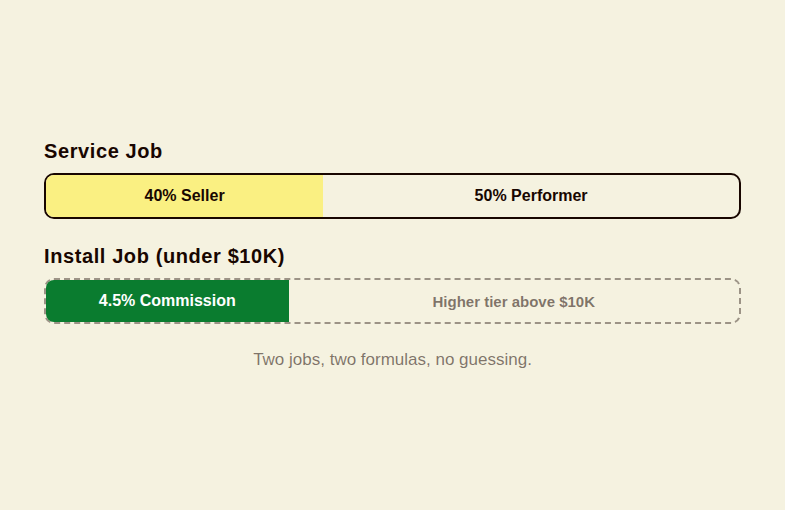
ShareWillow rebuilt the plan around separate bonus buckets for service and install work, each with its own explicit split rule that a technician could calculate in his head on the drive home. On service jobs, the split runs roughly 40 percent to the person who sold the work and 50 percent to the technician who actually performed it. That distinction matters in a shop where the tech who diagnoses a problem and sells the repair isn't always the same person who does the physical work, and it means both roles get paid for the specific value they added instead of splitting an undifferentiated pool.
Install work runs on a different structure entirely, because install jobs behave differently. On jobs under $10,000, the seller earns a 4.5 percent commission. Above that threshold, the commission tiers up, so a technician who lands a larger install isn't capped at the same rate that applies to a routine water heater swap. Bigger jobs carry bigger complexity and bigger risk, and the pay structure now reflects that instead of flattening every install into one number.
Settling the Water Heater Question for Good
The redesign also forced the company to write down, in plain language, exactly what counts as service and what counts as install. That sounds like a small administrative step, but it's the piece that actually restores trust in the plan. Once a water heater replacement has a fixed classification rule instead of a judgment call, a technician can predict his own pay before the job is even finished. He doesn't need to wait for a paycheck to find out which bucket a job landed in, and the office doesn't need to referee a debate about it after the fact.
That clarity does something else that's easy to underestimate: it changes what technicians pay attention to on the job. When the seller's cut and the performer's cut are both spelled out, a technician who's good at closing the sale but weaker on execution, or the reverse, can see exactly where his strengths translate into dollars. That's a very different incentive environment than one blended number that rewards vague overall performance without telling anyone which behaviors actually moved it.
Where the Cost Tracking Fits In
The new structure also gave the company a natural place to net out pass-through costs before calculating commission, rather than after the fact. Because install and service are now tracked as separate revenue streams with separate rules, permits, subcontractor costs, and equipment rental can be subtracted from the install side specifically, instead of getting lost in a blended company-wide number. The commission a technician earns on an install now reflects what the job actually netted the business, not just what it billed. That single change closes the margin gap that the original blended plan had been quietly running on for years.
Profit sharing
made simple.
Give your team a stake in the company’s success. ShareWillow helps you create and manage profit-sharing programs that motivate employees and drive business results.
A redesigned pay structure is only a theory until it survives contact with a real paycheck. So instead of rolling the new service and install buckets out to the whole team at once, the company piloted it on a single technician for seven months.
Seven Months, One Technician, One Real Test
That patience paid off in the data. During the pilot, the technician's best month brought in $114,000 in total revenue, split roughly $104,000 in install work and $9,000 to $10,000 in service work. That single month is a useful stress test on its own: it's exactly the kind of month where a blended bonus plan would have been hardest to explain, since the install revenue so heavily outweighed the service revenue that any shared pool would have masked what actually drove the number.
More important than any single month was what happened across the full seven-month pilot. When the company compared what the technician earned under the new split-bucket structure against what he would have earned under the old blended plan, the new plan matched or beat the old one in roughly 95 percent of months. That's the number that actually justified a company-wide rollout. It's one thing to design a pay structure that makes more sense on paper. It's another to prove, month after month, that the technician doing the work isn't worse off for the change, and in the vast majority of cases is doing at least as well or better.
From Spreadsheets to Fields Built Into the Job
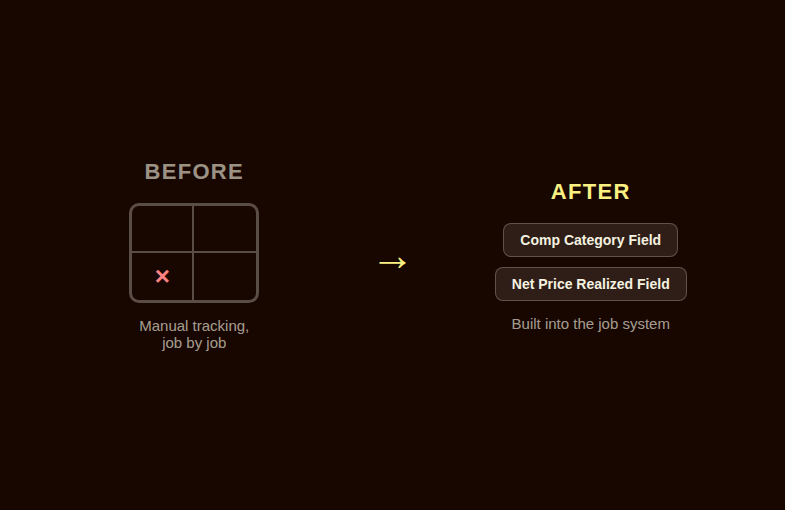
The pilot also exposed how much of the old process depended on manual tracking that wouldn't scale. Classifying jobs, splitting revenue, and netting out pass-through costs had all been living in spreadsheets, maintained by hand, job by job. That's a workable stopgap for one technician during a pilot. It's not a workable system for a full team of install and service techs running dozens of jobs a week.
So alongside the pay structure itself, the company is now building the classification and cost logic directly into Housecall Pro with two new custom fields: a comp category field that assigns each job to service or install at the source, and a net-price-realized field that captures the real revenue a job generated after pass-through costs are accounted for. Once those fields are populated as part of normal job workflow, the commission math that used to require a spreadsheet and a judgment call runs off data the system already has. That's the difference between a pay plan that depends on someone remembering to do the math correctly every month, and one that just works because the categorization happens as part of doing the job.
What This Means If You're Running a Blended Bonus
If your service and install work are still feeding into one shared bonus number, this is worth auditing before your next big install month makes the confusion worse. A few things to check:
- Can a technician explain, in one sentence, exactly how his last bonus was calculated? If not, the plan is too blended to trust.
- Do you have a written rule for ambiguous jobs, like a water heater replacement, that everyone applies the same way every time?
- Are permits, subs, and equipment rental being netted out of install revenue before commission runs, or are you paying commission on billed revenue instead of realized revenue?
- Could you pilot a new structure on one technician for a few months before touching the whole team's pay?
Separating service and install into their own buckets, with their own rules and their own math, is one version of a broader shift a lot of trades businesses are making away from flat, one-size-fits-all commission. It's a similar move away from flat commission to the one we've covered in plumbing companies building out career-path pay plans, and it tends to produce the same result: technicians who can predict their own paychecks tend to trust them, and trust is what actually drives performance. If you're weighing a redesign of your own plan, ShareWillow's plan design tools are built around exactly this kind of split-bucket structure, and our work with plumbing businesses specifically has shown how much clarity a properly separated comp plan can add to both technician trust and company margins.
Related reading
- Nobody Could Hit The Bonus: How A Home Services Company Recalibrated Its Way To A $3,000 Payout
- Modeling the Right Rate: How a Storm-Panel Installer Landed on 17% Commission
- Incentives, Commissions, and Bonuses: What’s the Difference and Why It Matters
- Companies with Profit Sharing: Who They Are & What They Offer
Conclusion
When service and install pay share one bucket, nobody can tell what they're actually being paid for, and separating the two is often worth more than any rate increase.
Create incentives
that
drive results
You shouldn't need complex equity plans to align your team. ShareWillow makes it simple to create transparent profit-sharing programs that motivate employees and grow your business.

Incentive plans to help
small businesses thrive.
.png)
"I was able to leverage the knowledge of the ShareWillow team to learn how other companies were designing their bonus plans. The template was extremely helpful."

Brian Tustin
Owner, First Rate Movers
