A residential painting company grew from four employees to twelve in under five months, and its spreadsheet-based bonus plan couldn't keep up. Two payroll errors got corrected live on a call. Here's how the plan was rebuilt to scale with the crew, and why weekly payouts turned out to matter more than the formula itself.
Three trucks, one spreadsheet, and a business about to outgrow both
When a residential painting company first started building a real incentive plan, the whole operation ran on a lean, year-round core: three or four employees, organized loosely around three crew leads who each treated their truck like its own small business. It was a good, workable size for a Google Sheet to handle the bonus math.
Less than five months later, that same company had grown to 12 employees. The Google Sheet hadn't grown with it.
This is a good problem to have and a real one at the same time. Painting is seasonal, physical, competitive-crew work, and this company leaned into that: the three trucks functioned almost like separate businesses, competing informally with each other, with each project manager pushing their own team's numbers. That culture is an asset. It's also exactly the kind of environment where a bonus system built for four people starts to visibly strain under twelve.
What "the spreadsheet" actually meant
Before any of the growth happened, the incentive math itself was already reasonably sophisticated for a company that size. The owner had built a project-based structure: a 40% gross-profit threshold had to be cleared before any bonus pool existed at all, and 50% of profit above that threshold got split among the team based on role and hours worked. On a representative $100,000 project with $57,000 in profit, that meant a $40,000 threshold, $17,000 in profit above it, and an $8,500 award pool split among the crew that earned it.
That's a genuinely solid framework. The problem was never the formula. It was everything downstream of the formula: the math lived in a spreadsheet, which then had to be manually transcribed into QuickBooks for actual payroll. Callback penalties, a flat $50 deduction per incident, were tracked by hand. And the owner was the only person who really understood how the whole thing fit together, which meant every payout cycle ran through him personally, whether or not that was the best use of his time that week.
At four employees, that's an inconvenience. At twelve, it's a bottleneck with a growing number of ways to go wrong.
Where growth started breaking the seams
By the time the company reached its June operations review, the cracks were showing in specific, fixable ways. New hires fell through role-mapping gaps in the spreadsheet logic, most visibly a newer technician whose payout came back as zero because the manual system simply hadn't been updated to account for his role. Time-and-material jobs and callbacks weren't captured consistently, which meant the owner was manually flagging "do not award" exceptions rather than having the system handle them automatically. And the daily reality of running the numbers meant re-entering the same job data across three separate places: the field service platform, the Google Sheet, and, eventually, ShareWillow itself.
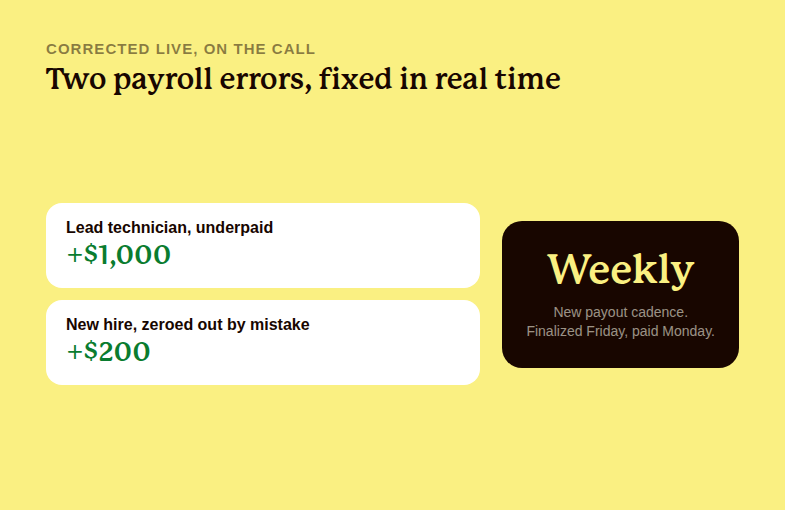
Two specific errors from the May payout cycle became the clearest illustration of the problem. A lead technician was underpaid by $1,000. A newer hire was shorted $200. Both were role-mapping mistakes, not malicious and not even particularly surprising given how the system worked, but both were exactly the kind of error that erodes a crew's confidence in the numbers if it happens more than once.
The fix: two plans, not one, and a payout cycle fast enough to matter
The rebuild didn't collapse the incentive structure down to something simpler. If anything, it got more precise. ShareWillow built out a dual-plan structure that kept the project-based team pool (the 40% threshold, 50%-above-threshold, 60% role / 40% hours split) but layered an individual technician scorecard on top of it, incorporating five-star reviews, callback deductions, technician-generated leads, and sales commissions, with tiered wage bands running from junior ($15 to $22/hour) through mid-level ($22 to $28) to lead ($30 to $35).
On the operations review call itself, the ShareWillow team live-corrected both the $1,000 and $200 errors, entering and confirming the fixes in-system in real time rather than promising a fix "next cycle." They rebuilt the role-assignment logic that had caused the errors in the first place, so the same mistake couldn't quietly repeat itself with the next new hire. And critically, they enabled direct manual metric entry inside the platform, so the owner could update numbers himself when needed instead of every change requiring a support request.
Why weekly, not monthly, turned out to matter
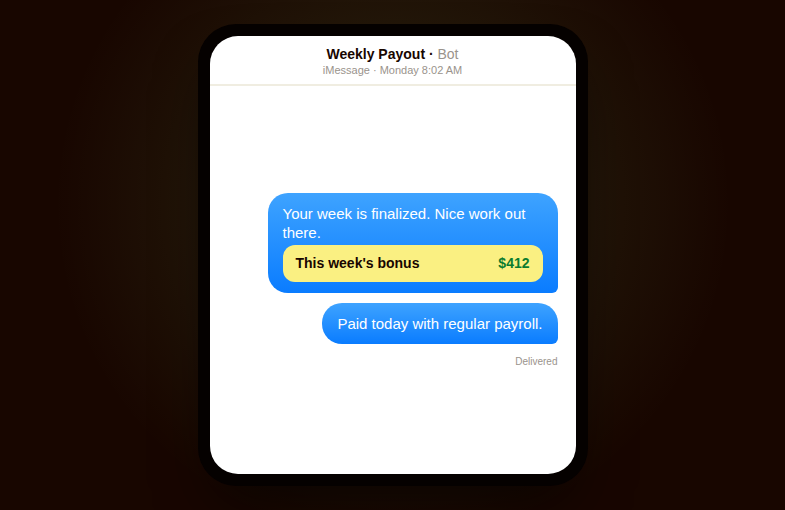
The single change that made the biggest difference to how the plan actually felt day to day was moving payout cadence from monthly to weekly: a Monday-through-Sunday period, finalized by Friday, paid the following Monday, timed specifically so the payroll run the owner was already doing every Monday morning through QuickBooks could absorb it without adding a new administrative step.
The reasoning behind the switch was almost entirely about psychology, not mechanics. A monthly bonus is disconnected from the work that earned it by design. A tech who does an exceptional job installing a tricky exterior job on the second of the month doesn't see that reflected in a payout until the end of the month, by which point the specific job that earned the bonus has faded into "just another week." A weekly cycle collapses that gap. The connection between "I did good work on this job" and "I got paid more this week" stays vivid and immediate, which is exactly the mechanism that makes any incentive plan actually change behavior instead of just being a number on a monthly statement nobody thinks about until it arrives.
The owner was explicit about the second-order benefit too: faster, more visible payouts reduced what he described as end-of-month pressure and questions from leads, the informal, slightly anxious "did I hit it this month" conversations that used to cluster around the last few days of every pay period. Weekly payouts spread that tension out into something closer to routine.
Why the individual scorecard mattered as much as the team pool
A project-based team pool is good at rewarding a crew for finishing a job under budget. It's not built to notice that one particular technician is the one who consistently gets the five-star reviews, or that another has started bringing in leads of their own outside of what the office assigns. Left as the only incentive, a pure team pool can quietly flatten individual effort into a group average, which is fine for crew cohesion and not great for recognizing your best people.
That's the gap the individual scorecard was built to close. Layered on top of the project pool, it tracked five-star reviews (with a small bonus, around $75, once the company crossed cumulative review thresholds), callback deductions at the same $50-per-incident rate the team pool used, credit for technician-generated leads, and sales commissions for anyone who helped close additional work on-site. The tiered wage bands underneath it, junior painters at $15 to $22 an hour, mid-level at $22 to $28, leads at $30 to $35, meant the scorecard bonuses stacked on top of a base that already reflected experience, rather than trying to do all the differentiation through incentive pay alone.
In practice, this meant a lead technician's effective hourly rate could run a dollar or more above their stated base once incentive pay was factored in, without that lift ever needing to come out of a separate, opaque bonus conversation. It was just the visible sum of a wage plus a scorecard, both legible to the technician in the app at any time.
Competitive trucks, and why that culture is worth protecting
It's worth returning to the detail about the three trucks functioning like separate small businesses, because it explains why the dual-plan structure fit this company specifically, rather than being a generic best practice applied from outside. A crew culture built on friendly competition between trucks needs an incentive system that can reward both the truck's collective performance and the standout individual on that truck, or it risks flattening the exact dynamic that made the culture work in the first place.
The owner's own instincts pointed in this direction before the formal system caught up: ideas like an "employee of the month" recognition and a whiteboard visible in the shop, alongside the digital scorecard, were floated as ways to reinforce the same competitive, recognition-driven culture in a low-tech, high-visibility way. The lesson generalizes past painting. Software can calculate a bonus with more precision than a spreadsheet ever could, but it's the visible, social reinforcement, a whiteboard, a leaderboard, a name called out in a Monday meeting, that actually makes a number feel like recognition instead of just a line item on a pay stub.
Profit sharing
made simple.
Give your team a stake in the company’s success. ShareWillow helps you create and manage profit-sharing programs that motivate employees and drive business results.
Growth, cadence, and an honest caveat
The headline number here is real: this company's core team roughly tripled, from three or four employees to twelve, in under five months on the new plan. It would be tidy, and dishonest, to claim the payout cadence alone caused that growth. Painting is a seasonal business, and summer demand was doing real work in that headcount number too.
What's fair to say is narrower and still meaningful: a bonus plan that pays fast, accurately, and predictably removes friction from scaling a crew-based trades business, at exactly the moment when scaling puts the most strain on manual processes. A company can't productively add eight new employees to a system where the owner personally reconciles every payout by hand. Something has to give, either the growth or the process, and this company chose to fix the process.
It's also worth naming the honest limits of adoption here. In-app usage was still concentrated mostly among the two project managers and leads by the June review; summer and seasonal crew were, realistically, more likely to be paid manually outside the app during peak season. That's a normal, unglamorous part of scaling a trades business, not a failure of the plan. Tools roll out to the people managing the work before they reach everyone doing the work, and that's a fine order of operations as long as the gap keeps closing.
What this means if your crew is about to outgrow your spreadsheet
If you run a painting company, or any crew-based trade where headcount swings seasonally, a few questions from this story are worth asking about your own setup before growth forces the answer on you:
- What happens when a new hire joins mid-cycle? If the answer involves someone manually updating a spreadsheet formula, that's a role-mapping gap waiting to zero out someone's paycheck the way it did here.
- How many places does the same job data get entered? Every additional system a job has to be manually re-keyed into is another chance for the numbers to drift apart.
- How long is the gap between doing good work and getting paid for it? If it's longer than a couple of weeks, the incentive is arriving too late to actually shape behavior on the job it was meant to reward.
None of these require abandoning a plan that's already working conceptually, the way this company's project-pool structure was. They require a system precise and fast enough to keep up with it. If you're running a similar structure and want to see how the pieces fit together, ShareWillow's plan design tools are built for exactly this kind of multi-role, project-based incentive math. And if margin protection alongside real bonuses is more your concern than growth, it's worth reading how another painting company protected its margin while still paying real bonuses, a related but different challenge than the one this crew faced.
Related reading
Conclusion
A bonus formula only works if the system behind it can keep pace with growth. This crew proved both actually can.
Create incentives
that
drive results
You shouldn't need complex equity plans to align your team. ShareWillow makes it simple to create transparent profit-sharing programs that motivate employees and grow your business.

Incentive plans to help
small businesses thrive.
.png)
"I was able to leverage the knowledge of the ShareWillow team to learn how other companies were designing their bonus plans. The template was extremely helpful."

Brian Tustin
Owner, First Rate Movers