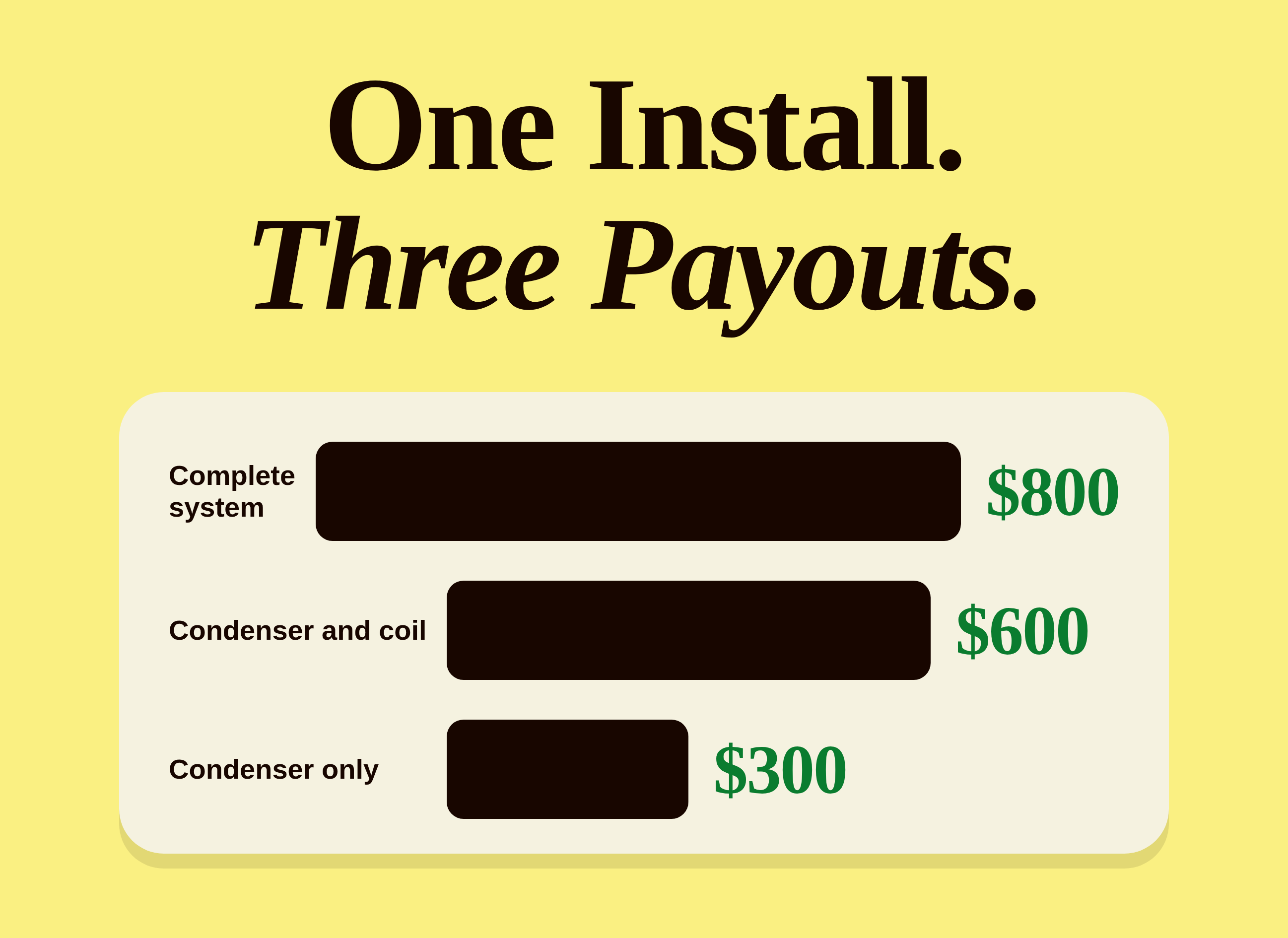
A rule change let a plumbing company's CSR team collect an inbound bonus without doing the outbound work it was built to reward. The fix caught roughly $60,000 a year in unearned pay before it went out the door.
Most owners assume a bad incentive plan fails loudly. A technician complains the tiers are unreachable, or a CSR quits because the bonus never seems to land. The version that should worry you more is the quiet one: a plan that keeps paying out every week, on schedule, looking completely normal, while it is quietly rewarding people for work that never happened.
That is what surfaced at a residential plumbing company running about 17 service vans across two connected brands, with an in-house customer service team handling both inbound booking and outbound follow-up calls. The company had built a CSR bonus around a simple idea: reward the team for converting inbound calls into booked jobs, but only if they were also doing the outbound work, callbacks, re-engagement calls, and follow-ups, that kept the pipeline full. On paper, it tied a bonus to two behaviors instead of one. In practice, a rule change to how the qualifier was calculated broke the link between them, and nobody noticed until the numbers started looking strange.
A Bonus That Forgot to Check the Second Half of Its Own Rule
The plan's original logic required a CSR to hit a minimum volume of completed outbound calls before the inbound conversion bonus kicked in. That was the whole point. A rep who booked every inbound call perfectly but never picked up the phone to chase a stalled lead was only doing half the job, and the plan was built to reflect that. Somewhere in a rule update, the outbound requirement stopped being enforced. The inbound bonus kept calculating and kept paying, whether or not a single outbound call had been logged that week.
Once that gate came down, outbound call volume did not just stagnate, it collapsed. Why would it not? The plan no longer required it, and reps are rational: if a step in a process stops mattering to the paycheck, most people stop doing that step, not because they are cutting corners on purpose, but because nobody is going to keep doing unpaid, ungated work indefinitely when the system has already told them it is optional. The team's own numbers told the story plainly. A metric that was supposed to hover in the 150 to 200 call range for a fully engaged CSR spiked toward 400, not because the team suddenly got twice as productive, but because a separate change in how a related group bonus was being calculated started rewarding volume in a way that had nothing to do with real outbound effort. Two problems were now stacked on top of each other: reps collecting an inbound bonus with no outbound qualifier attached, and a group incentive inflating numbers that did not reflect actual work.
Here is the part that should make any owner running a manual or partially-manual incentive plan sit up. This was not a case of somebody gaming the system. Nobody set out to defraud the company. A single rule change, made with good intentions, silently detached a bonus from the behavior it was supposed to require, and the plan kept running exactly as configured, correctly executing an incorrect rule, for weeks. That is the specific danger of an incentive plan that lives partly in a spreadsheet and partly in someone's memory of how it is supposed to work. The system does not know the rule is broken. It just keeps paying.
What $400 a Week Actually Adds Up To
The dollar figures are what turned this from an internal curiosity into an urgent fix. Weekly per-rep bonus payouts under the broken rule had climbed from an intended range of roughly $150 to $200 up to around $400. That sounds like a manageable overage until you annualize it. Sustained across a full year, that gap works out to somewhere in the neighborhood of $60,000 in unearned bonus pay, per CSR, for work that was never actually being done. Multiply that across a team, and a rule that quietly broke in a routine update turns into a payroll liability large enough to change how the owner thinks about every other automated calculation running in the background of the business.
The company's operations lead caught the pattern the way most of these things get caught: not through an audit, but through a gut feeling that the numbers looked off, followed by pulling the actual outbound call logs and comparing them against what the bonus report was paying out. That comparison is the piece worth underlining for any owner reading this. The bonus report, taken on its own, looked fine. It was internally consistent. It only became obviously wrong once someone laid it next to a completely separate data source, the raw ServiceTitan call activity, and saw that the two did not match up at all.
Rebuilding the Qualifier So It Cannot Silently Drop Again
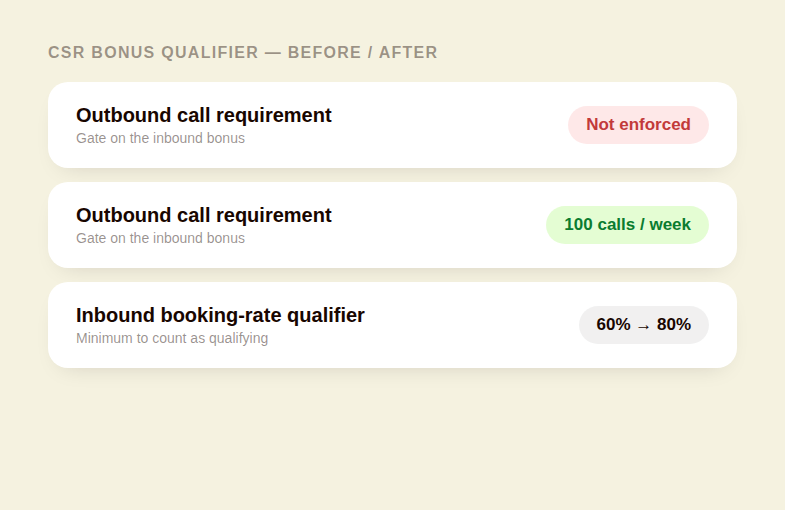
ShareWillow rebuilt the CSR bonus structure from the ground up, and the priority was not just fixing the immediate gap, it was making sure the same failure mode could not happen again without anyone noticing. The new plan pulls its qualifiers directly and continuously from ServiceTitan rather than relying on a rule that has to be manually re-verified every time something else in the system changes. A CSR now needs 100 completed outbound calls in a week before the inbound conversion bonus activates at all, a hard, automatically-checked gate instead of a rule that can quietly stop being enforced. On top of the individual qualifier, each van now carries its own weekly revenue threshold, a $150,000 base tier and a $175,000 stretch tier, so the incentive ties back to real production at the crew level, not just call volume that can be inflated in ways disconnected from actual booked work.
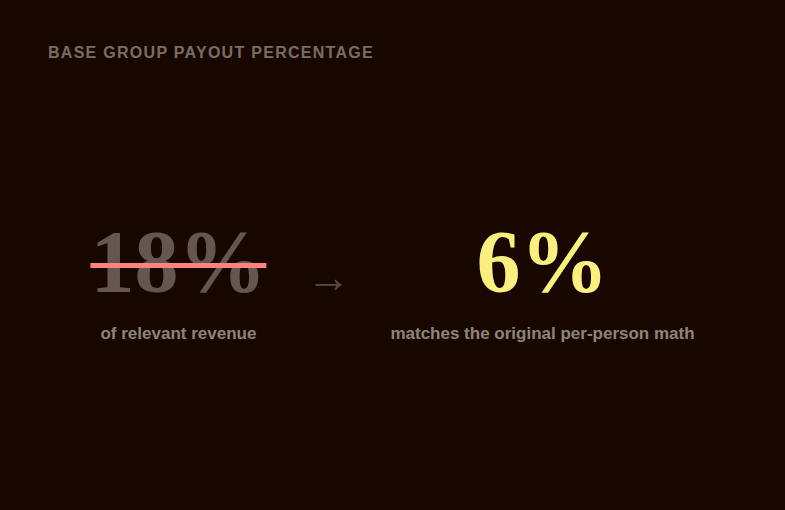
The inbound booking-rate qualifier itself got tightened too, moving from 60 percent up to 80 percent, closing a gap that had let a mediocre inbound conversion rate still count as a qualifying month. And the payout math underneath all of it got corrected outright: the base group payout percentage had drifted to roughly 18 percent of relevant revenue, well above what the original per-person math was ever designed to produce. It was reset to approximately 6 percent, restoring the intended relationship between total payout and the number of people actually splitting it. Alongside the qualifier rebuild, the team cleaned up a separate but related issue in how sold-by and technician-split commissions were calculating, closing a path where the same job could effectively generate a double payment across two different commission rules.
Profit sharing
made simple.
Give your team a stake in the company’s success. ShareWillow helps you create and manage profit-sharing programs that motivate employees and drive business results.
What Changed, Concretely
- The inbound conversion bonus now requires 100 completed outbound calls a week, verified automatically against ServiceTitan call logs, before it activates.
- Each van carries its own weekly revenue qualifier, a $150,000 base tier and a $175,000 stretch tier, tying payout to real production instead of call volume alone.
- The inbound booking-rate qualifier moved from 60 percent to 80 percent.
- The base payout percentage was corrected from roughly 18 percent down to about 6 percent of relevant revenue, matching the plan's original per-person math.
- Sold-by and technician-split commission logic was rebuilt to close a path that had allowed the same job to generate two separate payouts.
The result is not a dramatic before-and-after revenue story. It is something more important for a business running any kind of incentive pay: a plan that got caught quietly overpaying by roughly $60,000 a year per rep, before that number compounded further, and was rebuilt so the qualifier that matters most cannot silently stop being enforced again. Weekly payouts are back in the intended $150 to $200 range, and every dollar in that range is now tied to a verified outbound call count instead of a rule nobody is watching.
Why This Is Worth Checking in Your Own Shop
Most owners running a CSR or technician bonus plan built partly by hand, or partly in a spreadsheet, have some version of this risk sitting quietly in their own numbers. A rule gets updated for one reason, a qualifier gets loosened to fix an unrelated complaint, and the two changes interact in a way nobody modeled ahead of time. The plan keeps running. The checks keep clearing. Nothing looks broken until someone happens to compare the payout report against a completely independent source of truth, like raw call logs or job records, and finds the gap.
A few questions worth running against your own plan this week: does every qualifier in your bonus structure pull from a live, verifiable data source, or does part of it depend on a rule someone configured months ago and nobody has re-checked since? If a rep's bonus jumped 100 percent in a single quarter, would you notice, or would it just look like a good month? And if you found a gap like this one, would you know how far back it went, or how much it has already cost?
Companies working through a similar rebuild, closing the gap between what a bonus plan is supposed to require and what it is actually paying out, can see how ShareWillow structures automated incentive pay plans that stay synced to real field data instead of a static rule. Plumbing and field service companies specifically can look at what a typical plumbing incentive plan looks like when every qualifier is verified automatically instead of trusted on faith.
The lesson underneath the dollar figures is simple, and it applies well beyond CSR bonus plans. An incentive is only as strong as its weakest, least-monitored qualifier. The moment one gate in the structure stops being checked, the whole plan quietly turns into something else, a flat bonus dressed up as a performance incentive. Catching that gap before it compounds another year is worth more than the $60,000 figure alone suggests, because the same blind spot, left unexamined, does not stay contained to one bonus line.
Related reading
Conclusion
An incentive plan that pays out regardless of the qualifying work isn't an incentive plan anymore, it's a raise nobody approved.
Create incentives
that
drive results
You shouldn't need complex equity plans to align your team. ShareWillow makes it simple to create transparent profit-sharing programs that motivate employees and grow your business.

Incentive plans to help
small businesses thrive.
.png)
"I was able to leverage the knowledge of the ShareWillow team to learn how other companies were designing their bonus plans. The template was extremely helpful."

Brian Tustin
Owner, First Rate Movers