An outdoor lighting installer was calculating commission on jobs the business hadn't been paid for yet, more than doubling its real revenue number. Here's how a single filter fixed it.
Most owners assume that if a bonus or commission plan feels unfair, the problem is the math on the pay side: the percentage is wrong, the tiers are wrong, the split is wrong. Sometimes it is. But just as often, the plan's structure is fine and the input feeding it is broken. You can build the fairest commission formula in the world and still pay technicians on numbers that were never true, if the revenue figure going into the formula was wrong to begin with.
The number that was more than double reality
Ask most home services owners what their "revenue" is for a given month, and they'll pull it from the same place: the completed jobs report inside whatever field service software runs their business. It feels authoritative. It's a real number, generated by a real system, and it's usually the number that ends up driving commission and bonus calculations for the whole team.
It's also, quietly, one of the easiest numbers in the entire business to get wrong.
An outdoor and landscape lighting installer running roughly 100 jobs a month found this out the hard way during a routine commission plan setup. Their May "completed jobs" report showed $363,849 in revenue. Their actual, collected cash for that same month was $172,008.93. The reported figure was more than double what the business had actually been paid.
How a revenue number gets to be 2x too high
The gap wasn't fraud, or a software bug in the traditional sense. It was a definitional mismatch that's extremely common and almost never questioned: "completed" and "collected" are not the same thing, and most commission plans quietly assume they are.
A job can be marked complete in the field the moment a crew finishes installing the last fixture. That triggers the job to show up in a "completed jobs" report, which is exactly the report most owners point their commission calculations at, because it's the closest thing to a real-time revenue number the software offers. But completion and payment are two different events, sometimes separated by weeks. A commercial client on net-30 terms, a homeowner waiting on insurance reimbursement, a punch-list item holding up final invoicing. None of that shows up in a "completed" filter. All of it shows up in accounts receivable.
This particular company had also recently migrated onto their field service platform in what the implementation notes described as "a nontraditional way," which is a polite way of saying the revenue and job data hadn't been fully cleaned up yet. Multi-technician jobs had no standardized way to split credit between a lead installer and a helper. Callback responsibility (whose fault a return trip was) wasn't tracked at all. Upsells and technician-generated leads had no dedicated field to capture them. And labor-hour estimating was, in the implementation team's words, "manual head-math," because the estimating tool didn't expose an hours field the way it needed to for accurate commission projections.
Any one of those gaps is manageable on its own. Stacked together, they meant the business had no reliable, end-to-end picture connecting a job in the field to a dollar in the bank to a commission on a paycheck.
The fix: only pay commission on money you actually have
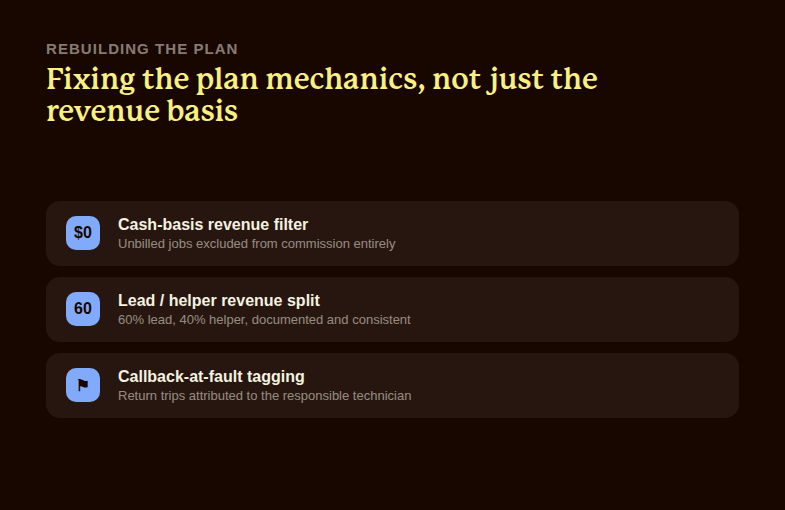
The single highest-leverage change was also the simplest to describe and the easiest to overlook: filter commissionable revenue down to jobs where the outstanding balance is $0. Cash basis only. If a customer hasn't paid, that job's revenue doesn't count toward the pool yet, no matter how "complete" the field work is.
That one filter took the reported number from $363,849 down to the real $172,008.93, a correction of roughly 53 percent. Applied to a commission structure, the difference is not cosmetic. It's the difference between a technician earning a percentage of money the business actually has, versus a percentage of money the business is still owed and might not collect in full, on schedule, or at all. Left unfixed, that gap compounds every single pay period, and it compounds in exactly one direction: toward paying out more than the business has actually taken in.
Alongside the revenue filter, ShareWillow's implementation team rebuilt the rest of the plan's mechanics from the ground up:
- A standardized 60% lead technician / 40% helper revenue split for any job worked by more than one person, replacing what had been an ad hoc, undocumented arrangement that varied by crew.
- A callback-at-fault tag, so a return trip could be attributed to the specific technician responsible for the original issue rather than spread ambiguously across whichever crew happened to be on the truck that day.
- Commissionable tracking for upsells and a technician lead-source field, so a tech who generated their own lead or added a scope expansion on-site actually got credit for it instead of that value disappearing into the general job total.
Why the 60/40 split matters more than it sounds like it should
It's tempting to treat a lead/helper revenue split as a minor administrative detail, the kind of thing you set once and forget. In practice, it's one of the most emotionally loaded numbers on a two-person crew, because it's a daily, explicit statement of whose work counted more.
Before the rebuild, this company had no documented split at all. Crews worked it out informally, which meant the actual division of credit could vary from job to job depending on who was assertive, who was new, or who simply didn't think to ask. That's a recipe for quiet resentment on a lighting install crew where a lead technician is running the layout and voltage calculations while a helper is digging trenches and setting fixtures. Both roles matter. They don't contribute equally to the sale, but an undocumented split leaves that judgment call to be renegotiated, implicitly, every single job.
Formalizing it at 60% to the lead and 40% to the helper didn't change the underlying economics of the business by much. What it changed was predictability. A helper could look at a job and know, in advance, what their share would be, instead of finding out after the fact and comparing notes with a coworker on the drive home. That kind of certainty is worth more to crew morale than the specific percentage split, as long as the percentage is documented, consistent, and communicated.
What the fix revealed, beyond the revenue correction
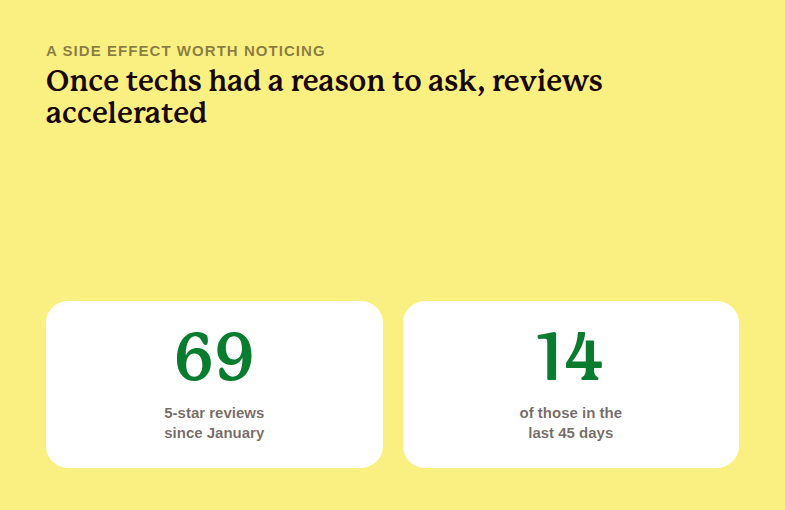
Fixing the revenue basis didn't just correct a number. It gave the owner a clean enough data foundation to see parts of the business that had been invisible before. Once accurate commission tracking was in place, review generation became visible as its own metric worth watching: the company had logged 69 five-star reviews since the start of the year, with 14 of them landing in just the prior 45 days, a clear acceleration once techs had a direct incentive tied to asking for them.
That's a useful reminder about what a commission plan is actually for. It's not only a payroll mechanism. Done well, it's a live signal of what the business is rewarding, and technicians are remarkably good at optimizing for whatever gets measured and paid. When review generation quietly became part of the incentive structure, review generation accelerated. When accurate revenue became the basis for pay instead of an inflated field-completion number, the business started paying for actual performance instead of a number that had never really existed.
The company was also asked to tighten a related, unglamorous discipline: consistent technician time-clock punches through their payroll system, ADP, for every job. It's the kind of housekeeping item that's easy to deprioritize and expensive to skip, because commission accuracy depends on labor-hour accuracy just as much as it depends on revenue accuracy.
Profit sharing
made simple.
Give your team a stake in the company’s success. ShareWillow helps you create and manage profit-sharing programs that motivate employees and drive business results.
The callback problem nobody wants to look at directly
The callback-at-fault tag deserves its own mention, because it's the piece of this rebuild that owners tend to resist the longest, usually for a reason that sounds reasonable on its surface: nobody wants to build a system that feels like it's pointing fingers at technicians.
But the alternative, which is what this company had before, isn't neutral. It's just invisible. When callback costs get absorbed into general job expenses without being attributed to anyone, the business still pays for them. The crew that causes the fewest callbacks and the crew that causes the most are treated identically, which means the plan is quietly subsidizing inconsistency instead of rewarding the technicians doing careful, correct work the first time. A callback-fault field doesn't have to be punitive. It can simply make visible a pattern that was always there, so that coaching, training, or recognition can actually target where it's needed instead of being distributed evenly across a team that isn't performing evenly.
Once that visibility exists, most owners find the conversation gets easier, not harder. A technician with a low callback rate has a number to point to. A technician with a high one has something concrete to work on, rather than a vague sense that management is unhappy with them for reasons nobody can quite articulate.
A question every field service owner should be able to answer
If you run a home services business of any trade, whether it's landscaping and outdoor services, electrical, plumbing, or general contracting, there's a version of this question worth asking about your own numbers: when someone calculates commission or bonus payouts, what revenue figure are they actually using, and is it cash collected or work completed?
For a lot of owners, the honest answer is "I'm not entirely sure," which is exactly the position this lighting company was in before the audit. That's not a knock on the owner. Most field service software is built to answer "is the job done," not "have we been paid," and those are genuinely different questions that happen to look similar on a dashboard.
A few places to check in your own systems:
- Pull your commission-basis report and your accounts receivable report side by side for the same month. If commission is calculated on "completed" work rather than "collected" work, the two numbers will diverge, and the size of that gap is your real exposure.
- Check how multi-technician jobs split credit. If there's no documented rule, ask your leads and helpers separately what they believe the split is. A mismatch in their answers is a sign the current system runs on assumption, not record.
- Look for a callback-fault field. If return trips get absorbed into general job costs without being tied to a specific technician, you have no way to see whether callbacks are concentrated on a few crews or spread evenly, which is exactly the kind of pattern a good incentive plan should surface, not hide.
The takeaway
A revenue number that's off by 2x doesn't usually announce itself. It looks like a normal report, generated by normal software, that everyone has simply always trusted. The only way to catch it is to go looking, and the fix, once you find it, is often smaller and simpler than the problem made it seem: one filter, applied consistently, that asks a system to pay on money you actually have instead of money you're still hoping to collect.
This isn't the only time a phantom revenue number has quietly inflated a field service company's commission math. Another lighting company found $192,000 in phantom revenue hiding inside their own software, a strong reminder that this is a pattern worth checking for proactively, not a one-time surprise. If you're building or auditing a commission structure of your own, ShareWillow's plan design tools are built specifically to surface gaps like this one before they turn into a technician's paycheck.
Related reading
- Why This 6-Technician Shop Tied Bonuses to Sold Hours, Not Just Revenue
- The Bonus Tier Nobody Could Ever Reach, and the $3,000 Fix
- Incentives, Commissions, and Bonuses: What’s the Difference and Why It Matters
- 7 Profit Sharing Plan Examples for Your Small Business
- When to Pay Technician Commission: Completed Date vs. Paid Date, and the $6,600 in Open Balances That Forced the Question
Conclusion
A commission plan is only as fair as the revenue number underneath it. Check what yours is actually counting.
Create incentives
that
drive results
You shouldn't need complex equity plans to align your team. ShareWillow makes it simple to create transparent profit-sharing programs that motivate employees and grow your business.

Incentive plans to help
small businesses thrive.
.png)
"I was able to leverage the knowledge of the ShareWillow team to learn how other companies were designing their bonus plans. The template was extremely helpful."

Brian Tustin
Owner, First Rate Movers