A small plumbing and HVAC company had no reliable way to tell which technicians were actually earning their pay, or whether its bonus math held up against what other shops were paying. Here's how a tiered plan built around sold hours fixed both problems, and ended up doubling as a recruiting tool.
The owner of a small, owner-operated plumbing and HVAC company knew his crew of six technicians worked hard. What he didn't know, with any real confidence, was who was actually moving the needle for the business each month. He had a rough sense of who stayed busy and who didn't, but busy and profitable are not the same thing, and he had no clean way to separate them.
He had tried building some kind of incentive structure before this. It existed, sort of, but it lived in his head and a handful of spreadsheet tabs, recalculated by hand every pay period. That meant every payout became an exercise in checking his own math, then checking it again, before he felt comfortable actually cutting a check. That's a rough place to run a bonus program from. If the owner doesn't trust the number enough to hand it over without hesitation, the techs aren't going to trust it either, and the whole point of incentive pay, getting people to care about the numbers, falls apart before it starts.
Pay That Wasn't Tied to Performance
The core issue was simple to state and hard to fix without help: pay wasn't clearly connected to what each technician actually produced. Two techs could work the same number of hours in a week and generate very different amounts of revenue for the business, and the pay structure didn't reflect that gap at all. A technician who consistently sold more work, upsold a repair into a replacement, or closed a maintenance agreement while he was on site, looked the same on payday as a technician who just showed up and did the minimum.
That's a problem for two reasons. First, it's a retention risk. Your best people notice when the pay structure doesn't distinguish them from everyone else, and eventually they either stop trying to sell or they leave for a shop that pays for performance. Second, it's an information problem for the owner. Without a system that ties dollars to outcomes automatically, he had no fast, reliable way to see who was actually earning their keep. He could guess. He could ask his ops manager. But he couldn't point to a number and say, with confidence, "this is why this person got paid what they got paid."
No Reference Point for What "Fair" Actually Looked Like
The second piece of the pain point was less obvious but just as important: even if he built a plan, he had no way to know whether it was any good. Was a 1 percent commission rate too stingy? Was a threshold set at a level nobody could realistically hit, which would make the whole plan feel like a bait and switch? Was he about to promise payouts the business couldn't sustain if the whole crew hit their numbers at once?
Most owners in this position are flying blind on this question, and understandably so. You don't get to see what the shop down the road is paying its technicians. There's no public benchmark for "reasonable commission rate on sold hours for a residential plumbing and HVAC crew." So plans get built on gut feel, sometimes copied loosely from something an owner heard about at a trade association meeting, and then adjusted reactively once the first payout period reveals whether it was too generous or not generous enough.
For this owner, that uncertainty was the real blocker. He wasn't short on motivation to reward his team. He was short on a structure he could trust: one that connected pay to performance automatically, calculated itself correctly every single period, and had actually been checked against what similar shops in the industry were doing. Without that, incentive pay stays a good idea that never quite gets off the ground, stuck in draft form in a spreadsheet nobody fully trusts.
A Tiered Plan Built Around Sold Hours
Working with ShareWillow, the owner landed on a tiered commission plan that uses sold hours as the qualifying metric alongside monthly revenue. Sold hours is a good fit for a plumbing and HVAC crew because it captures more than time on the clock. It reflects work a technician actually generated and closed, whether that's diagnostic time, repair time, or a bigger job a tech identified and sold while he was already on site. It rewards the selling, not just the doing.
The plan runs in three tiers, and getting the thresholds right took some real tuning:
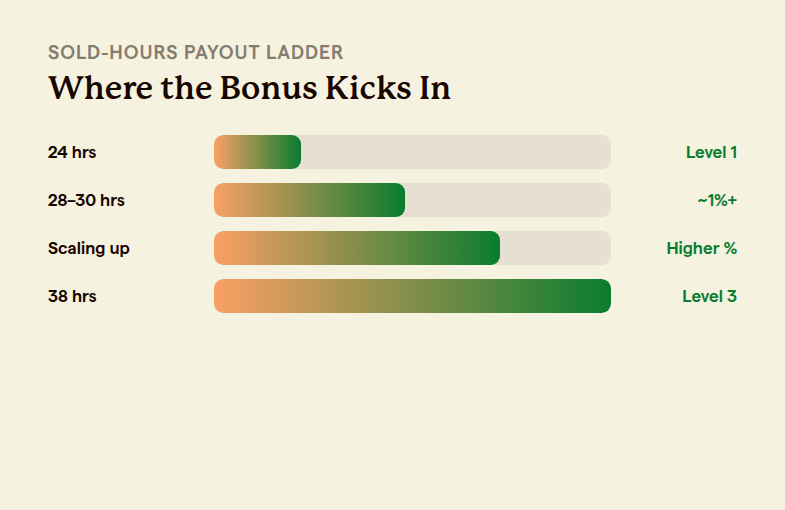
- Level 1: 24 sold hours. This was originally set at 26, but the team lowered it to 24 to make the first tier genuinely attainable. A threshold nobody can hit isn't a threshold, it's a demotivator.
- Level 2: 28 to 30 sold hours. Below 28 sold hours, the payout is $0. From 28 to 30 sold hours, the rate starts around 1 percent and scales up from there as sold hours climb. This tier is where most of the team's actual bonus activity happens.
- Level 3: roughly 38 sold hours. This is the top tier, reserved for technicians who are significantly outproducing the rest of the crew, whether through sheer volume or through consistently selling larger jobs.
The gap between tiers matters as much as the tiers themselves. Going from $0 below 28 hours to a real payout right above it gives technicians a clear line to cross, not a vague sense that "more is better." And because the rate keeps scaling as sold hours climb toward 38, there's no ceiling effect where a top performer plateaus and loses the incentive to keep pushing.
Why It Had to Run Inside the Software the Team Already Used
A commission plan that lives in a spreadsheet is a commission plan that eventually gets neglected, miscalculated, or quietly abandoned when the owner gets busy. So the plan was integrated directly with the company's field-service software, which meant sold hours and job data synced into the payout calculation automatically instead of getting re-entered or reconciled by hand.
That integration did two things for the owner. It removed the manual math that made him second-guess every payout before he released it, and it gave him a review step: payouts could be checked and finalized before each pay period closed, instead of being calculated after the fact and hoped to be correct. That's a meaningful shift from where he started, calculating everything by hand and hoping he hadn't made an error somewhere in the process.
Checking the Plan Against Similar Shops
The other piece was benchmarking. Before finalizing the rates, ShareWillow compared the plan's structure, the thresholds, the payout percentages, the overall cost as a share of revenue, against similar home-services shops. This mattered for exactly the reason the owner had been stuck before: he needed to know his plan wasn't just an invented number he'd feel nervous about a year later. It needed to be competitive enough to actually motivate the crew, and sustainable enough that the business could keep paying it out month after month without the math turning against him. Benchmarking turned "does this feel about right" into an answer he could actually stand behind.
Profit sharing
made simple.
Give your team a stake in the company’s success. ShareWillow helps you create and manage profit-sharing programs that motivate employees and drive business results.
What the Plan Actually Paid Out
In the observed payout period, the results made the case for the plan on their own. The top technician earned a $3,000 bonus on roughly $100,000 of sold revenue in a single month. Notably, he did it largely through selling additional work rather than performing installs himself. As the owner put it, the technician "still makes a pretty good bonus for not touching a wrench," because so much of his value came from identifying and closing work, not from swinging a hammer.
Across the team, total incentive payout for that period came to roughly $4,000, spread across four to five technicians. That's not an enormous number in absolute terms, and that's part of the point. A well-structured plan doesn't need huge dollar figures to change behavior. It needs to be visible, understandable, and reliably tied to what people actually did.
A Crew That Started Watching the Numbers
The clearest sign the plan worked wasn't the dollar figures, it was the behavior change. The owner described a team that is now genuinely engaged with the numbers behind their pay, checking in regularly to understand how the calculation works. He put it simply: "they're always calling me and saying, hey why does this show this." That's a technician who cares enough to ask a question, which is a very different posture from a technician who just cashes a check and moves on.
The owner also found a way to make the wins visible to the whole crew, not just the person who earned them. He uses an oversized novelty "big check" prop, the kind you'd see at a golf tournament, to present a technician's payout in front of the rest of the team. It's a small thing, but it turns an individual bonus into a shared moment, and it makes the incentive plan something the whole shop can see working, not just a line on one person's pay stub.
That visibility ended up paying off in a way the owner hadn't fully anticipated. A prospective hire, someone who had gone quiet on the owner's outreach and stopped responding, signed on the very next day after hearing from someone on the crew about a technician's payout. Word of a real, visible bonus traveled faster than any recruiting pitch the owner had made directly.
What This Means for Your Shop
You don't need a big team or a complicated formula to get results like this. A handful of principles carried this plan from idea to something the crew actually trusts:
- Tie pay to a metric that reflects real production, like sold hours, not just time on the clock or raw revenue that one person happens to be attached to.
- Set thresholds that are attainable but still require a stretch. A tier nobody can reach is worse than no tier at all.
- Automate the calculation so payouts sync with the job data you already have, instead of relying on manual math you have to trust every single period.
- Check your rates against what similar shops pay before you commit to them, so you know the plan is both competitive and sustainable.
If you're building or rethinking a plan like this, ShareWillow's plan design tools are built specifically for structuring tiered thresholds like these and syncing them with the field-service software your team already runs on. And if you run a plumbing or HVAC shop of any size, the same core approach, tie pay to real production, automate the math, and check your numbers against the market, applies whether you have three technicians or thirty.
Related reading
Conclusion
When a technician can see exactly how his own work turned into his own paycheck, he stops wondering if the math is fair and starts trying to beat it.
Create incentives
that
drive results
You shouldn't need complex equity plans to align your team. ShareWillow makes it simple to create transparent profit-sharing programs that motivate employees and grow your business.

Incentive plans to help
small businesses thrive.
.png)
"I was able to leverage the knowledge of the ShareWillow team to learn how other companies were designing their bonus plans. The template was extremely helpful."

Brian Tustin
Owner, First Rate Movers