CSR bonus structure example: a plumbing company paid $20 per membership, set 150/200/250 booking tiers, and a 70% categorization goal. See how it works.
A CSR bonus structure is easy to get wrong in one of two ways. Either it pays for activity nobody can verify, or it pays so little that the person answering the phones never notices it. A plumbing company with six technicians, four helpers, two CSRs, a service manager, and a dispatcher set out to build one that avoids both, and the details are worth stealing.
The company runs on ServiceTitan, and the call desk sat in the middle of the business with almost no measurement. The owner wanted the CSR plan to reward three things: selling memberships, booking more calls, and categorizing calls correctly so the data behind every other plan could be trusted. This is how the pieces fit together, why the numbers landed where they did, and what the company is still watching.
The Problem: A Call Desk Nobody Measured
Before the new plan, call categorization sat at roughly 50% to 57%. The owner wanted 70% to 80%. That gap matters more than it sounds. If half the calls are not labeled correctly, every report built on call data is partly guesswork, including the booking rate that other plans depend on.
The same review turned up a pattern on the field side. Technicians were not consistently writing estimates or selling, and most sales were concentrated with the service manager. Callbacks were expensive too: a damaged tub or sink can turn a callback into a $500 to $1,000 problem. Helpers were measured on attendance alone. So the company rebuilt several plans at once, and the CSR plan was designed to line up with the rest rather than sit off to the side.
If you are weighing a similar rebuild, it helps to see how other companies handled the phone desk. One plumbing company turned booking rate into a weekly paycheck in its CSR incentive plan built around booking rate, and another found a qualifier that paid out even when it should not have in a CSR bonus qualifier rebuild.
CSR Bonus Structure Piece One: Memberships Pay More Than the Techs Get
The first lever is memberships. The plan pays the CSR $20 for each membership sold. Technicians get $15. That gap is deliberate: the owner wanted the call desk to push memberships, so the CSR award starts higher. It can be lowered later if it starts to feel lopsided, and the company plans to adjust with real numbers.

Technicians also got a push on memberships. The top membership seller each month earns a $100 bonus, and ties split it evenly. Paying both roles to sell memberships gives the call desk and the field two chances to bring it up. For another view of how a capped membership award behaves in practice, see this HVAC membership sales commission case.
Booking Tiers Set Where the CSRs Already Were
The second piece is calls booked. The plan uses tiers at 150, 200, and 250 calls. Those numbers were raised on purpose: one CSR was already booking roughly 200 calls, so a tier set below that level would have paid her for work she was already doing. The first draft of a tier structure is easy to set too low, and a bar that nobody has to stretch for is just a pay raise with extra steps.
The fix is to look at current performance before choosing thresholds. If your best CSR is already at the middle tier on day one, move the tiers up so the middle one is a real stretch and the top one is rare. That is the same thinking behind a good tiered plan for any role, and our guide to bonus structure examples shows how companies in different trades size their levels.
Call Categorization: The Metric That Keeps Every Other Number Honest
The third piece is the quiet one. The plan starts with a 70% call categorization goal. Categorization is not glamorous, but it is the reason a booking rate means anything. If calls are labeled loosely, a CSR can book plenty of calls and still look average, or look great because the denominator is wrong.
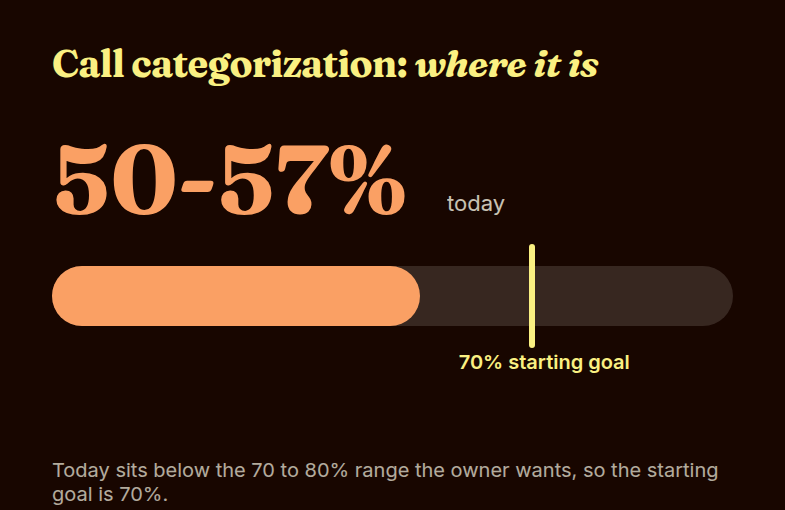
Starting the goal at 70% rather than 80% was a practical call. The company is at 50% to 57% today, so 70% is a meaningful jump without being out of reach, and it leaves room to raise the bar once the habit sticks. A goal that looks impossible on day one tends to get ignored.
Sizing the CSR Bonus Structure Against Pay
Both CSRs earn $28 an hour. The owner wanted the bonus to land at about $500 a month, using 10% of annual salary as the benchmark. Do the math with a standard 2,080-hour year and you get about $58,240 in salary, 10% of that is roughly $5,824, and spread across twelve months it comes to about $485. The plan is built so a CSR who hits the targets earns close to that $500 mark.
That benchmark gives the owner a defensible answer when a CSR asks why the number is what it is. Rather than picking a figure that feels right, the company anchored the bonus to a share of pay, and the tiers and award amounts were then shaped to fit. If you are building your own, start with a target as a percentage of pay and work backward to the per-unit awards.
What Was Left Out on Purpose
Not every metric made it in. The company wanted to reward outbound calls, but the first data pull returned zeros for that field, so it was left out of the CSR plan rather than guessed at. This is a lesson that applies to any CSR bonus structure: if you cannot trust the number, do not pay on it yet.
There was a second hiccup on the setup side. A ServiceTitan permission mix-up, where the right admin setting was applied in one section but the user still sat in a dispatcher role, hid reports until it was corrected. Neither problem is dramatic, but both are the kind of thing that quietly breaks a plan in week one if nobody checks the data before launch. Catching them before launch is the right order.
Keeping the Whole Team Pointed the Same Way
A CSR plan works best when the rest of the company rewards the same behavior. A few other changes shipped alongside it:
- Technician sales commission rose from 1% to 2%
- The $100 monthly bonus for the top membership seller
- Callbacks changed from a fixed deduction to a monthly eligibility rule, so any damage-related callback makes that person ineligible for that month's award
- The helper plan moved from attendance to tracking revenue, callbacks, memberships, and five-star reviews
- The plans moved to a weekly cadence to match the weekly paycheck
The dashboard is also visible. A TV in the break room runs the ShareWillow dashboard in rank-only mode, which shows who is ahead without showing dollar amounts, and it can be filtered by plan and time period. Rank without dollars keeps the competition friendly and avoids pay conversations on the floor. The owner also noted that technicians said they would accept whatever plan was offered, which is a good sign for adoption and a good reason to be careful that the plan is fair.
Profit sharing
made simple.
Give your team a stake in the company’s success. ShareWillow helps you create and manage profit-sharing programs that motivate employees and drive business results.
The Result So Far, and What to Watch
The new plans start October 1, and the old ones close out in September, so there are no payouts to report yet. The structure is set, though: $20 per membership for the CSR, booking tiers at 150, 200, and 250, a 70% categorization starting goal, and a bonus targeted around $500 a month. The first few weeks are the test of whether the tiers are set in the right place and whether the categorization goal moves the data the way the owner expects.
The honest advice for anyone copying this: treat the first month as a calibration period. Watch whether the CSRs hit the middle tier too easily, whether categorization climbs, and whether membership sales rise on both the phone and in the field. Adjust one lever at a time so you know what caused the change. Companies that want these metrics tracked automatically can see what that looks like in ShareWillow's product features.
Frequently Asked Questions
What is a good CSR bonus structure for a home service company?
A good one pays for results the CSR controls and the company can measure: memberships sold, calls booked, and call categorization. Keep it to a few metrics, tie the total to a share of pay, and exclude any metric whose data you do not trust yet.
How much should a CSR bonus be?
There is no standard number, but anchoring to a percentage of salary keeps it defensible. This company targets about $500 a month, which is roughly 10% of annual pay for a CSR earning $28 an hour.
Should CSRs earn a membership bonus?
Yes, if the CSR is part of how memberships get sold. This plan pays $20 per membership to the CSR and $15 to technicians, so the call desk has a reason to push them. You can adjust the gap once you see who is actually driving the sales.
Related reading
- The CSR Incentive Plan That Turned a Plumbing Company's Booking Rate Into a Real Weekly Paycheck
- The Bonus Was Meant for Outbound Calls. It Was Paying Out Either Way.
- HVAC Membership Sales Commission: The Capped Spiff That Caught a $440 Payroll Gap
- 9 Bonus Structure Examples Employees and Employers Love
Conclusion
Tie the CSR bonus to memberships, booking tiers, and categorization, and anchor the total to a share of pay.
Create incentives
that
drive results
You shouldn't need complex equity plans to align your team. ShareWillow makes it simple to create transparent profit-sharing programs that motivate employees and grow your business.

Incentive plans to help
small businesses thrive.
.png)
"I was able to leverage the knowledge of the ShareWillow team to learn how other companies were designing their bonus plans. The template was extremely helpful."

Brian Tustin
Owner, First Rate Movers