Plumbing technician minimum pay done right: a company raised its weekly floor from $600 to $900 and fixed an add-on commission error worth about $3,000.
Plumbing technician minimum pay is the quiet argument inside almost every performance-pay plan. Owners want technicians to earn more when they produce more. Technicians want to know what a bad week looks like. A plumbing company with roughly six field employees on a weekly performance plan just reworked that answer, raising its weekly minimum from $600 to $900 and fixing a commission error that could have cost about $3,000.
The company runs on ServiceTitan, and its technicians were hired specifically for performance pay. Then the same technicians started asking to be paid for the work that sits around the job: weekly meetings, truck maintenance, and cleanup. Here is how the owner handled each request, what the numbers look like, and what any company can borrow.
The Problem: Performance Pay Meets Unpaid Time
When technicians are paid only on what they produce, time spent on anything else feels like a pay cut. They asked for paid time for meetings, truck maintenance, and cleanup, and the requests created friction with management. At the same time, early clock-in errors were undermining trust in the hourly rates the system calculated, and add-on commissions were being miscalculated. Together, those issues put the fairness of the plan in question.
Owners often respond to that kind of friction by loosening the whole plan, and it is usually a mistake. A better move is to fix each issue where it lives: set a clear floor, price the non-billable time on purpose, and clean up the commission logic. That is what this company did.
Plumbing Technician Minimum Pay: Why the Floor Moved From $600 to $900
The weekly minimum went from $600 to $900. The owner considered setting it at 40 hours times $25, which would have been $1,000, and decided against it. A flat $900 keeps the guaranteed floor from getting too high while still giving technicians a number they can plan their week around.
The floor works as a safety net, not a target. The owner also made clear that repeatedly failing to hit the minimum could lead to termination, so it does not replace production. That balance matters: a floor with no expectation attached turns into a base salary, and a plan with no floor at all turns good technicians into nervous ones. If you are comparing structures, our post on protecting base pay while launching commission shows a related approach where the higher of two amounts wins.
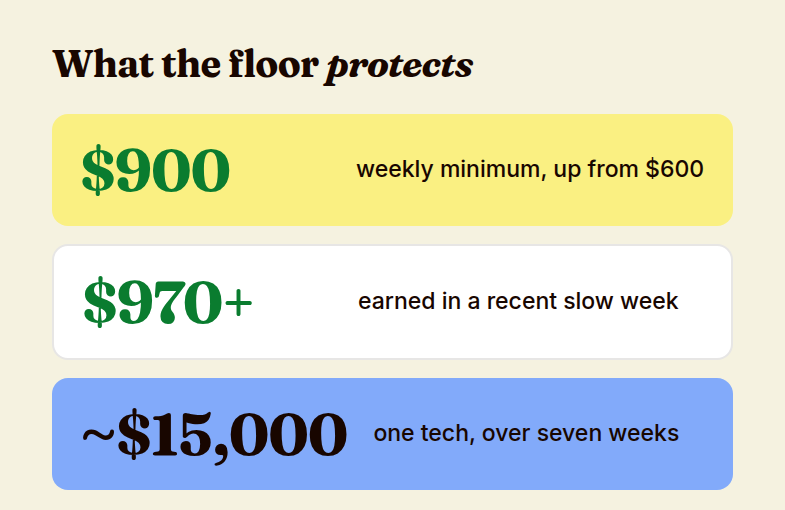
The early data suggests the floor is not the main source of pay. Technicians recently earned more than $970 in a slow week, which clears the minimum. One technician earned approximately $15,000 over seven weeks and had not previously exceeded $80,000 a year. Those are real numbers from this company, and they show the plan paying strong producers well while the floor stays in the background.
Pay for Meetings and Training on Purpose
The second change was internal time. Meetings and training had been paid at $15 an hour, but that number was not a policy. It was simply the hourly rate that had been typed into ShareWillow. The owner turned it into a deliberate decision and raised it to $25 an hour, tied to roughly a 30-minute weekly meeting.
That is a small cost, about a half hour a week per technician, and it removes one of the loudest complaints from the plan. It also sets a useful rule: if the company wants technicians at a meeting, the company pays for the meeting. Technicians who feel their non-billable time is valued tend to complain less about the billable pay structure.
The $3,000 Add-On Commission Error
The third fix was the one with the biggest dollar value. Add-on commissions were being miscalculated because there were two competing "sold-by" fields, and the full invoice total was being used as the base. The commission was being figured on the whole invoice instead of on the item that was actually sold.
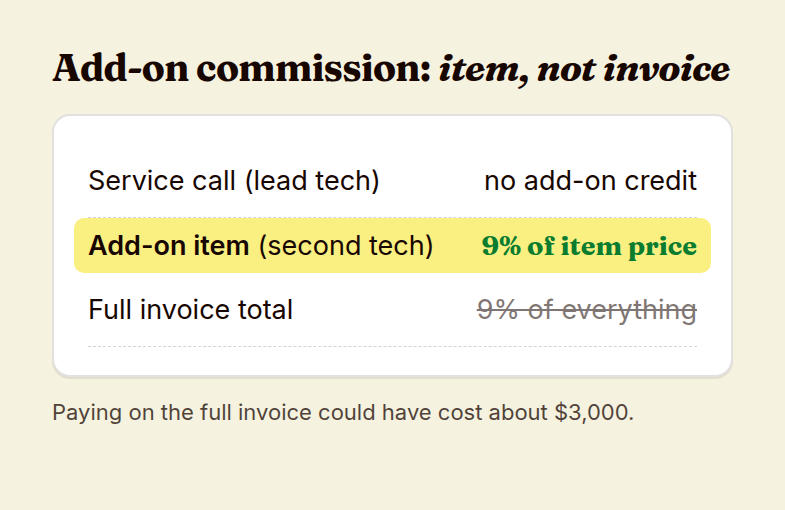
The corrected logic uses the sold-by technician on the invoice item and pays 9% of the unique item price. The original logic could have cost approximately $3,000. That is a prevented error, not a realized savings, so treat it as an estimate. It still shows why commission logic deserves a review before payroll runs. Another plumbing company found a different timing problem in how to pay plumbing technicians when payroll timing creates a gap.
The Rest of the Plan, in Plain Numbers
The floor is only one piece. The full plan is straightforward enough to explain in a minute:
- 9% on sold revenue and 9% on completed revenue, so a technician who both sells and completes a job can receive 18%
- Membership sales pay $20 each
- Non-fault recalls pay $25 an hour
- After-hours or weekend work pays 50% of the trip charge
- New technicians are paid $35 an hour for their first two weeks, with a cited high of $58 an hour
Revenue on a job is split across everyone who worked it, based on clocked hours. The owner will send a list of helpers and hourly staff who should be excluded from the splits. If you want to see a seller and completion split designed from scratch, read how one plumbing company split a 22% pool between the seller and the techs who finish the job.
Why the Numbers Did Not Match ServiceTitan, and Why That Is Normal
The weekly revenue in ShareWillow did not match the weekly revenue in ServiceTitan, which is a common early scare. The difference comes from how each system counts. ShareWillow uses the completion date and clocked-hour splits, while ServiceTitan sales dashboards use sold status. Those are different questions, so they produce different weekly totals.
There are two practical risks to plan for. First, clawbacks: if a customer cancels after commission has been paid, the company needs a rule for what happens. Second, edge cases in the split: one technician spent two hours resolving a customer issue and was kept in the split as a valid cost. Deciding those cases in advance keeps arguments out of payroll week. The calculation basics are covered in our guide to how to calculate bonus pay.
Profit sharing
made simple.
Give your team a stake in the company’s success. ShareWillow helps you create and manage profit-sharing programs that motivate employees and drive business results.
How to Set Your Own Minimum Pay Floor
If you are building a plumbing technician minimum pay rule from scratch, start with three questions. What is the lowest weekly paycheck a good technician could live with? What would a full week at a fair hourly rate cost you? And how far below that number are you comfortable guaranteeing?
This company answered with $900, which sits just under the $1,000 a 40-hour week at $25 would have produced. The gap is intentional. It leaves a reason to produce above the floor, which is the whole point of a performance plan. Whatever number you pick, write down what happens when someone sits at the floor week after week, because the answer shapes how the plan is read by everyone else on the team.
Then test the floor against real weeks before you announce it. Pull the last several pay periods, run each technician through the new rules, and look for anyone who would have been paid the floor. If it is most of your team, the commission rates are too low. If it is almost nobody, the floor is mostly reassurance, and that is fine.
What to Take From This
There are four moves any company can copy. Set a minimum that protects technicians without becoming a salary. Price non-billable time deliberately instead of by accident. Check that commission is calculated on the item that was sold, not the whole invoice. And verify clock-ins early, because bad time data poisons every hourly figure the plan uses.
One honest note: the company has not yet measured whether the new floor changes behavior. The structure is in place and early earnings look strong, but the real test is a few months of data. Companies that want weekly performance pay calculated automatically can see how it works in ShareWillow's product features.
Frequently Asked Questions
How much minimum pay should a plumbing technician on commission get?
There is no single right number. This company moved from $600 to $900 a week and chose a flat figure instead of 40 hours at $25, which would have been $1,000. Pick a floor you can afford in a slow week and that still leaves room for the technician to earn more by producing.
Should I pay technicians for meetings and training under a performance plan?
Usually yes. This company pays $25 an hour for about a 30-minute weekly meeting. It costs little and removes a common complaint that performance pay punishes time spent on anything but billable work.
Do commission-paid technicians still need to meet minimum wage rules?
Generally yes. Employees paid on commission still have to clear federal and state minimum wage and overtime rules, so check your setup with a payroll advisor before you finalize a floor.
Related reading
- How to Pay Plumbing Technicians: The Timing Fix That Closed a $1,700 Payroll Gap
- Plumbing Commission Structure: How a Plumbing Company Split a 22% Pool Between the Seller and the Techs Who Finish the Job
- Technician Commission vs Hourly Pay: How an HVAC Company Protected Base Pay While Launching a 5% Service and 3% Install Plan
- How to Calculate Bonus Pay: A Step-by-Step Guide to Fair and Motivating Compensation
Conclusion
Set a floor that protects technicians without becoming a salary, pay non-billable time on purpose, and commission the item sold.
Create incentives
that
drive results
You shouldn't need complex equity plans to align your team. ShareWillow makes it simple to create transparent profit-sharing programs that motivate employees and grow your business.

Incentive plans to help
small businesses thrive.
.png)
"I was able to leverage the knowledge of the ShareWillow team to learn how other companies were designing their bonus plans. The template was extremely helpful."

Brian Tustin
Owner, First Rate Movers