A home services company's commission tiers were set too high for anyone to hit. A three-level rebuild tied to sold hours and revenue paid its top seller $3,000 on $100,000 in July sales alone.
A commission plan only works if someone can actually reach the number on the page. That sounds obvious until you look at how many trades companies set their first tier off a gut feeling rather than real payroll data, then wonder six months later why nobody on the team has ever hit it. That was the situation at a home services company running a small crew of HVAC and plumbing technicians, until a rebuild of the commission structure turned an unreachable threshold into a plan that paid its top seller $3,000 in a single month, for sales alone, without a single install to show for it.
The owner had built an early version of the plan with good intentions. He wanted technicians to feel rewarded for growing revenue, not just clocking hours, and he wanted a floor generous enough that nobody walked away with nothing. What he ended up with instead was a threshold nobody could clear and a flat minimum payout that undercut the whole idea of an incentive in the first place. If a technician showed up and did the bare minimum, the plan still cut a small check regardless of hours worked. If a technician actually pushed to sell more, the tier above the floor sat just out of reach, calibrated off a number that had never been checked against what a real month of work in the field actually looked like. Neither situation motivated anybody to do anything differently.
A Floor Nobody Could Clear, and a Ceiling That Paid Regardless
The math problem was subtle but corrosive. The plan's lowest tier required 26 sold hours before a technician earned anything meaningful, a number that sounds reasonable on a spreadsheet until you account for how a typical week actually breaks down once drive time, callbacks, slow days, and PTO get factored in. Almost nobody was clearing it. Meanwhile, the plan still guaranteed a flat 1 percent payout no matter what a technician's hours looked like that month, which meant the team's best and least engaged performers were separated by only a rounding error in take-home pay. A technician who hustled to sell an extra job got functionally the same bump as one who barely made rate. That is not an incentive plan. It is a participation trophy with math attached.
There was a second pressure sitting underneath the numbers. Some of the company's technicians had worked under a well-known competitor performance-pay platform before, and they compared notes. The owner knew that if his new plan looked stingier or more confusing than what a competitor down the road was offering, he would lose the exact behavior he was trying to encourage: technicians choosing to stay, sell more, and treat the company's growth as their own. A commission plan does not exist in a vacuum. It gets measured against whatever a technician's last employer, or a friend at another shop, is bragging about at a barbecue.
Fixing this meant solving two problems at once. The floor needed to be low enough that a technician doing solid, ordinary work could actually clear it in a normal month, not just in an exceptional one. And the tiers above the floor needed enough separation, and enough real dollars behind them, that a technician chasing the next level would notice the difference in their paycheck rather than shrugging it off as rounding.
It is worth being honest about how a threshold like the original 26-hour floor gets set in the first place, because it happens the same way at a lot of small trades companies. An owner sits down, thinks about what a full, productive week should look like, and picks a number that feels right. The problem is that a number that feels right rarely accounts for the messy reality of a service business: a truck breaks down, a job runs long because a part has to get special-ordered, a technician takes a half day for a family emergency, and suddenly a month that should have produced 26 sold hours produces 21. Multiply that across a whole team and a whole year, and a threshold that felt generous in the owner's head turns out to be one that almost nobody clears in practice. The gap between what a plan assumes and what a normal month actually looks like is where most incentive plans quietly fail, long before anyone bothers to check the math against real payroll history.
Three Levels, Built Around Sold Hours Instead of a Guess
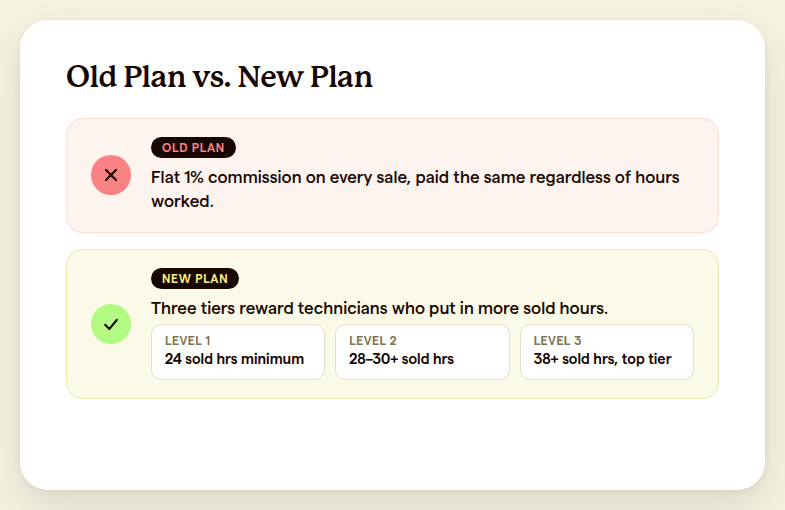
The rebuilt plan replaced the single unreachable tier with three levels, each anchored to sold hours rather than a flat attendance number, so the plan rewarded revenue-generating work specifically rather than just clocking in. Level 1 dropped from the old 26-hour floor to 24 sold hours, a change that looks small on paper but meaningfully widened who could clear it in a typical month once real scheduling variance was accounted for. Level 2 raised the bar to 28 to 30 sold hours, and below that line a technician earned nothing at that tier, a deliberate choice to make the middle tier mean something instead of blurring into the floor the way the old flat payout had. Level 3 set the top bar at 38 sold hours, reserved for technicians putting up genuinely strong months.
The attendance-linked structure mattered as much as the dollar amounts. Tying the tiers to sold hours rather than a simple revenue number meant a technician could not accidentally back into a high tier off one enormous job while doing the bare minimum the rest of the month, and it meant a technician grinding through a steady, consistent month of real work had a clear, honest path to the next level. It also solved the original complaint directly. The plan no longer paid a flat rate regardless of effort. It paid more, in clearly separated steps, the more a technician actually sold.
The competitive question got addressed head on rather than left to guesswork. Rather than assuring the owner in the abstract that the new tiers were fair, ShareWillow pulled the numbers from the competitor platform some of his technicians had used before and walked through the payout curve side by side with the new plan during the same call where the structure was finalized. Seeing the two curves next to each other, rather than trusting a general assurance that the new plan was competitive, was what actually let the owner sign off with confidence. A commission plan a technician will trust needs to survive being compared to whatever else is out there, not just look reasonable in isolation.
There was a more mundane reason the redesign mattered too. The owner was doing this math by hand before, tier by tier, technician by technician, at the end of every month, and he said outright that he expected to eventually make a mistake doing it that way. A three-level structure with real dollar separation between tiers is harder to compute by hand accurately than a single flat rate, which meant the rebuild only worked because the calculation itself moved off a spreadsheet and into a system that could apply the same rule consistently to every technician, every month, without drift.
That consistency matters more than it sounds like it should. A commission plan that pays correctly nine months out of ten and then quietly misfires on the tenth does not just cost a few dollars in a reconciliation. It costs trust, and trust is the entire reason a tiered plan works better than a flat one in the first place. A technician who suspects the math might be wrong on any given month stops trusting the plan the same way they would if the tiers themselves were unreachable. Moving the calculation off a spreadsheet and into a system built to apply the same rule the same way every time is what let the owner tell his team, with a straight face, that the number on the check was correct.
Profit sharing
made simple.
Give your team a stake in the company’s success. ShareWillow helps you create and manage profit-sharing programs that motivate employees and drive business results.
The First Real Month Under the New Plan
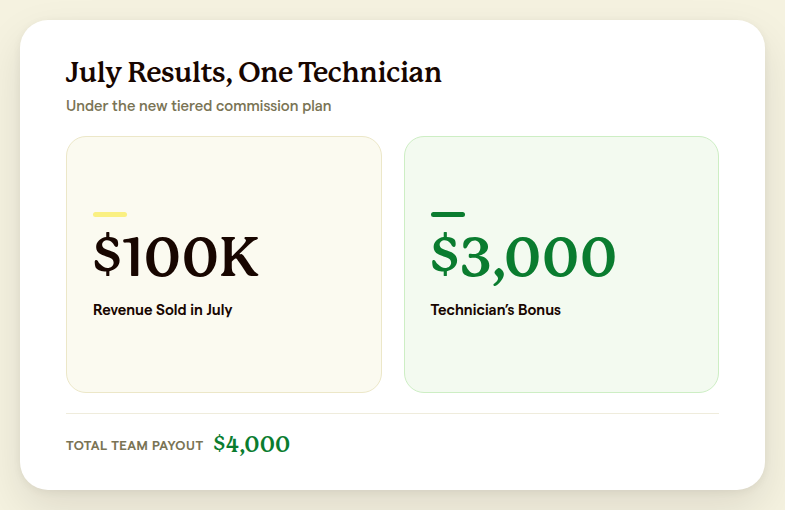
July was the first full month under the rebuilt structure, and it produced the kind of result the original plan had never once come close to. The team's top-earning technician sold roughly $100,000 in revenue that month and earned a $3,000 bonus for it, notable in particular because that number came almost entirely from sales, not from installs. He had, in the owner's words, barely touched a wrench, and still walked away with a meaningful bonus because the new tiers rewarded the selling itself rather than requiring a technician to also be the one swinging the tools. Across the whole team, incentive payouts for the month totaled roughly $4,000, spread across everyone who cleared a tier rather than concentrated in a single flat number that meant the same thing to everybody.
The owner's reaction is worth dwelling on, because it says something about what a working incentive plan actually does beyond the math. He decided to have an oversized novelty check printed, the kind normally reserved for golf tournaments and game shows, so he could hand it to his top performer in front of the rest of the crew. That is not a detail a spreadsheet produces on its own. It came from a payout that finally felt big enough, and fair enough, to be worth celebrating out loud, in front of the team, rather than quietly dropped into a paycheck and never mentioned again. The other technicians watching that moment are the ones a redesigned plan is really built for. A $3,000 check waved around the shop the next morning does more to pull the rest of the team toward the next tier than any explanation of the new thresholds ever could.
It also reframes what a company gets for its incentive spend. The old plan's flat 1 percent floor cost the business money every month and bought almost nothing in return, since it paid out regardless of whether a technician pushed harder or coasted. The rebuilt plan's roughly $4,000 in total July payouts bought something specific: a top performer with a public, visible reason to keep selling, a team watching that performer get rewarded and recognized in front of them, and an owner who could point to a real number instead of a hope when he talked about what the incentive plan was supposed to do. The dollar total was not dramatically larger than what the old plan might have paid out across a full team in a typical month. What changed was where the money went and what it was buying.
What This Means for Your Own Plan
If a commission tier in your own shop has been sitting untouched for months, it is worth asking whether the number was ever checked against a real month of payroll data, or whether it was set the same way this company's original floor was, as a reasonable-sounding guess. A threshold nobody can reach and a flat payout that ignores effort are two versions of the same underlying failure: a plan that does not actually distinguish between a technician's best month and an ordinary one. Companies exploring a similar rebuild, tying commission tiers to sold hours rather than a single flat rate, can see how ShareWillow structures multi-level incentive pay plans that calculate every tier automatically instead of leaving an owner to do it by hand at month end. HVAC and home services companies specifically can look at how a similar rebuild played out for a commission tier nobody was hitting at another HVAC shop, or browse what a typical HVAC incentive plan looks like when it is built around real, attainable thresholds from the start.
The lesson underneath the dollar figures is a simple one. A technician who sells $100,000 in a month and takes home $3,000 for it did not get lucky. He got a plan that finally paid attention to what he actually did, in tiers he could actually reach, checked against real numbers instead of a guess. That is the entire difference between a commission structure and a number nobody ever expected anyone to hit.
Related reading
Conclusion
A commission tier nobody can reach isn't an incentive plan, it's a number on a page. Rebuilt around attainable, attendance-linked thresholds, this team's first real payout cycle put $3,000 in one technician's pocket for sales alone, and gave the owner a paycheck he was proud to blow up poster-size.
Create incentives
that
drive results
You shouldn't need complex equity plans to align your team. ShareWillow makes it simple to create transparent profit-sharing programs that motivate employees and grow your business.

Incentive plans to help
small businesses thrive.
.png)
"I was able to leverage the knowledge of the ShareWillow team to learn how other companies were designing their bonus plans. The template was extremely helpful."

Brian Tustin
Owner, First Rate Movers