
An 18-person electrical contractor had sales reps running on three or four different commission structures at the same time, with no shared standard. Here is how the company unified everyone onto one KPI-driven plan without blowing up anyone's paycheck.
Five Ways To Get Paid Is Four Too Many
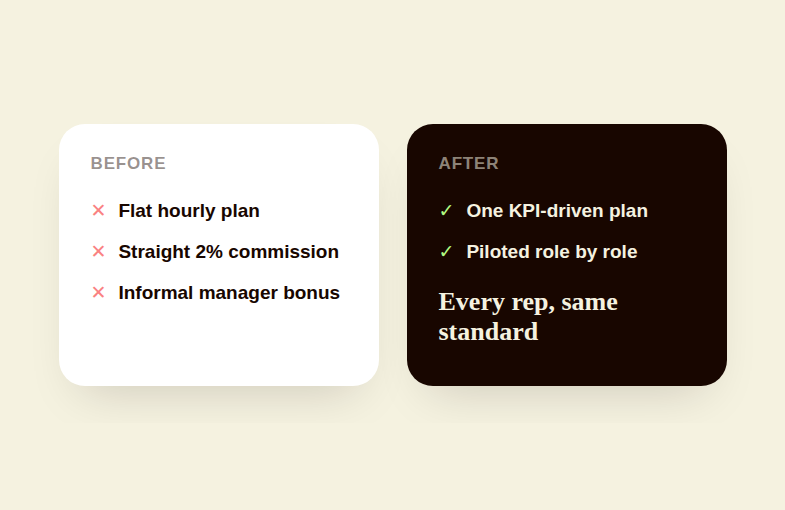
An 18-person electrical contractor came into a recent planning conversation with a problem that will sound familiar to a lot of growing trades businesses. The company had grown fast, adding sales reps, field techs, and office staff over a few years, and its commission structure had grown right along with it. Except it had not grown as one plan. It had grown as five.
Different reps were being paid on different terms depending on when they were hired, which manager onboarded them, and which deal type they closed most often. One rep worked off a flat percentage of revenue. Another had a tiered structure that kicked in after a monthly threshold. A third was on a hybrid plan nobody could fully explain without pulling up a spreadsheet. None of it was malicious. It is just what happens when commission plans get built deal by deal, hire by hire, instead of designed as a system from the start.
The cost of that drift is not just administrative headache, though there was plenty of that. It is fairness. When five people on the same sales team are technically earning under five different formulas, two things happen. Top performers start to suspect, sometimes correctly, that they are not getting the best deal available. And managers lose the ability to answer a simple question: is our commission plan actually working the way we designed it to?
Why Fragmented Commission Plans Happen
It is worth naming why this happens, because it is rarely a planning failure so much as a byproduct of growth. A company hires its first sales rep and builds a commission plan around that one person's role. A year later it hires a second rep with a slightly different focus, maybe more service work than new installs, and adjusts the plan to fit. By the time an electrical contractor has 18 people between sales, field, and office, the "plan" is really a patchwork of one-off decisions that made sense individually but never got reconciled into something coherent.
This is especially common in electrical, HVAC, and plumbing businesses because roles blur. A service tech might also sell add-on work. A sales rep might also run a small crew. Every one of those hybrid roles tends to get its own custom pay arrangement instead of fitting inside a shared framework, and the framework never gets built because nobody has time to stop and design one while also running the business.
The fix is not to punish anyone for how the plan got fragmented. It is to replace the patchwork with one standard that flexes by role without splintering into five different formulas.
Building One KPI-Driven Plan
The company's new approach centers on a single KPI-driven commission plan that applies to every relevant role, with the specific targets and weightings adjusted by position rather than by individual. A sales rep and a service tech who upsells might be measured on different key metrics, but they are both operating inside the same plan architecture, with the same transparency and the same rules for how a dollar earned becomes a dollar paid.
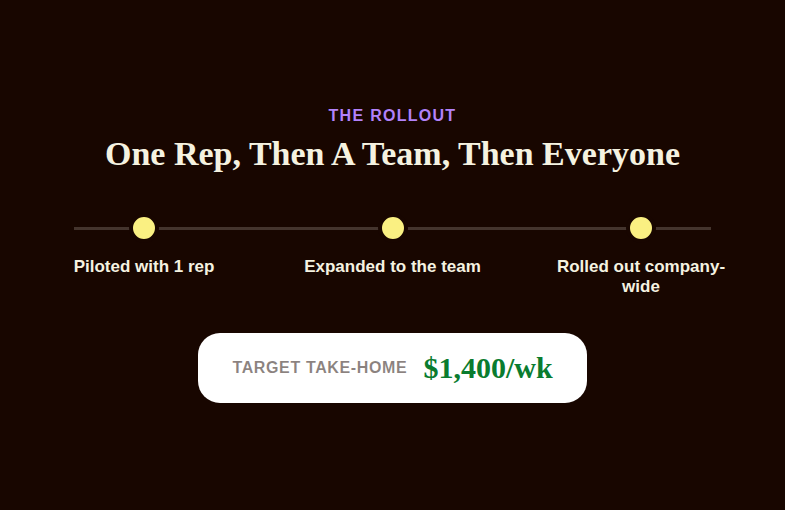
Rolling out a change like this across 18 people is not something you flip on company-wide overnight, and the team was deliberate about that. The plan was piloted person by person, starting with a single rep, before expanding to the broader team and eventually the full company. That staged rollout mattered for two reasons. It let the company catch structural issues while the blast radius was small, like a KPI that sounded good in theory but was hard to track accurately in practice. And it let the first participants become internal proof points. When a rep on the new plan can point to a clear, predictable number, that credibility travels faster through a team than any announcement from ownership ever could.
The target the company built toward was a consistent take-home of roughly $1,400 per week per rep under the new structure, a number chosen specifically so every rep, regardless of which of the old five plans they used to be on, could see what "fair and achievable" looked like under the new one.
What Unifying Pay Actually Buys You
The most obvious win here is administrative. One plan is dramatically easier to run, audit, and explain than five. But the bigger win shows up in how the team talks about pay. When commission structures are unified and transparent, conversations about compensation stop being individual negotiations and start being conversations about performance. A rep who wants to earn more knows exactly which numbers to move, because everyone is playing by the same rules.
There is also a retention angle that is easy to underestimate. Fragmented commission plans quietly punish loyalty. The rep who has been there five years is often on the oldest, least favorable version of the plan, simply because nobody went back and updated it. Unifying the structure fixes that silently, without ever having to have an awkward individual conversation about why someone's deal was worse than a newer hire's.
For any incentive pay platform to make this kind of unification possible, it has to handle the messy part well: different roles, different KPIs, one coherent plan, rolled out gradually enough that people trust the number before they are asked to depend on it. That is the part that turns "we should really fix our commission plan" from a permanent to-do item into something that actually ships.
If your team is running more pay structures than you can list from memory, that is usually not a sign you need more plans. It is a sign you are overdue for one good one. For more on getting incentive structures right the first time, see How a 10-Person Electrical Shop Turned One Number Into Real Technician Pay and The $600 Bonus Nobody Earned: How One Sales Team Fixed Its Duplicate Commission Problem.
Profit sharing
made simple.
Give your team a stake in the company’s success. ShareWillow helps you create and manage profit-sharing programs that motivate employees and drive business results.
Signs Your Commission Structure Has Fragmented
A few warning signs tend to show up well before a company realizes it is running five plans instead of one. If more than one of these sounds familiar, it is worth an audit.
- You cannot describe your commission plan in one sentence. If explaining how pay works takes a flowchart, a spreadsheet, and a caveat about "well, except for" someone specific, the plan has already fragmented, even if nobody has called it that yet.
- New hires get a different deal than tenured staff for the same role, and not because performance or seniority explains the gap. That is usually a sign the plan was rebuilt at some point without folding existing team members into the update.
- Reps compare notes and get confused, not competitive. A little friendly comparison is healthy. Confusion about why two people in the same role are paid on different formulas is not.
- Payroll takes longer every cycle, not because the business grew, but because more exceptions and one-off calculations have piled up over time.
None of these are signs of a bad business. They are signs of a business that grew faster than its pay structure did, which is a good problem to have and a very fixable one. The company in this story fixed it not by writing a more complicated plan, but by writing one, clear, KPI-driven plan and giving every role a fair way into it.
Questions Owners Ask Before Unifying Commission Plans
Won't some reps end up worse off under one plan? It is a fair concern, and it is exactly why the pilot approach matters. Rolling the plan out person by person, starting with a volunteer or a trusted rep, lets a company see the real-world impact on take-home pay before anyone is forced into a change. In this case, the target take-home of $1,400 per week was set specifically so the new plan improved outcomes for the team, not just for the business.
How long does it take to design a KPI-driven plan from scratch? Less time than most owners expect, mainly because the hard part is not designing the plan. It is agreeing on which KPIs actually reflect the work each role does. Once that is settled, usually in a handful of focused conversations, building the plan itself and rolling it out in stages can happen inside a single quarter.
Does one plan mean everyone gets paid the same way? No, and this is the most common misunderstanding. A unified plan means one framework and one set of rules, not identical pay for different jobs. A field tech who upsells and an inside sales rep can both operate under the same KPI-driven structure while being measured on entirely different metrics that fit their actual role.
What if a rep pushes back on switching plans? This is where the pilot data does the talking. Once a rep can see, in real numbers, that the new plan performs at least as well as the old one, resistance tends to fade quickly. The company found that reps who were skeptical going in became some of the strongest advocates once they saw their own paycheck under the new structure.
Related reading
- How a Small Electrical Company Rebuilt Commission to Keep Its Best Installers
- How a Multi-Trade Contractor Stopped Double-Paying Commission on Generators
- Incentives, Commissions, and Bonuses: What’s the Difference and Why It Matters
- 9 Bonus Structure Examples Employees and Employers Love
- Electrician Bonus Plan: How an Electrical Company Rewards Passed Inspections and Scores Apprentices Every Week
Conclusion
A commission plan that only one person in the office can fully explain is not really a plan. It is a collection of exceptions waiting to cause a dispute. This electrical contractor did not need a more generous pay structure. It needed one plan, applied consistently, that every rep could trust and every manager could actually run. If your team is one audit away from finding out how many different ways your people get paid, that is usually the clearest sign it is time to build the one plan that replaces all of them.
Create incentives
that
drive results
You shouldn't need complex equity plans to align your team. ShareWillow makes it simple to create transparent profit-sharing programs that motivate employees and grow your business.

Incentive plans to help
small businesses thrive.
.png)
"I was able to leverage the knowledge of the ShareWillow team to learn how other companies were designing their bonus plans. The template was extremely helpful."

Brian Tustin
Owner, First Rate Movers
