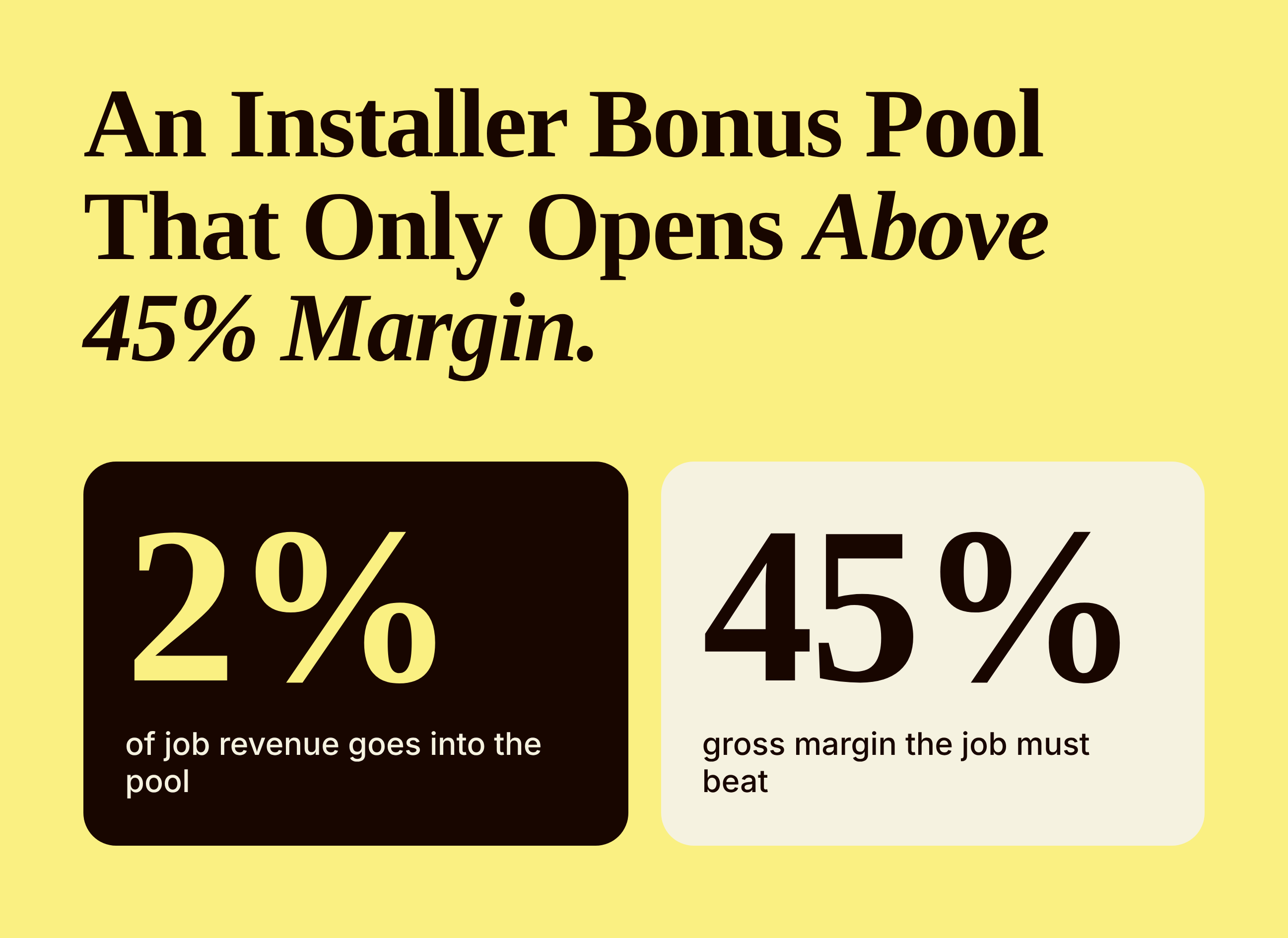
Landscaping crew bonus plan: a report showed 31.83 hours saved on a 50-hour bid, but the crew used 54.25. Here is how one company fixed the data first.
A landscaping crew bonus plan lives or dies on one number: how many hours the crew was supposed to take versus how many it actually took. One landscaping company that runs mowing, maintenance, and construction crews just learned how easy it is to get that number wrong. Its new incentive report showed a construction crew saving 31.83 hours on a job bid at 50 hours. The owner's lead said the crew had actually spent 54.25 hours across several visits. That is not a savings. That is a job that ran over by 4.25 hours.
The company caught the gap in a review call before anyone was paid on it. This is what went wrong, what they changed, and the rules they put in place so a landscaping crew bonus plan reflects the real job.
The Problem: Construction Does Not Behave Like Mowing
Mowing is repetitive. A crew shows up, mows, leaves, and the hours for that visit are easy to total. A bonus built on hours saved against an estimate works well there, which is the lesson from a landscaping company that fixed its mowing incentive and landed on a clean rate for every hour saved.
Construction and hardscape work is different. A job might be fine grading and hydroseeding that stretches across several visits. A crew might work two days, pause for four to six weeks while the customer waits on a permit or the weather turns, and then come back. The software the company uses to track time records each task and each clock-in, but it does not record when a construction job is finished. When the report decided how many hours were used, it looked at the clock-in dates it could see and totaled a portion of them.
That is how a 54.25-hour job showed up as 18.17 recorded hours against a 50-hour estimate, and how a reasonable-looking dashboard produced a 31.83-hour "win." Nothing was wrong with the idea of the bonus. The report was simply measuring a slice of the job and calling it the whole thing.

A few other data issues showed up in the same review:
- A maintenance report pulled in the wrong job, showing 70 estimated hours against only 4.38 recorded, when the real job had 61.07 hours logged against a 70-hour bid
- Time entries were sometimes assigned to the wrong task or job, which the operations lead said takes hours a day to correct
- A construction win of $139 was based on a placeholder amount, and another $400 win was claimed on a job where much of the work may have shifted to time and materials
Landscaping Crew Bonus Plan Rule One: Add Up Every Visit
The first fix is to stop treating each time-sheet entry as its own job. For construction, the company is changing the report so it combines every entry for a job across the year before it compares hours to the bid. A job with five visits becomes one job with one total. That is the number that gets compared to the estimate, and it is the number a crew lead can check against their own memory.
This matters for fairness as much as accuracy. A crew that finishes a job in 40 hours should be paid for beating a 50-hour bid, and a crew that takes 54 should not. When the report undercounts, it quietly rewards the wrong behavior and teaches the team to distrust the plan. If you have ever wondered why crews stop caring about a bonus, that is usually the reason. Our case study on paying $50 for every hour a crew saves shows how a clean hours-saved award works once the underlying numbers can be trusted.
Rule Two: Mark the Job Complete Before It Pays
Because the software does not give a completion date for construction, the company is adding a simple yes or no field at review time: complete or not complete. The award only calculates for jobs marked complete. That small qualifier prevents the second kind of error, where a job that is only half finished looks like it is far under budget.
It also puts a human decision in the loop at the moment it matters. The two people who review jobs each week look at the hours, confirm the job is done, and mark it. The bonus then follows the review instead of guessing at it. That is a lighter touch than building complex automation, and for a company whose construction jobs can pause for weeks, it is the most reliable option available.
Rule Three: Decide What Happens When the Scope Changes
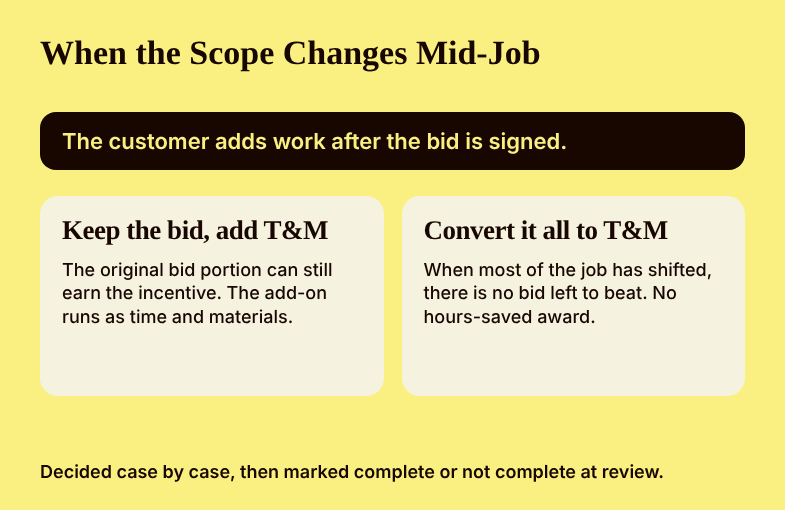
The hardest question on the call was not about software at all. Construction jobs change. A customer adds sod, a trench turns out to be deeper than expected, or half the property is suddenly in scope. If the original bid was 50 hours and the job grew, what does the crew's incentive cover?
The company landed on a case-by-case answer, with two options:
- Keep the bid portion and add time and materials. The original scope can still earn the incentive, and the added work is billed and tracked separately
- Convert the whole job to time and materials. When most of the work has changed, there is no fixed bid left to beat, so no hours-saved award applies
One specific job on the list, a sod project, is waiting on that call from the owner. Writing the rule down before the next scope change is the point. A crew should never have to guess whether a change erases their bonus. The broader lesson shows up in our story about a job budgeted at $1,400 that cost $518: a bonus tied to a budget only works when everyone agrees on what the budget covers.
Profit sharing
made simple.
Give your team a stake in the company’s success. ShareWillow helps you create and manage profit-sharing programs that motivate employees and drive business results.
Callbacks: Keep Judgment Where It Belongs
On the mowing side, the review also settled a debate about callbacks. The company could try to detect them automatically. It chose not to. Callbacks are case-specific: a customer complaint about a missed edge is not the same as a lawn that grew back after a drought. The team records the decision in a shared spreadsheet by flipping a callback field to true, and the next data pull marks that job ineligible for the award.
It is a sensible compromise. Judgment calls stay with the people who know the customer, and the plan applies them consistently. The same week, the mowing dashboard showed a projected payout of $91 for one crew member the prior week and $74 for the current week, split between two people and expected to drop after callback exclusions. Small numbers, but they are real numbers the crew can see and trust, which is where trust in a plan starts.
The Result: A Plan That Measures the Real Job
Before anyone was paid, the company found a 36-hour swing between what the report said and what the crew actually did, caught a wrong-job entry in maintenance, and wrote three rules that make construction bonuses defensible: add up every visit, mark the job complete, and decide scope changes in advance. The data is still being cleaned up, and the team is working through time-clock issues, but the structure is in place.
How to Set Up a Landscaping Crew Bonus Plan
- Total every visit. Combine all time entries for a job before comparing them to the bid.
- Require a completion check. A yes or no at review keeps half-finished jobs from paying out.
- Write your scope-change rule now. Decide how bid work and add-on work are treated.
- Handle callbacks with judgment. Record them in one place and let the plan apply them.
- Audit a few jobs by hand. If the report disagrees with the crew lead, trust the crew lead and find the gap.
For more on how plans like this are built across trades, see our bonus structure examples, and if you run a landscaping company, ShareWillow's product features show how job data connects to pay.
Frequently Asked Questions
How do you pay a landscaping crew a bonus?
The most common approach is to tie the bonus to hours saved against a bid or estimate, then share a portion of the saved labor value with the crew. The key is that the estimate and the recorded hours both have to be accurate, or the math pays the wrong people.
What happens to the bonus when a landscaping job changes scope?
Decide in advance. Many companies keep the original bid portion eligible and track added work as time and materials, or convert the whole job to time and materials when the scope shifts a lot. What matters is that the rule is written down before the first change.
How do you handle callbacks in a crew incentive?
Record each callback decision in one shared place and mark the affected job ineligible. Because callbacks vary, many companies prefer a manual yes or no over trying to automate it.
Related reading
Conclusion
Total every visit, mark the job complete, and settle scope changes in advance so a crew bonus rewards the real job.
Create incentives
that
drive results
You shouldn't need complex equity plans to align your team. ShareWillow makes it simple to create transparent profit-sharing programs that motivate employees and grow your business.

Incentive plans to help
small businesses thrive.
.png)
"I was able to leverage the knowledge of the ShareWillow team to learn how other companies were designing their bonus plans. The template was extremely helpful."

Brian Tustin
Owner, First Rate Movers