One technician on a small water delivery route got flagged 19 times in a single week for unpaid invoices that were actually paid. Here's how a three-day grace period and two other fixes got that down to 4 for the whole month.
Nineteen False Alarms in One Week
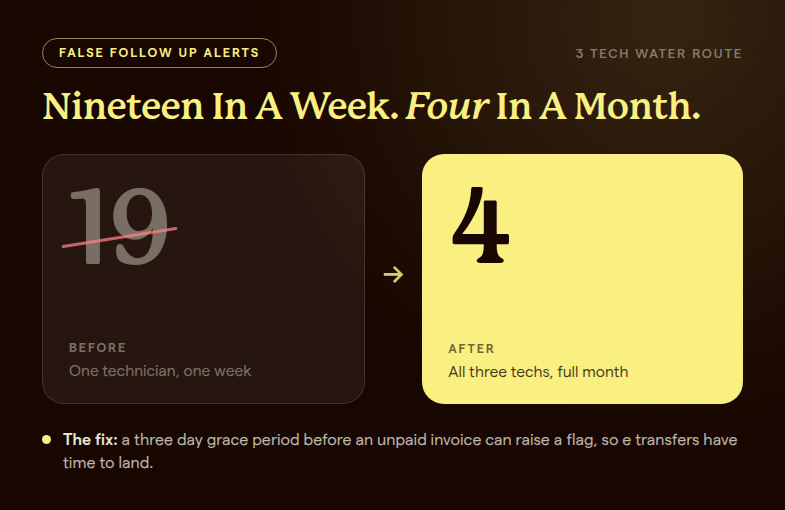
Picture the busiest technician on a small water treatment and delivery route. Nineteen times in a single week, the payroll system flagged one of his jobs with the same warning: manager needs to follow up on an unpaid invoice. Almost every job he touched, the operations lead said, "almost 100 percent of the jobs" that week carried the flag.
If you ran that route, what would you assume? That your tech was skipping collection steps. That customers weren't paying. That something in your process had quietly broken. You'd start having an uncomfortable conversation with a technician who, it turned out, hadn't actually done anything wrong.
The real cause was smaller and stranger: customers were paying by e-transfer, and the bookkeeper hadn't marked those payments as received in the system yet by the time the flag fired. The invoice was, in every practical sense, paid. The software just hadn't caught up. Once the team added a simple three-day grace period before an unpaid invoice counts against a technician, the flag count for that entire month dropped to four. Not four per week. Four for the whole month.
That's a 79 percent reduction in false alarms, and it took about twenty minutes to fix once someone actually looked at why it was happening.
A Small Route, a Lot of Moving Parts
This company runs a route-based water treatment and delivery operation out of a single depot, with three core field technicians covering the day-to-day stops and two additional techs on a separate, lower-oversight pay structure for piece work. It's a lean operation. The person who runs point on data and finances, effectively the company's own power user, described a familiar feeling on a recent call: "All the metrics look so good when we meet, and then I look at them on my own time and nothing. I don't know why. Missed something."
That sentence is worth pausing on, because it's not a complaint about the software. It's an honest description of what it's like to run a small field service business with real work to do. Dashboards make sense in the moment, with someone walking you through them. Alone, at 9pm, after a full day, they often don't, not because the numbers are wrong but because nobody's had time to build the habit of checking them the same way twice.
The company runs its jobs, invoices, and task tracking through one platform and its vehicle mileage through a separate fleet tracking tool, with ShareWillow syncing the two together to calculate pay. That's a completely normal setup for a route-based business. It's also exactly the kind of setup where small data mismatches between two systems can quietly snowball into numbers nobody trusts.
Three Errors, Twenty Minutes, Zero Defensiveness
What makes this story worth telling isn't just that the errors got fixed. It's how quickly they got fixed once someone was actually looking for them, and how the team responded when the problems turned out to be on their own end.
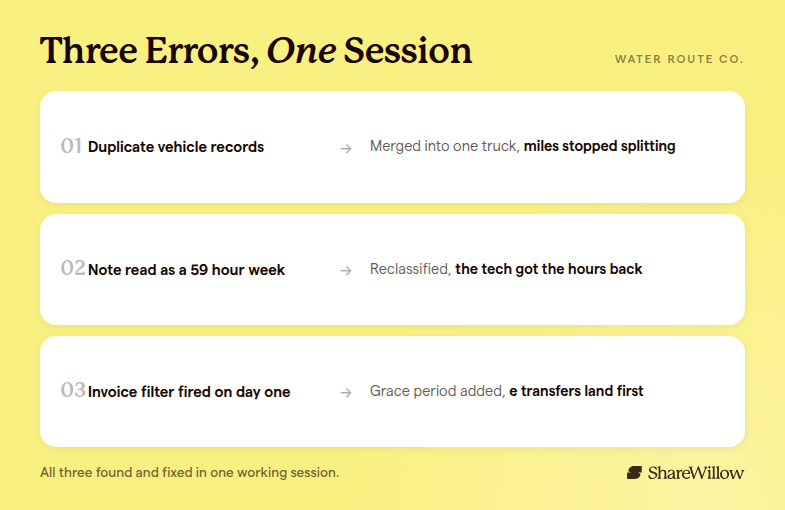
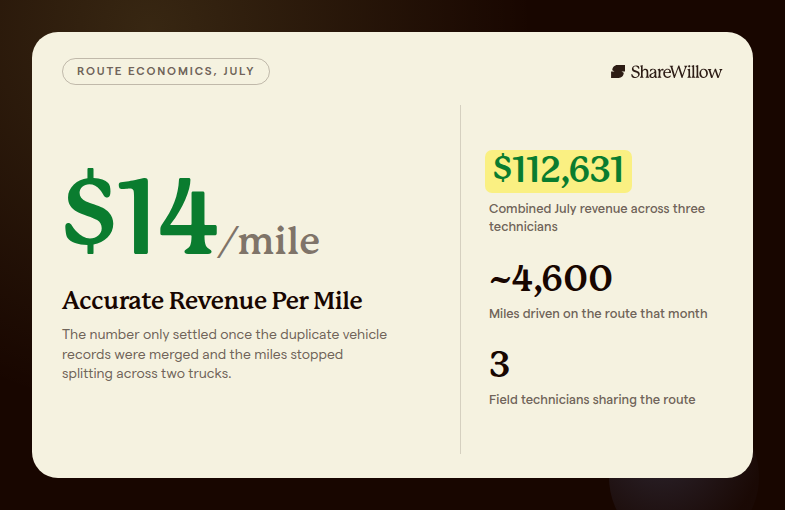
Error one: revenue per mile looked triple a normal month. When July's revenue-per-mile number came in looking almost three times higher than usual, the operations lead flagged it immediately rather than assuming it was a good month. The cause was duplicate vehicle records in the fleet tracking tool, essentially the same truck logged twice under slightly different names, which meant mileage was being undercounted against real revenue. Once the vehicle records were cleaned up and correctly mapped, the number settled at a believable, accurate $14 per mile average. His response, once he understood the cause, was immediate ownership: "That's our fault on our side, then we'll have to figure something out with that."
Error two: a 59-hour week that wasn't real. One technician's weekly hours showed 59, despite the tech only having worked three days that week. The cause was a dispatcher's note marking the tech "booked off" on his days away, which the system had misread as a full day clocked in until 23:59. It wasn't the first time this pattern had shown up either. A previous week had shown the same technician logging as many as 200 hours, an obviously impossible number that had gone uncorrected until this review caught it. Once flagged, the fix was straightforward: correct the punch logic so a "booked off" note doesn't get read as hours worked. The reaction from the company side, again, was to own it rather than deflect: "I'm sorry, I should've looked into that more."
Error three: the false unpaid-invoice flags. This one, it turned out, traced back to a filter mistake ShareWillow's own team had made on a prior call. Rather than let it sit, the rep owned it directly on the call: "That was just me messing with the report, that I should [not have]." The company's reaction wasn't frustration, it was relief, and an immediate, practical ask: build in a grace period so a same-day or next-day e-transfer doesn't trigger a false flag. That fix, the three-day grace period, is what took the flag count from nineteen in a single week down to four for the entire month.
Three separate errors, three different root causes, one on the fleet-tracking side, one on the dispatch side, one on ShareWillow's own reporting side, all surfaced and corrected inside a single thirty-minute working session. Nobody spent the call defending their turf. Everybody spent it fixing the actual problem.
What a Trustworthy Number Is Actually Worth
It's tempting to read a story like this and think the win is the 79 percent number. It's not, not really. The real win is quieter: a small operator who runs three techs and a fleet of trucks no longer has to wonder whether a flag on his screen means something real or means his tools disagreed with each other again.
Across the three core technicians, July brought in $112,631 in combined revenue, split roughly $37,388, $35,308, and $39,053 across the crew, over about 4,600 miles of route driving. Those are real, specific, tech-by-tech numbers that a three-person operation can now use to have an actual conversation about performance, instead of an argument about whose fault a red flag is.
That shift, from arguing about the data to trusting the data, showed up clearly in how the call ended. After three separate mistakes got surfaced and fixed in half an hour, the response wasn't irritation. It was gratitude, unprompted: "You're the best. You guys' customer service is so awesome. You guys blow me away. Really appreciate it." That's not the kind of thing people say about a vendor relationship where every call is a fight. It's what people say when a problem got solved fast, honestly, and without anyone getting defensive about it.
Profit sharing
made simple.
Give your team a stake in the company’s success. ShareWillow helps you create and manage profit-sharing programs that motivate employees and drive business results.
Why This Matters Beyond One Route
Most small trades and field service businesses run on at least two systems that don't talk to each other cleanly: a job or dispatch platform and something else, a fleet tracker, a separate payroll tool, a spreadsheet someone built years ago that everyone's afraid to touch. Every seam between those systems is a place where a duplicate record, a misread status, or a stale filter can quietly generate a number that looks official but isn't true.
The fix isn't more oversight. Nobody wants to hire someone whose whole job is auditing the fleet tracker against the job software every week; that's not a real job, and it's not a good use of anyone's time on a three-truck operation. The fix is building the reconciliation logic once, correctly, so the two systems agree automatically and a human only gets pulled in when something genuinely needs a second look.
A few habits worth borrowing from this story, regardless of what trade you're in or what software you run:
- When a number looks unusually good or unusually bad, check it before you act on it. A revenue-per-mile number that's triple normal is almost never a great month. It's almost always a data problem wearing a good month's clothes.
- Build grace periods into anything that penalizes a technician automatically. Payment timing, especially with e-transfers and manual bookkeeping steps, is rarely instant. A rigid same-day rule will generate false positives no matter how good your software is.
- Own your own mistakes fast, on both sides of the relationship. The single biggest reason this got resolved in thirty minutes instead of dragging out over weeks is that nobody spent time defending a wrong number. Everybody moved straight to fixing it.
Building Incentive Pay for a Route You Can't Watch in Person
There's a specific challenge that route-based businesses have that a shop with a single location doesn't: you can't see the work happen. A tech on a water treatment route, a pool service loop, a lawn care circuit, or a pest control territory spends the entire day out of sight, making dozens of small decisions nobody's there to observe. Did they double check the filter before leaving. Did they mention the upsell. Did they take the efficient route or the familiar one. Incentive pay is one of the only tools that reaches into all of those small decisions without requiring a manager to ride along.
But that only works if the underlying numbers are right. A tiered, revenue-per-mile or revenue-per-stop structure sounds simple on a whiteboard. In practice it depends on clean vehicle records, accurate job completion data, and time tracking that reflects what actually happened, not what a misread dispatch note implies happened. Get those three things wrong and the incentive plan doesn't just fail to motivate, it actively erodes trust, because a tech who's doing everything right can end up looking like the problem on paper.
That's really what this story is about underneath the specific numbers. Three real errors, on three different systems, each one capable of quietly convincing an owner that a good technician was underperforming or a route was less profitable than it actually was. Finding and fixing all three in one sitting is what let this small operation keep its plan simple: pay based on real revenue per mile, split fairly by technician, without a manager needing to manually sanity-check every number every week.
Where to Start on Your Own Route
If you're running a route-based or field service business and you've ever looked at a metric and thought "that can't be right" but moved on anyway because you didn't have time to dig in, that instinct is usually correct. The gap is almost never that big to fix once you find it. It's finding it that's hard without the right eyes on the data regularly.
ShareWillow's platform features page walks through exactly how job data, mileage, and time tracking get reconciled automatically into a pay plan your team can trust without a manual audit every month. And if you want a no-obligation look at where your own numbers might be quietly disagreeing with each other, the free incentive audit connects directly to your existing tools and shows you the gaps in plain language, not spreadsheets.
Related reading
Conclusion
Three data errors, thirty minutes, and a route-based crew that trusts its dashboard again.
Create incentives
that
drive results
You shouldn't need complex equity plans to align your team. ShareWillow makes it simple to create transparent profit-sharing programs that motivate employees and grow your business.

Incentive plans to help
small businesses thrive.
.png)
"I was able to leverage the knowledge of the ShareWillow team to learn how other companies were designing their bonus plans. The template was extremely helpful."

Brian Tustin
Owner, First Rate Movers