Technician pay plans compared: a home services company piloted commission against hourly pay for one week, and techs earned up to 55% more take-home pay.
Technician pay plans are one of the hardest decisions a home service company owner ever makes, and most owners make the call once and never revisit it. Flat hourly pay feels safe. It is predictable for payroll, easy to explain to a new hire, and it never produces an awkward conversation about why one technician's check looks different from another's. It also has a quiet cost: it pays the technician who works a slow, easy day exactly the same as the technician who works a heavy, high-value one.
One home services company decided to actually test that assumption instead of debating it. Rather than switching every technician to commission overnight, the owner ran a side-by-side pilot: a two-person install crew, a lead technician and a helper, would be paid what they would have earned under the existing hourly wage, and separately what they would have earned under a proposed commission plan, for the same week of real jobs. Then they would compare the two paychecks line by line.
Why the company tested technician pay plans instead of guessing
The pain point was simple to describe and hard to solve: technicians were paid hourly no matter what they actually produced. A crew that knocked out a large, high-ticket job on a Saturday earned the same rate as a crew that spent the week on smaller, lower-margin work. There was no mechanism to reward the technician who took the tougher jobs, worked the weekend slot, or ran solo when a helper called out. Over time, that flatness becomes its own kind of unfairness. The company's best performers had no financial reason to keep being the best performers.
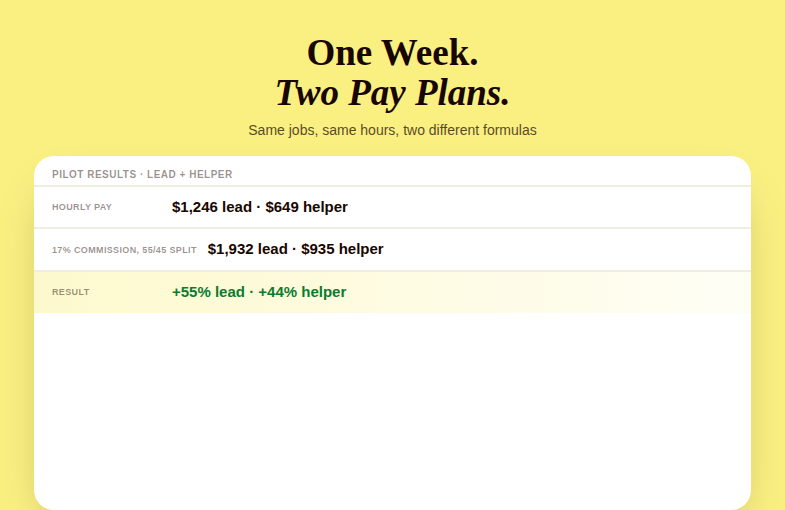
Leadership landed on a completed-revenue commission structure: 17% of completed revenue on each job, split 55% to the lead technician and 45% to the helper. It is a straightforward version of the kind of plan we cover in more depth in our guide to how to calculate bonus pay, and it mirrors what a lot of installation-heavy trades land on once they move past a flat hourly wage.

The one-week test that settled the argument
Instead of announcing a permanent change and hoping it worked out, the company ran both pay structures on paper for a single week and compared the results before making any commitment to the crew. That is a detail worth calling out on its own: testing a new pay plan against real job data before it touches anyone's actual paycheck is a much lower-risk way to find out whether the math works than rolling it out company-wide and hoping.
The results were not close. The lead technician's jobs for the week totaled $11,370 in completed revenue. At 17% with the 55% lead split, that technician would have earned $1,932 in commission, compared to $1,246 under the hourly rate for the same hours worked. That is a 55% increase in take-home pay for the exact same week of labor. The helper technician's jobs totaled $5,503 in completed revenue; at the 45% helper split, that technician would have earned $935 in commission versus $649 hourly, a 44% increase.
Both technicians beat their hourly rate in the same week they happened to work a heavier, higher-value job mix. That is exactly the signal a commission pilot is supposed to surface: does better work actually translate into better pay, or does the pay stay flat no matter what gets done?
What makes this test useful is that it was not cherry-picked after the fact. The company reviewed real, completed jobs for one calendar week and ran both formulas against the same numbers. No one adjusted the commission rate to make the story look good; the 17%/55%/45% structure was set before the week started. That is the difference between a pay plan you can trust and one you have to take on faith.
What a one-week pilot cannot tell you yet
To be fair to the process, one strong week is a signal, not a verdict. The company deliberately held off on going live company-wide and instead planned to track a second week before sitting down with the crew to make the plan permanent. A single week can be flattered by an unusually good job mix, and a technician pay plan that only looks good on a great week is not a technician pay plan you can build a business on. The honest next step, and the one this company took, is to run the comparison again on an ordinary week, not just a strong one, before locking anything in.
That patience matters more than it sounds like it should. A lot of companies read a story like this one and want to flip every technician to commission the following Monday. The better move, and the one worth borrowing directly from this company's playbook, is to pilot it with one crew, on real numbers, for at least two pay periods, before deciding whether it is right for the rest of the team.
Profit sharing
made simple.
Give your team a stake in the company’s success. ShareWillow helps you create and manage profit-sharing programs that motivate employees and drive business results.
How to run your own technician pay plan test
You do not need new software or a consultant to run a version of this test yourself. A few practical steps carried this pilot, and they will work in a five-person company just as well as a fifty-person one.
- Pick a commission rate and a split before you look at the week's numbers. If you set the rate after seeing the results, you have not tested anything, you have just picked a number that flatters the story you wanted to tell.
- Run it on paper first. Calculate what the crew would have earned under commission for a week of jobs they already completed under hourly pay, then compare the two totals line by line.
- Test more than one week. A single strong week tells you the plan can work. A slow week tells you whether the floor is livable. You need both before you commit.
- Split multi-technician jobs deliberately. A 55/45 lead-helper split, or whatever ratio fits how your crews actually divide the work, keeps the person doing the harder or more customer-facing part of the job from feeling shortchanged.
- Bring the crew into the review. Technicians trust a pay plan more when they have seen the actual math, not just the new number on their check.
This kind of hybrid thinking, where a company keeps the safety of a base structure while layering in performance pay, shows up across trades. A different home services company took a related approach and built a hybrid pay plan that pays whichever is higher between a guaranteed rate and commission, so technicians never have to choose between stability and upside. Another company took sold hours specifically and turned them into a bonus worth chasing once the metric was visible and predictable.
None of this is specific to installation crews. Facility management teams that dispatch in-house maintenance staff, HVAC and plumbing companies running mixed hourly and commission crews, and electrical or pest control companies weighing the same question all face the identical core problem: a flat hourly rate cannot tell the difference between a technician who is carrying the team and one who is coasting. The mechanics of the pilot, testing a proposed rate against real job data before touching anyone's paycheck, work the same way regardless of trade.
Frequently asked questions about technician pay plans
Is commission or hourly pay better for technicians?
Neither is universally better. Hourly pay protects technicians from a slow week and keeps payroll simple, but it does not reward technicians who take on harder or higher-value jobs. Commission rewards production but introduces pay volatility. Many companies land on a hybrid: a guaranteed base plus commission or bonus once production clears a threshold, so technicians get the upside of commission without losing the floor of hourly pay.
How do I split commission between a lead technician and a helper?
Most companies weight the split toward whoever carries more responsibility on the job, commonly somewhere between 55/45 and 65/35 in favor of the lead. The exact ratio matters less than picking one, testing it against real job data, and keeping it consistent so technicians can predict their own pay.
How long should I pilot a new technician pay plan before rolling it out?
Test at least two pay periods, ideally one that looks like a typical week and one that is unusually busy or unusually slow. A single strong week can make almost any commission rate look generous; a slow week is what actually tells you whether the floor is livable for your team.
Designing and testing a technician pay plan by hand, in a spreadsheet, against real job data, is exactly the kind of work that gets skipped when it is tedious. ShareWillow automates that comparison, syncing completed job data so you can see what a commission or bonus plan would have paid your team before you ever change a single paycheck.
Related reading
- How an HVAC Company Built a Hybrid Pay Plan That Pays Whichever Is Higher
- The $3,000 Paycheck: How One Home Services Company Turned Sold Hours Into a Bonus Worth Chasing
- How to Calculate Bonus Pay: A Step-by-Step Guide to Fair and Motivating Compensation
- 9 Bonus Structure Examples Employees and Employers Love
Conclusion
If your best technicians are quietly capped by an hourly rate, a short commission pilot will tell you more than a year of guessing.
Create incentives
that
drive results
You shouldn't need complex equity plans to align your team. ShareWillow makes it simple to create transparent profit-sharing programs that motivate employees and grow your business.

Incentive plans to help
small businesses thrive.
.png)
"I was able to leverage the knowledge of the ShareWillow team to learn how other companies were designing their bonus plans. The template was extremely helpful."

Brian Tustin
Owner, First Rate Movers