
Hourly plus commission for technicians only works if the math checks out. One home services company caught an 8.75-hour pay gap before its first payout.
Hourly Plus Commission for Technicians: Why the Math Needs a Check Before Payday
Hourly plus commission for technicians is one of the most common pay setups in home services. The technician gets a guaranteed hourly wage, and a percentage of sales or completed revenue rides on top. It protects the base, it rewards performance, and it is easy to explain in a hiring conversation.
It is also easy to get subtly wrong. Two numbers have to line up every pay period: the hours payroll already trusts and the commission the plan calculates. If either one drifts, a technician is overpaid or shorted, and nobody notices until a paycheck looks off.
A home services company running technician and CSR plans hit exactly that during setup. Before a single plan went live, the payroll administrator compared the plan's numbers against the payroll records and found four mismatches. This article walks through what they were, how each one got resolved, and the checks any company should run before paying commission on top of hourly wages.
The Plan: Hourly Stays in Payroll, Commission Comes From the Plan
The structure itself was simple. Technicians keep their hourly wage, which continues to run through the company's payroll provider. On top of that, they earn commission calculated from two revenue types:
- 3% of sold-by revenue: credit for the technician who sold the work.
- 15% of completed-by revenue: credit for the technician who finished it.
When two technicians are assigned to the same job, the credit splits evenly between them. A separate plan for the CSR was built alongside it, based on booking rate.
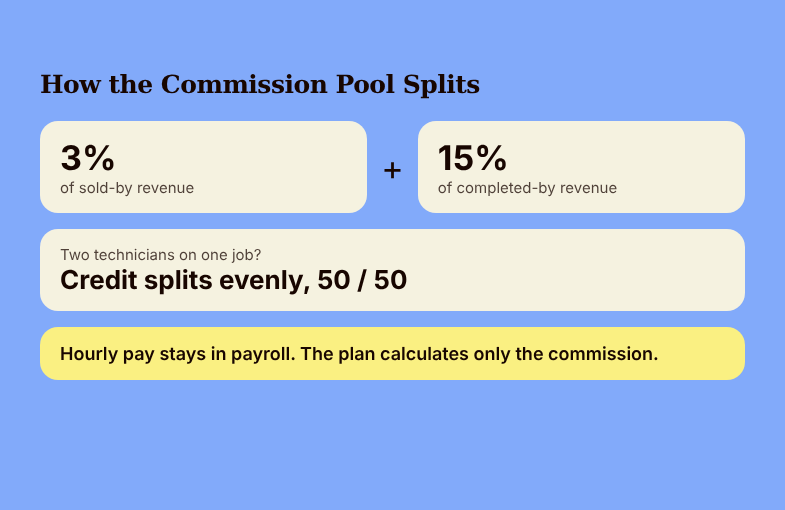
The division of labor is the part worth copying. Payroll keeps owning hourly wages, overtime rules, and tax withholding. The incentive platform owns only the commission figure and hands payroll a number to add. Nobody has to rip out a payroll process that already works. If you want to see how that handoff looks in practice, the ShareWillow product features page walks through it.
The catch is that the commission number depends on data that payroll also touches: job dates, who was assigned, and how many hours were worked. That overlap is where the gaps showed up.
Four Numbers That Did Not Match
The payroll administrator did not take the plan's output on faith. The administrator lined it up against payroll records for one two-week pay period and flagged four things.
1. Regular hours ran about nine hours high
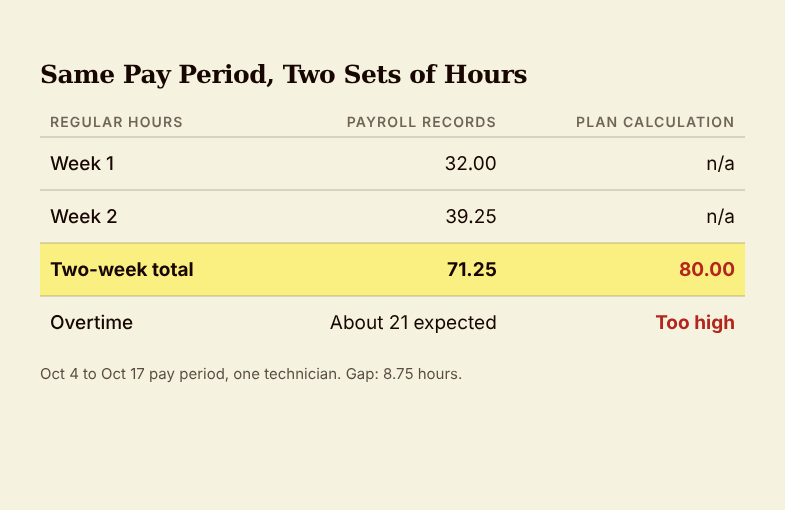
For one technician, payroll records showed 32 hours in the first week and 39.25 in the second, a total of 71.25. The plan showed 80. That is a gap of 8.75 hours in a single pay period for a single person. Multiply that across a full crew and a year, and an overstated hours number turns into real money.
2. Overtime looked too high
Based on a couple of ten- and eleven-hour days, the expected overtime for that technician was roughly 21 hours. The plan's overtime total came out higher than that. Overtime and commission interact, so an inflated overtime figure can distort both the wage side and the incentive side.
3. A booking rate disagreed with the records
On the CSR side, one booking rate showed 85% in the payroll records and 100% in the plan. The cause was a date rule: the plan grouped calls by the job's completion date, while the records used a different date. Neither is wrong on its own. They simply answer different questions.
4. One large install sat inside the sold-by number
A single $20,000 install appeared in the sold-by metric for the period, in a dataset of just three jobs. Whether install sales should earn the 3% sold-by commission at all was an open policy question, and one big job made it impossible to ignore.
None of these were bugs in the ordinary sense. They were rules that nobody had written down yet. That is the real lesson of hourly plus commission pay: the plan is only as good as the definitions underneath it.
Fixing Paid Hours: Meal Deductions, Idle Time, and Overtime
The hours problem traced back to a handful of rules the company applied in payroll but had never spelled out for the plan. Once they were written down, they were straightforward:
- Deduct 30 minutes for shifts under 10 hours.
- Deduct 60 minutes for shifts over 10 hours.
- Exclude idle time from paid hours.
- Count driving time, but only inside the adjusted clock-in and clock-out times.
With those applied, the hours calculation was rebuilt and the overtime logic corrected so it matched what payroll would actually pay. This is the same kind of drift described in The GPS Bug That Turned 36 Hours of Work Into 64 Hours of Overtime: the data was real, but the rules sitting on top of it were not the rules anyone expected.
It also explains why payroll review at this company was slow. Each employee's time entries were checked and corrected by hand, so finalized hours often were not available until late Monday after a Saturday pay-period close. A commission plan that depends on those hours can only be as current as that review.
If your company is deciding how to structure the base side of the plan, the case study on protecting base pay while launching a service and install commission plan covers the tradeoffs in detail. For the overtime side, how one installer company pays the greater of base or performance pay shows another approach.
Profit sharing
made simple.
Give your team a stake in the company’s success. ShareWillow helps you create and manage profit-sharing programs that motivate employees and drive business results.
Two Questions Math Could Not Answer
Two of the four mismatches could not be settled by recalculating. They needed a decision from the owner.
Do install sales count toward sold-by commission? In many home services companies, technicians who sell a replacement or large install earn something for it, and techs who only complete the work earn through the completed-by rate. If installs are sold by a dedicated comfort advisor, paying the technician too can mean paying twice for one sale. The company chose to confirm the policy before finalizing rather than let a single $20,000 job decide it by accident.
Which date drives the booking rate? A CSR books a call on one day, the job completes on another, and the customer pays on a third. Any of the three can be the right trigger, but you have to pick one and use it everywhere. The plan was set up so the person who owns that rule could make the call. The same logic applies to technician commission, and it is covered more fully in this look at sold versus completed revenue.
If you are building a plan like this from scratch, the guide to designing HVAC commission pay is a good companion. It lays out how to choose commission rates and what to measure before you set them.
A Pre-Payout Checklist for Hourly Plus Commission Pay
You do not need special software to run this check, only discipline. Before the first payout under any hourly plus commission plan, verify:
- Hours: compare plan hours with payroll hours for every technician, not a sample.
- Deductions: write down meal-break and idle-time rules and confirm the plan applies them.
- Overtime: recompute a few weeks by hand, including the weeks with the longest days.
- Revenue dates: decide whether sold date, completed date, or paid date triggers commission.
- Outliers: look at the largest single job in the period and ask whether it should count the way the plan counts it.
- Metric dates: pick one date for booking and conversion rates and use it everywhere.
The outcome here was not a flashy percentage. It was a plan where the hours matched payroll, the overtime matched reality, and two policy questions got decided on purpose. In payroll, that counts as a win, because the alternative is a technician who finds the mistake first.
FAQ
Can you pay technicians hourly plus commission?
Yes. Many home services companies guarantee an hourly wage and add commission on sold or completed revenue. The hourly base protects the technician in slow weeks, and the commission rewards the work that grows the company. Confirm the structure with your payroll provider so overtime and minimum wage rules are handled correctly.
How is overtime calculated when technicians earn hourly pay plus commission?
In general, commission earned during a pay period has to be factored into the regular rate when overtime is calculated, not just the hourly wage. The exact method depends on how and when the commission is earned, so have your payroll provider or accountant confirm the formula before the first payout.
What should I check before paying commission on top of hourly wages?
Compare the plan's hours, overtime, and revenue against payroll for a full pay period, technician by technician. Decide which date triggers commission, and review the largest single job to be sure it is counted the way you intend.
Related reading
- Technician Commission vs Hourly Pay: How an HVAC Company Protected Base Pay While Launching a 5% Service and 3% Install Plan
- The GPS Bug That Turned 36 Hours of Work Into 64 Hours of Overtime
- Overtime Pay for Commissioned Employees: How One Installer Company Pays the Greater of Base or Performance Pay
- Sales Commission on Sold vs Completed Revenue: How a 16-Person Home Services Company Caught $224,000 of Installed Work Posing as Sales
Conclusion
Hourly plus commission only feels fair to technicians when every hour and every dollar in the plan matches payroll, so check both before the first payout.
Create incentives
that
drive results
You shouldn't need complex equity plans to align your team. ShareWillow makes it simple to create transparent profit-sharing programs that motivate employees and grow your business.

Incentive plans to help
small businesses thrive.

"I was able to leverage the knowledge of the ShareWillow team to learn how other companies were designing their bonus plans. The template was extremely helpful."

Brian Tustin
Owner, First Rate Movers
