Learn how to pay HVAC helpers and apprentices fairly: see how a 26-person plumbing and HVAC company built separate tiers instead of one flat plan.
Figuring out how to pay HVAC helpers and apprentices fairly, without either underpaying the people learning the trade or breaking the incentive plan for everyone else, is one of the most common places a home service company's pay structure quietly falls apart. A 26-person plumbing, heating, and electrical company based in New Hampshire, running crews in both New Hampshire and Vermont, had been running some version of performance pay for years. It still wasn't working. "Somebody's always unhappy, or there's an issue, and there's always something," the owner said, describing years of tweaking a plan that never quite fit.
The root problem wasn't the commission rate. It was that one plan was being asked to cover three genuinely different jobs: managed technicians who sell and perform the work, non-managed technicians and helpers who support a job but don't sell, and installers running higher-ticket jobs that don't behave like service calls. "Currently, the system is a one-size-fits-all, which is one of the issues," the owner said. "It's really difficult and nerve-wracking to manage."
Why HVAC Helpers Get Left Out of Commission Plans
The company's install crews typically paired one managed technician, who could sell add-on work and closed the job, with a helper or apprentice who was still learning the trade. That helper mattered to the job getting done well and on time, but under the existing commission structure there was no clean way to pay them for it. The company's field service software made the gap worse: "You can't really pull reports for non-managed technicians or give them revenue," the owner explained, describing a system that treated helpers as invisible to the metrics the rest of the pay plan ran on.
That invisibility had a real cost beyond fairness. Technicians didn't know what they'd earn until the check arrived. "Right now, it's like, I wanna make more money, I gotta work more hours. That does not have to be the case," the owner said, describing a team where extra hours felt like the only lever anyone had, whether or not that was actually true under the plan on paper. "Nobody likes the unknown. I'm trying to fix that."
Splitting One Plan Into Three
Working with ShareWillow, the company rebuilt its pay structure around the actual shape of its workforce instead of a single formula stretched to cover everyone. The redesign split into three distinct tracks:
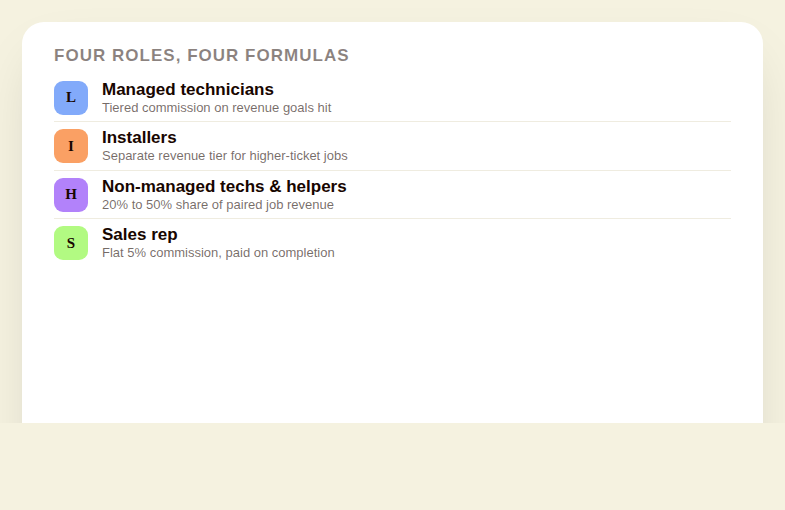
- Managed service technicians kept a tiered commission structure, with commission percentage tied to whether the technician hit a minimum revenue goal for the period, roughly landing around 40 percent of qualifying revenue once tiers and rates were finalized.
- Installers were pulled onto their own revenue tier entirely separate from service work. "It would make sense to have a revenue tier for service jobs and a revenue tier for install jobs separately, because those install jobs are way higher tickets," the owner said, recognizing that folding a $15,000 install into the same tier structure as a $300 service call was mathematically distorting both.
- Non-managed technicians and helpers finally got a defined place in the plan: a combined revenue metric with managed technicians, splitting the credited revenue so a helper paired with a managed tech on a job earned a 50/50 share when both were managed-level, or a 20 percent share when the helper was in a supporting, non-managed role.
A fourth track handled the company's single inside sales representative, who ran on an intentionally simple plan: a flat 5 percent commission on whatever he sold, paid out on job completion rather than tied to any team-wide metric.
How the Revenue Split Actually Works for a Helper
The mechanics of the split mattered as much as the decision to build one. Rather than trying to itemize exactly which minutes of a job a helper contributed, the company kept it simple: on jobs worked by a managed technician and a paired helper, the job's credited revenue is divided according to the role, with the managed technician and a second managed-level partner splitting 50/50 when two leads work together, and a non-managed helper earning a 20 percent share of the combined revenue metric when paired with a managed technician. That gives every helper a direct, visible line between the jobs they touch and the number on their paycheck, without requiring the office to build a parallel time-tracking system just to justify it.
The company was deliberate about keeping the new structure simple rather than more granular, even though more granular was technically possible. "In reality, simpler really is better, from what I've seen, especially when we're implementing something somewhat new," the owner said while finalizing the plan. That preference showed up again when the team considered, and ultimately shelved, a proposed 1 percent "sold-by" commission for certain technicians on jobs they didn't lead. It wasn't rejected because it was a bad idea; it was tabled because it added a layer of complexity the team wasn't ready to manage on day one. "We can remove it for now, and it can kind of be one of those things" the owner said, leaving room to add it back once the simpler version was running cleanly.
The company also moved its payout cadence from every-other-week to monthly as part of the rebuild, choosing to launch the new structure with a full month of clean data behind the first payout rather than trying to reconcile a partial pay period against a brand-new formula. That sequencing choice, launch the calculation logic first, migrate the cadence once the first cycle proves out, is a pattern worth borrowing for any company redesigning how it pays a mixed crew of leads and helpers at the same time.
What Changed for the Techs Who'd Been Invisible in the Old Plan
The clearest sign the redesign worked wasn't a specific dollar figure. It was that, for the first time, every role on a job site, managed tech, helper, installer, or salesperson, had a defined, visible formula tied to work they could see themselves doing. A helper riding along on an install no longer had to wonder whether their work counted toward anything. An installer no longer had their high-ticket jobs diluted by a revenue tier built around service call math. And a technician who wanted to know what a given week would pay could actually work it out, instead of waiting for the unknown the owner had spent years trying to fix.
Profit sharing
made simple.
Give your team a stake in the company’s success. ShareWillow helps you create and manage profit-sharing programs that motivate employees and drive business results.
Building a Pay Plan Around Your Actual Team, Not a Formula
The lesson here generalizes well past plumbing and HVAC crews in New England. Most home service companies don't have one job title doing one kind of work; they have leads, helpers, installers, and often a salesperson or two, all touching revenue differently. A single commission percentage applied uniformly across that mix will always shortchange someone, usually the helpers and apprentices, since they're the hardest role to measure and the easiest to leave out of the formula entirely. Splitting the plan by role, the way this company did, costs a little more setup time but removes the guesswork that turns "somebody's always unhappy" from a punchline into a genuine retention risk.
If you're rebuilding your own structure, start by listing every role that touches a job, not just the technicians who sell, and decide deliberately how each one earns before you pick a percentage. This guide to tiered bonus structures is a useful place to see how tier logic scales across different roles, and this breakdown of a multi-role incentive rebuild covers a similar redesign from a different starting point. For a closer look at commission timing specifically, this plumbing technician pay guide walks through a separate, timing-related payroll fix worth checking your own plan against.
FAQ
How much should you pay an HVAC helper or apprentice?
Most companies pay helpers and apprentices a solid guaranteed hourly rate, then add a smaller performance component, often a percentage share of the revenue on jobs they work alongside a lead technician, commonly in the 15 to 25 percent range of the combined metric. The goal is to give helpers a visible stake in the job without diluting the lead technician's own incentive.
Should helpers be paid differently than installers?
Yes. Installers typically work higher-ticket jobs than day-to-day service and helper work, so folding install revenue into the same tier as service calls skews both. Give installers their own revenue tier, and give helpers a defined split tied to the jobs they actually support.
What's the easiest way to start paying non-managed technicians fairly?
Start simple: pick one combined revenue metric shared between the lead and the helper on a job, set a clear percentage split for the helper's role, and resist the urge to build a more granular formula until the simple version has run cleanly for a full pay cycle.
Related reading
- In a Tight Labor Market, Nobody Could Explain How the Bonus Was Calculated
- How to Pay Plumbing Technicians: The Timing Fix That Closed a $1,700 Payroll Gap
- How to Maximize Employee Performance with Tiered Bonus Structures
- Service Manager Bonus Plan: How One HVAC Company Fixed a Metric Nobody Trusted
Conclusion
Splitting one flat bonus plan into separate tracks for leads, helpers, and installers is how this company finally learned how to pay HVAC helpers fairly.
Create incentives
that
drive results
You shouldn't need complex equity plans to align your team. ShareWillow makes it simple to create transparent profit-sharing programs that motivate employees and grow your business.

Incentive plans to help
small businesses thrive.
.png)
"I was able to leverage the knowledge of the ShareWillow team to learn how other companies were designing their bonus plans. The template was extremely helpful."

Brian Tustin
Owner, First Rate Movers