How to pay HVAC subcontractors fairly alongside W-2 techs: see how a growing 3-location HVAC company built one plan to hold labor cost near 20%.
Figuring out how to pay HVAC subcontractors alongside a growing W-2 crew is one of the trickiest pay decisions a young HVAC company faces, because the two groups are compensated completely differently by default, and neither method gives an owner a real handle on labor cost. A Florida-based HVAC, electrical, and plumbing company, about a year old and expanding to three locations, ran headfirst into that problem. "Our biggest bottleneck has been finding the right pay structure for these guys," the owner said, describing the gap between how the company paid its two full-time technicians and its rotating bench of subcontractors as the single thing slowing down its hiring and its growth.
The company's subcontractors were paid flat, per-job rates: $850 for a completed install, $300 to swap a compressor, $50 for a diagnostic visit. It's a simple system, and it's common in HVAC, but it has a structural blind spot. A flat per-job rate doesn't move with the market, doesn't reward a subcontractor for selling a bigger repair instead of the cheapest fix, and gives the owner no lever to pull if labor cost starts drifting away from target. And the company's labor cost was drifting: "Month of July, we were at 16 percent, which was great, and now we're back up to like 25, 30 percent," the owner said, describing swings the flat-rate system had no way to explain or correct.
Setting a Labor-Cost Target First, Then Working Backward
Rather than picking a new subcontractor rate off the top of their head, the company anchored the whole redesign to a number they already knew mattered: a 20 to 25 percent labor-cost target for service and repair work. "We typically target about a 20 percent labor rate for service and repair," the owner said, and that target, not a specific commission percentage, became the constraint everything else had to fit inside. Every pay decision, for W-2 techs and subcontracted labor alike, got measured against whether it kept the company inside that band or pushed it out.
That reframing matters for any company weighing how to pay HVAC subcontractors, because it flips the usual question. Instead of asking "what's a fair flat rate per job," the company asked "what payout, at our actual job mix and pricing, holds labor cost near 20 percent," and let that answer drive the rate rather than the other way around. It's the same logic behind a well-built HVAC labor-cost incentive plan: a target percentage is a much sturdier foundation for pay decisions than a rate that feels roughly right.
Moving From Flat Fees to a Percentage-Based Model
Working through the redesign with ShareWillow, the company weighed a direct question about its subcontractor pay: keep the existing flat per-job fees and simply track them inside a single system, or move subcontractors onto a percentage-based structure that scales with the value of the work, the same way a commissioned W-2 technician's pay would. "Do you want to move away from that and towards a percentage, or do you want to stick with that and just track that in ShareWillow?" was the question on the table, and the direction the company leaned was toward percentage-based pay, so a subcontractor doing a $12,000 install earned proportionally more than one doing a $4,000 repair, instead of both landing on the same flat number regardless of ticket size.
The shift wasn't only about subcontractors. The company also built out commission logic for specific revenue categories its team was already selling, including a 5 percent commission on duct cleaning, deliberately structured to pay on what a technician sold rather than what they completed, since sales and fulfillment weren't always the same person. That distinction, paying the seller rather than defaulting to whoever closed the ticket, is a detail that's easy to get backward and expensive to unwind once techs notice the plan is crediting the wrong person.
Four Roles, Four Plans, One Shared Target
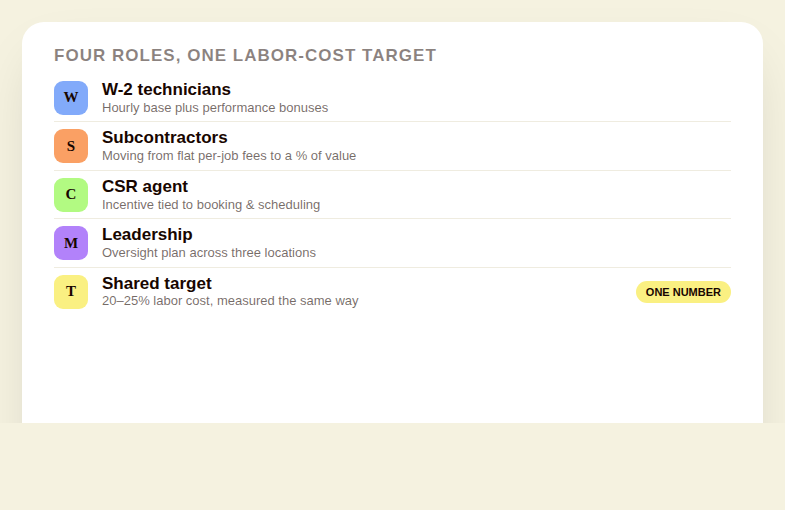
Rather than trying to force W-2 technicians, subcontractors, customer service reps, and leadership into a single formula, the company mapped out four separate plans built around each role's actual job:
- Full-time W-2 technicians, paid hourly with performance bonuses layered on top for service agreements sold and customer reviews earned, all designed to keep blended pay inside the 20 to 25 percent labor-cost band.
- Subcontractors, moving from flat per-job fees toward percentage-based pay tied to completed work value, so their earnings scaled with the job instead of resetting to zero context between tickets.
- A CSR agent, whose incentive needed to reflect booking and scheduling performance rather than field production, since that role doesn't touch a wrench but still directly controls how much billable work reaches the technicians and subcontractors in the first place.
- Leadership and management, with its own plan reflecting oversight responsibilities across a company that was actively scaling into three separate locations at once.
The company also leaned on a lightweight recognition layer alongside the formal pay plans: a monthly leaderboard, where the top performer that month earned an extra reward on top of their regular incentive pay. It's a small mechanism, but paired with a real labor-cost-anchored plan underneath it, it gave the team something to compete for on a shorter cycle than a full pay period, without requiring a second parallel commission structure to administer. The company was also weighing whether to fold membership sales tracking into the same system, since memberships were already being sold and counted by hand, and the owner wanted one place where every category of sold work rolled up against the same labor-cost target instead of living in a side spreadsheet.
Why the Subcontractor Question Gets Harder as You Grow
The urgency behind fixing subcontractor pay wasn't abstract. The company was actively in hiring mode, having just let go of an underperforming technician and expanding to a third location, which meant it needed a subcontractor pay structure that could absorb new people quickly without the owner personally negotiating a custom rate for each one. A percentage-based structure tied to a shared labor-cost target does that naturally: a new subcontractor slots into the same formula as an existing one, and the company's overall labor cost stays predictable even as headcount, and the mix of W-2 versus 1099 labor, keeps shifting underneath it.
Profit sharing
made simple.
Give your team a stake in the company’s success. ShareWillow helps you create and manage profit-sharing programs that motivate employees and drive business results.
Building Your Own W-2 and 1099 Pay Structure Around a Target, Not a Guess
If you're running a mixed crew of employees and subcontractors and trying to figure out how to pay HVAC subcontractors without guessing at a rate, start with the number that actually matters to your business, your target labor cost as a percentage of revenue, before you touch a commission percentage or a flat fee. That target should apply the same way whether the person doing the work is on your W-2 or invoicing you as a 1099 sub; the goal is one shared economic reality, expressed through role-appropriate pay structures, not two disconnected systems that happen to share a schedule. A similar approach worked for the Southwest Florida trades company that rebuilt its own technician pay around a 25 percent labor-cost target using tiered hourly-plus-commission rates, and it's worth reading alongside this one if your team includes any hourly-plus-commission roles.
It's also worth looking at how a hidden payroll leak can quietly widen the gap between your target and your actual labor cost, the way it did for the company described in this HVAC commission structure breakdown. And if you haven't landed on your target percentage yet, this guide to bonus structure examples is a reasonable starting point for benchmarking what other home service companies are actually paying out.
FAQ
Should HVAC subcontractors be paid flat rates or a percentage of the job?
Flat per-job rates are simple but don't scale with ticket size or move with your labor-cost target. A percentage-based structure, tied to completed job value, keeps subcontractor pay proportional to the work and gives you a lever to hold labor cost near a target percentage as job mix and pricing shift.
What labor-cost percentage should an HVAC company target?
Many home service companies target somewhere between 20 and 25 percent of revenue for service and repair labor, though the right number depends on your overhead, trade, and market. The key is picking one target and measuring every pay decision, for W-2 techs and subcontractors alike, against whether it keeps you inside that band.
Can W-2 technicians and 1099 subcontractors be paid from the same incentive plan?
They generally need separate plan structures, since W-2 pay typically includes an hourly base while subcontractor pay is usually per-job or percentage-based, but both can and should be built around the same underlying labor-cost target so the company's overall numbers stay predictable regardless of who's doing the work.
Related reading
- How a Southwest Florida Trades Company Rebuilt Pay Around a 25% Labor-Cost Target
- HVAC Commission Structure: How One Company Closed a Hidden Install-Helper Payroll Leak
- 9 Bonus Structure Examples Employees and Employers Love
- How a Multi-Trade Home Services Company Cut HVAC Labor Costs From 58% to 40%
Conclusion
Instead of guessing at flat per-job rates, this HVAC company built one labor-cost target and let it decide how to pay W-2 techs and 1099 subs alike.
Create incentives
that
drive results
You shouldn't need complex equity plans to align your team. ShareWillow makes it simple to create transparent profit-sharing programs that motivate employees and grow your business.

Incentive plans to help
small businesses thrive.
.png)
"I was able to leverage the knowledge of the ShareWillow team to learn how other companies were designing their bonus plans. The template was extremely helpful."

Brian Tustin
Owner, First Rate Movers