
Learn how to split commission between technicians: an HVAC and electrical company divides completed revenue by logged time at a 20% labor target.
If you want to split commission between technicians fairly, the first rule is to stop splitting it evenly. When two technicians work the same job and the commission is cut 50/50, the one who spent six hours on site gets the same credit as the one who stopped by for ninety minutes. Over a year, that teaches your best people to stop helping each other.
A small HVAC and electrical company is rebuilding its incentive plans right now and ran straight into this question. This post walks through how the owner decided to split commission between technicians, why he rejected a commission on sold revenue, and the math behind a $35,200 monthly minimum that protects a 20% labor target.
The Starting Point: Four Plans and No Dedicated Salesperson
The company has four plans configured: one for customer service reps and three for technicians, grouped by hourly rate. Two lead technicians earn $46 and $44 an hour and share a plan built on the $46 tier. A third technician earns $40 an hour and has his own HVAC plan. An apprentice earns $18 an hour and sits on a separate plan.
There is no dedicated salesperson. Technicians are expected to sell while they work, which is common in a company this size. That matters because it shapes what kind of commission makes sense. When everyone on a job both works and sells, a plan that pays for sold revenue alone ends up rewarding whoever wrote the estimate, not whoever got the job finished well.
Why the Owner Rejected a 2% Commission on Sold Revenue
The first draft was the one many owners reach for: 2% of everything a technician sells. The owner rejected it, and his reasoning is worth borrowing. He wanted incentives tied to completed revenue, and he wanted them to pay only after the business had cleared the revenue it needs to stay profitable.
That is a different philosophy from a flat sales percentage. A flat percentage pays from the first dollar, including months when the company never covered its labor cost. A completed-revenue plan with a threshold pays only when the month works. If you want the wider picture on structuring pay around profit, our guide to HVAC commission pay and how to design a plan that drives profit covers the main models.
How to Split Commission Between Technicians by Logged Time
Once revenue counts only when a job is completed, the next question is who earns it. On a job with more than one technician, the company will credit completed revenue according to each person's logged time on that job. Three rules came out of the call:
- Time sets the share. Each technician's slice of the job equals their logged hours divided by the total technician hours on the job.
- Apprentices are excluded. Apprentices do not share production revenue. They earn commission only on jobs they sell themselves, and the owner has not yet set that rate.
- A working owner counts. If the owner works a job in the field, his logged time counts in the split, even though he is not a plan participant.
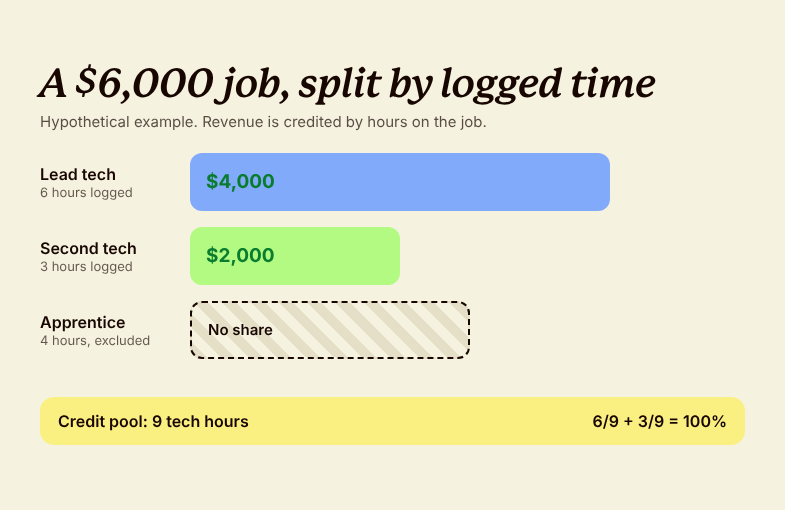
Here is a hypothetical example, not a real job. Say a $6,000 job has a lead technician with six logged hours, a second technician with three, and an apprentice with four. The apprentice is excluded, so the credit pool is nine technician hours. The lead earns credit for six ninths of the revenue, or $4,000, and the second technician earns credit for three ninths, or $2,000.
Our case study on a comp plan split that took one plumbing technician to a $114,000 month shows the same principle from the opposite direction: when credit follows the work actually done, pay disputes drop and the strongest technicians stay.
The Math Behind the $35,200 Monthly Minimum
The second piece of the plan answers a different question: how much completed revenue does a technician need to produce before an incentive pays at all? The owner chose a 20% labor-cost target, and the minimum falls out of simple arithmetic.
- Take the technician's hourly rate and multiply by monthly hours. At $40 an hour and 176 hours, labor costs $7,040.
- Divide that labor cost by the 20% target. $7,040 divided by 0.20 is $35,200.
- Treat $35,200 as the minimum completed revenue for the month. Incentive pay begins only above that line.

The same method works for any hourly rate, which is why the company grouped technicians into tiers. A technician at $46 an hour has a higher minimum than one at $40, because the labor target is a percentage of revenue, not a fixed dollar goal. For more on setting a labor target that fits your business, read our case study on how a multi-trade company cut HVAC labor costs from 58% to 40%.
Small Awards That Sit Beside the Revenue Split
Revenue is only part of the picture. The company layered three small, flat awards on top so quality and customer experience count too:
- $25 per five-star review. This matches the gift card the owner already hands out, so the plan simply replaces a manual reward.
- $50 deduction per callback or recall. The company will tag the original job when a callback is confirmed, and remove the tag if the visit turns out to be unrelated.
- $25 per membership sold. The owner has not confirmed this amount yet, and membership counts will come from service-plan reporting.
The callback tag is the detail that deserves attention. The company first considered matching callbacks by customer and address, but a customer with several jobs would have been charged to the wrong technician. Tagging the original job removes the guesswork, and removing the tag when a visit is unrelated keeps the deduction fair.
Test the Plan Against Last Year Before You Launch It
No payouts exist yet, so there is no result to report. What the owner did ask for is the next best thing: a full-year backfill that recalculates what each technician would have earned under the new structure, month by month. A review of those numbers is scheduled for the coming week.
This is the step most owners skip. Running the plan against history shows you how many months would have paid, how large the typical payout is, and whether any technician would have earned less than today. If you want a refresher on the arithmetic, our step-by-step guide to calculating bonus pay walks through it.
Two data risks are worth planning for. Membership reports can misallocate a sale, which would make an individual count wrong, and customer review data may not show which technician earned the review. Fixing those before launch is cheaper than fixing them after a payout.
How to Split Commission Between Your Own Technicians
- Pick the revenue basis. Completed revenue is easier to defend than sold revenue.
- Set a labor target. Convert it into a monthly minimum for each hourly tier.
- Split by logged time. Divide each job's revenue by each technician's share of total hours.
- Decide who is in the pool. Keep apprentices out and count a working owner by time.
- Backfill a year of data. Confirm the payouts make sense before anyone sees a paycheck.
To see how a plan like this becomes a payout technicians can check on their phones, explore ShareWillow's product features, or read how HVAC companies use them.
Profit sharing
made simple.
Give your team a stake in the company’s success. ShareWillow helps you create and manage profit-sharing programs that motivate employees and drive business results.
Frequently Asked Questions
How do you split commission between two technicians on the same job?
The fairest method is to split by logged time on the job. Add up the technician hours, divide each person's hours by the total, and credit that share of the completed revenue. An even split only works when the technicians truly contribute equally.
Should apprentices share in the commission split?
Many companies keep apprentices out of the production revenue pool and pay them hourly, with commission only on jobs they sell. That keeps the lead technician's credit tied to the work that generated the revenue. Whatever you choose, write it down before launch.
What if the owner works on the job?
If the owner works in the field, count the owner's logged time in the split just like any technician's. That keeps the credit honest and prevents the technicians from carrying revenue the owner helped produce.
Related reading
- The Comp Plan Split That Took One Plumbing Technician to a $114,000 Month
- Plumbing Commission Structure: How a Plumbing Company Split a 22% Pool Between the Seller and the Techs Who Finish the Job
- How a Multi-Trade Home Services Company Cut HVAC Labor Costs From 58% to 40%
- HVAC Commission Pay: How to Design a Plan That Drives Profit (Not Problems)
Conclusion
Split commission between technicians by logged time, protect a labor target first, and keep apprentices out of the revenue pool.
Create incentives
that
drive results
You shouldn't need complex equity plans to align your team. ShareWillow makes it simple to create transparent profit-sharing programs that motivate employees and grow your business.

Incentive plans to help
small businesses thrive.
.png)
"I was able to leverage the knowledge of the ShareWillow team to learn how other companies were designing their bonus plans. The template was extremely helpful."

Brian Tustin
Owner, First Rate Movers
