
An HVAC company owner feared losing technicians to a rival's payout numbers, until a closer look showed his own commission plan was quietly disqualifying people who should have earned. A rebuilt, tiered revenue-and-hours structure paid a top tech $3,000 on $100,000 in monthly revenue and gave him real numbers to compare against the rumors.
Every HVAC owner has heard some version of the same rumor: a competitor down the road is paying technicians better, and if you don't do something about it, your best people are going to find out. For the owner of a 40-technician residential HVAC company, that rumor had a name attached to a payroll platform used by a rival shop, and it had numbers attached to it too. Word around the break room was that technicians doing comparable revenue at that other company were walking away with $2,000 to $7,000 in commission and bonus pay. His own techs were hearing the same thing.
That is not a comfortable position for an owner to sit in. You do not need a spreadsheet to feel the risk. You need one good technician to take a phone call from a recruiter, hear a number that sounds bigger than what he is currently taking home, and start wondering if the grass really is greener. Losing a single experienced install or service tech in a market where trained labor is scarce is expensive in ways that show up long after the exit interview: missed callbacks, slower ramp time for the replacement, momentum lost on a route the departing tech had spent years building.
So the owner came to ShareWillow with what sounded, at first, like a rate problem. He assumed his commission percentages were simply too low compared to what techs were hearing about elsewhere, and he wanted to know if he needed to raise them to stay competitive. That is a reasonable first guess. It is also, in this case, not what was actually happening.
What made the situation harder to sit with was that he genuinely liked his team. This wasn't an owner looking to cut corners on pay or squeeze more out of his techs for less. He had built a 40-person shop in a competitive market largely by treating his people well, and the idea that a rival's payroll platform, one whose actual mechanics he'd never seen up close, might be quietly picking off his best installers felt like losing a fight he hadn't even known he was in.
The Number That Kept the Owner Up at Night
The $2,000 to $7,000 figure he'd heard about the competing platform was doing a lot of work in his head. It framed the whole conversation as a rate problem: pay more, or lose people. But nobody had actually sat down and compared his plan's mechanics, line by line, against what his own techs were earning today. He was reacting to a number he'd heard secondhand, not a number he'd calculated himself.
That distinction mattered more than it sounds like it should. Once ShareWillow pulled his actual plan design and ran it against real job data from the months prior, a different picture started to form. The issue wasn't that a 3 percent or 5 percent commission tier was too stingy on paper. The issue was that very few technicians were ever landing inside the tiers that paid well, and some weren't qualifying for any payout at all, month after month, without the owner realizing why.
In other words, the plan on paper looked competitive enough. The plan in practice was quietly starving itself of participants. And an incentive plan that pays out to almost nobody will always look worse next to a competitor's plan, whether or not that competitor's numbers are even accurate.
The Real Problem Wasn't the Rate. It Was the Rules.
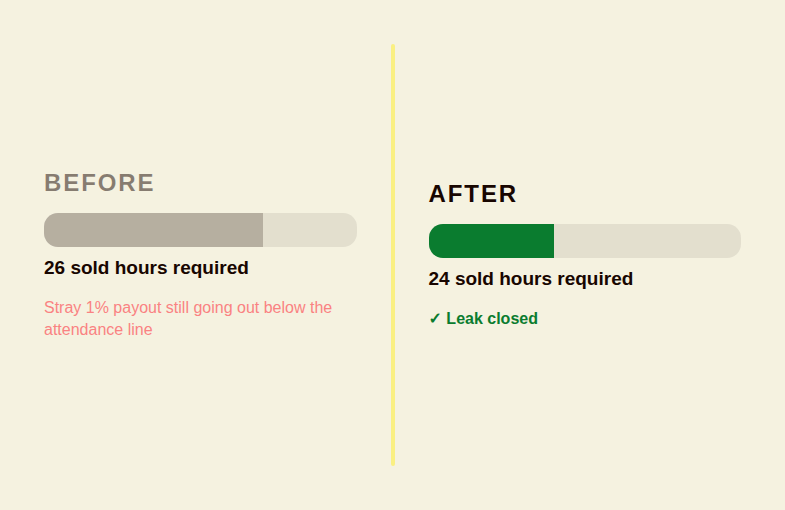
Every commission plan has a qualification bar, some minimum level of activity or output a technician has to clear before any payout kicks in. In this company's plan, that bar was set at 26 sold hours in a month. On the surface, 26 sold hours sounds like a modest ask for a full-time residential tech. In practice, it was quietly knocking a meaningful share of the team out of eligibility every single month, including technicians who were otherwise strong performers on revenue.
The owner had set that threshold at some point in the past, likely with good intentions and imperfect data, and then never revisited it as call volume, crew size, and route density shifted underneath it. That is an extremely common pattern. Thresholds get set once during plan design and then treated as fixed infrastructure, when they should really be treated as a dial the owner checks and adjusts as the business changes. Nobody was going back and asking whether 26 was still the right number, or whether it had ever been the right number for every tech on the roster.
Digging further into the plan's calculation logic turned up a second issue, smaller in dollar terms but just as revealing. Technicians who fell below a separate attendance threshold, the ones who should have been excluded from payout entirely for that period, were still receiving a stray 1 percent payout they were never supposed to get. It was a leftover from an earlier version of the plan's rules that nobody had caught. It wasn't large enough to bankrupt the pool, but it meant the plan wasn't doing what the owner believed it was doing. He thought he had one set of rules running. He actually had two, and they disagreed with each other.
Between the miscalibrated 26-hour bar and the stray 1 percent bug, the owner had built a plan that was harder to read and less predictable than he realized, for both him and his techs.
This kind of drift is easy to miss precisely because nothing about it looks broken from the owner's chair. Payroll runs. Checks go out. Nobody files a complaint about a threshold they don't know exists. The only signal an owner usually gets is the one this owner got: a vague, growing sense that his plan wasn't landing the way he wanted it to, paired with rumors from outside the building suggesting someone else was doing it better.
Rebuilding Around Revenue and Sold Hours, Not Guesswork
The fix wasn't to throw out the structure and start over. It was to rebuild the plan around two numbers that actually track how a residential HVAC technician creates value: revenue generated and hours sold. ShareWillow restructured the plan into a tiered commission model, where a technician's payout percentage climbs as their revenue for the period climbs, measured against the hours they actually sold. That is a meaningfully different design than a flat commission rate applied uniformly to every tech regardless of how their month went.
The qualification bar came down from 26 sold hours to 24. That two-hour change sounds small written out like this, but it was the difference between a threshold that quietly excluded a chunk of the team and one that let more legitimately hardworking technicians actually clear the bar and start earning. The owner also got the ability to adjust that threshold himself going forward, instead of needing to submit a change request every time the business shifted. If call volume drops in a slow month, or a new tech is still ramping up, he can see the effect of moving that number before he commits to it, rather than guessing.
The stray 1 percent payout got closed. Technicians below the attendance threshold now correctly receive nothing for that period, which isn't a punitive change, it's just the plan finally matching the rules the owner thought he had all along. A commission plan that pays inconsistently, even in small ways, erodes trust faster than a plan that simply pays a lower rate consistently. Techs notice when the math doesn't add up from month to month, even if they can't articulate exactly why.
Profit sharing
made simple.
Give your team a stake in the company’s success. ShareWillow helps you create and manage profit-sharing programs that motivate employees and drive business results.
What Actually Happened in July
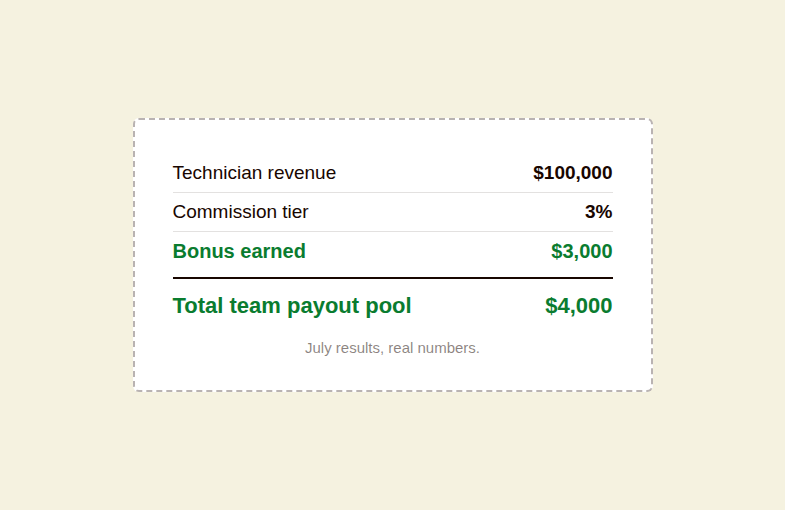
The redesigned plan had its first full test in July, and the numbers gave the owner something he hadn't had before: a real answer instead of a rumor. The company's top technician that month generated roughly $100,000 in revenue and landed in the plan's 3 percent commission tier, earning a $3,000 bonus on top of his base pay. Across the full team, the total commission pool paid out for the month came to roughly $4,000.
Those numbers matter for two different reasons. First, on their own terms: a technician bringing in six figures of revenue in a single month and walking away with $3,000 in commission is a meaningful, tangible number he can hold up against anything he's hearing about a competitor down the street. Second, and just as important, the owner now had his own real data to weigh against the secondhand $2,000 to $7,000 figure that had been worrying him for months. He wasn't guessing anymore. He had his top performer's actual output and actual payout sitting side by side.
Comparing Real Numbers Instead of Rumors
That comparison is worth sitting with, because it's the part of this story that generalizes to almost any shop worried about losing techs to a competitor's pay structure. A rumor about what another company pays is almost never apples to apples. It rarely accounts for how that other plan defines revenue, what hours actually count, what the qualification bar is, or how often technicians there actually clear it. An owner who reacts to that rumor by raising his own commission rate across the board is treating a plan design problem as a pricing problem, and he may end up paying more without ever fixing what was actually broken.
In this case, the fix cost the owner nothing in rate. He didn't raise his commission percentages. He fixed who could reach them and made sure the math paying out matched the math he believed he'd approved. A $100,000 month producing a $3,000 payout, with a $4,000 total pool across a 40-technician shop, is a plan the owner can now explain to his team with a straight face, because he understands exactly how it works and can walk any technician through their own number line by line.
What This Means If You're Worried About Losing Techs to a Competitor's Pay
The instinct to raise your rate the moment you hear a competitor is paying more is understandable, but it's usually the wrong first move. Before you touch your commission percentages, it's worth checking whether your current plan is actually delivering what it promises. That means:
It also helps to remember that the technicians hearing the rumor are doing the same rough math you are, just with less information. They don't know the other shop's actual qualification rules any better than you do. What they know is a number, and a feeling that they might be underpaid. Give them a real, specific number of their own, tied to their own revenue and their own hours, and the rumor loses most of its power.
- Pull the actual payout data for the last three to six months and see how many technicians are qualifying for any bonus at all, not just what the plan document says should happen.
- Check your qualification thresholds against current call volume and crew size. A bar set two years ago may be excluding people it was never meant to exclude.
- Audit the calculation logic itself for leftover rules from earlier plan versions. Small bugs, like a stray payout going to technicians who shouldn't qualify, undermine trust even when the dollar amounts are minor.
- Get your own real numbers before you react to a competitor's. A specific number like $3,000 on $100,000 in revenue is worth more in a conversation with a nervous technician than any rumor about what another shop pays.
None of that requires blowing up your commission rates. It requires knowing, with precision, how your plan actually behaves once real technicians and real jobs run through it. That is the work ShareWillow's plan design tools are built around, and it's a pattern that shows up constantly with HVAC businesses trying to hold onto their best people in a tight labor market. If this sounds familiar, it's worth reading about a similar retention-driven commission redesign we worked through with another team.
Related reading
Conclusion
Before you raise your commission rate to compete with a rumor, make sure your own plan is actually paying the technicians who've already earned it.
Create incentives
that
drive results
You shouldn't need complex equity plans to align your team. ShareWillow makes it simple to create transparent profit-sharing programs that motivate employees and grow your business.

Incentive plans to help
small businesses thrive.
.png)
"I was able to leverage the knowledge of the ShareWillow team to learn how other companies were designing their bonus plans. The template was extremely helpful."

Brian Tustin
Owner, First Rate Movers
