A small HVAC and install company was paying every technician a flat 1 percent commission no matter what they actually sold, and the owner knew it wasn't fair to the techs who were carrying the business. Here is how a tiered, sold-hours commission structure replaced the flat rate, and what one technician's real July paycheck looked like once the new plan went live.
Most small HVAC companies start commission the same way: pick a flat percentage, apply it to every job a technician touches, and hope it feels fair. It usually does, right up until the owner looks closely at who is actually earning that percentage and realizes some techs are getting paid the same as everyone else for doing a lot less. That was the exact problem facing the owner of a small residential HVAC and install company, running a lean crew of technicians on ServiceTitan, who had been paying a flat 1 percent commission to every tech regardless of how much they actually sold or installed that month.
The owner was blunt about it in a working session on the new plan: he didn't want a technician collecting that 1 percent "no matter what." If someone barely moved the needle in a given month, paying them the same rate as a technician who sold and installed real work all month made the whole commission structure feel arbitrary. His goal wasn't to cut anyone's pay. It was to give the team something worth chasing. As he put it, he wanted to "give these guys a nugget where they can hit something for once," a real, achievable target instead of a flat number nobody had to work for.
There was a second problem sitting underneath the fairness issue: the company's own performance dashboard couldn't be trusted. Historical data from March and April had errors baked into it, numbers that didn't match reality closely enough to build pay decisions on top of. Before any new commission structure could go live, that dashboard had to be wiped and rebuilt from clean data. It is a step easy to skip and expensive to skip: a commission plan is only as fair as the numbers feeding it, and a technician who spots an inconsistency in their own payout math will stop trusting the whole plan, not just the one number that looked wrong.
It's a familiar trap for growing shops. Software adoption happens in pieces: a scheduling tool goes in first, then a job-costing feature gets turned on, then someone starts pulling commission numbers from a dashboard nobody fully audited when it launched. Each piece works fine on its own. The trouble shows up later, when an owner tries to build something that depends on all of it agreeing, like a commission plan, and discovers the foundation underneath was never as solid as it looked. Cleaning that up before writing a single tier or percentage is unglamorous work, but it's the work that keeps a new plan from inheriting the old plan's credibility problem.
Building A Ladder Instead Of A Flat Line
The plan ShareWillow built with the company replaced the single flat rate with a three-level commission ladder, tied to a metric called sold hours: the hours of labor a technician personally sold and is responsible for, as distinct from total hours worked or total revenue passing through the shop. Sold hours is a more precise way to measure an individual technician's real contribution than raw revenue, because a tech who happens to land one large-ticket job isn't automatically credited as more productive than a tech who is consistently selling and completing solid work week after week.
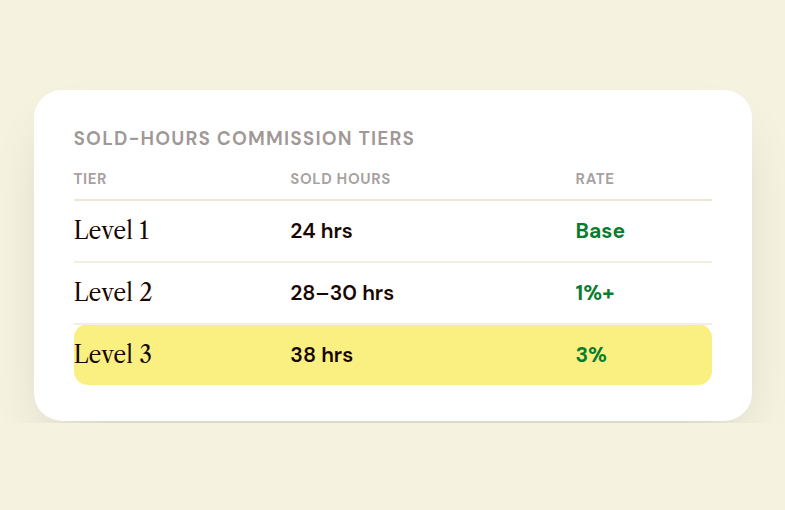
The three tiers work like a real ladder, not a light switch. Level 1 sits at 24 sold hours, a threshold the team deliberately lowered from an initial 26 hours specifically to give more of the staff a realistic shot at reaching it. Level 2 kicks in between 28 and 30 sold hours, where commission starts at roughly 1 percent and scales upward from there. Level 3, the top tier, requires 38 sold hours and pays out at 3 percent, a meaningfully higher rate reserved for technicians who are clearly carrying a full, productive month. A minimum sales threshold, discussed at roughly $15,000, was also built in so that commission only applies once a technician has cleared a real revenue floor, not just a token amount of activity.
Attendance And Attribution, Not Just A Percentage
A tiered rate alone doesn't solve the fairness problem completely. Two technicians can each log the same number of sold hours in a month and still deserve different outcomes if one of them missed several scheduled days along the way. The plan factors attendance into the payout, so a technician's commission can be reduced or withheld if they didn't show up for the hours they were scheduled, regardless of how their sold-hours number looks on paper. That single addition closes a loophole that flat-percentage plans almost never account for: raw output numbers can look identical while the underlying effort behind them is not.
The commission rate itself is applied against attributed revenue rather than total job revenue, which matters more than it might sound. A technician who sells a large piece of equipment but does none of the installation work lands in a different, lower percentage tier than a technician with more hands-on sold hours, even if the two dollar figures on paper look similar. This is the detail that made the plan feel fair to the owner in the first place: two technicians touching the same size job in different ways earn different amounts, proportional to what they actually did, not to which job happened to cross their desk that week.
What The First Real Payout Looked Like
Plans built on a whiteboard are easy to like. Plans that survive contact with a real payroll period are the ones worth writing about. This one got its first real test in July, when the owner and his ShareWillow contact ran actual job data through the new tiered structure to see what technicians would actually take home.
One technician landed squarely in the top tier. With close to $100,000 in attributed revenue and enough sold hours to clear the Level 3 threshold, his commission worked out to a $3,000 bonus for the period, a number that reflected real installed and sold work, not a rounding error or a one-off spike. The owner's reaction summed up why the tiered structure mattered more than the flat rate ever had: "he still makes a pretty good bonus for not touching a wrench. That's a great bonus." A technician who sold the work and moved it forward was being paid meaningfully more than a technician who simply logged hours, which was precisely the gap the flat 1 percent rate had been papering over.
Other technicians landed lower on the ladder, and that is exactly what a working tier structure should produce. A Level 1 technician was projected at roughly $500 for the period, a real number tied to real, if more modest, sold hours. Another technician came in around $65, made up mostly of membership and review bonuses rather than commission, because that technician hadn't cleared the revenue threshold that period. None of those numbers are a failure of the plan. They are the plan doing exactly what a tiered structure is supposed to do: pay more to the people who sold and completed more, and be honest about the months when someone didn't.
Profit sharing
made simple.
Give your team a stake in the company’s success. ShareWillow helps you create and manage profit-sharing programs that motivate employees and drive business results.
Checking The Numbers Against The Rest Of The Industry
Before finalizing payout expectations, the ShareWillow team benchmarked the new tiers against what technicians earn at a named competitor in the same market, where reps were reportedly taking home between $2,000 and $7,000 on revenue in the $50,000 to $70,000 range. The company's own numbers, a $3,000 bonus on close to $100,000 in revenue, landed comfortably inside that realistic band. That comparison mattered for a reason beyond simple reassurance: a commission structure that pays noticeably below market risks losing good technicians to a competitor down the street, while one that pays well above market without a matching increase in productivity puts real pressure on the business's own margins. Getting the tiers right meant the plan had to work for the company's cash flow and still be competitive enough to keep good people.
Total company-wide payout for the period came to roughly $4,000 across the team, a real, budgetable number the owner could look at and compare directly against what the business brought in that month. That is one of the quieter benefits of moving off a flat, ungoverned percentage: the owner can now see, before the fact, roughly what a strong month will cost in commission, instead of discovering the number after payroll runs.
Benchmarking also protected the plan from a subtler risk: designing tiers in a vacuum. It's tempting for an owner to set thresholds based on gut feel, what sounds generous, what sounds affordable, without ever checking what technicians doing similar work are actually earning a few miles away. A tier structure that looks reasonable on a whiteboard can turn out to be well below market once it's compared to real numbers, and by then a shop has usually already lost a technician or two to find out. Running the real July data against both the company's own history and a competitor's reported range gave the owner something more useful than a guess: a plan he could defend, to himself and to his team, with numbers on both sides of the comparison.
Why This Story Matters Beyond One Shop
The instinct to pay every technician the same flat rate is understandable. It's simple to explain, simple to run in payroll, and it avoids the awkward conversation about why one tech earns more than another. But simplicity has a cost. A flat rate treats a technician who is carrying the shop the same as one who is coasting, and over time, the technicians doing the real work notice. This is a common gap across HVAC and home services companies running on flat or informal commission: the plan feels fair on paper because everyone gets the same rate, but it stops feeling fair the moment a top performer compares their paycheck to a teammate who did meaningfully less.
A tiered, sold-hours structure fixes that without requiring the owner to play favorites or make subjective calls about who "deserves" more. The math does the work. A technician who sells and completes more real, attributable work climbs the ladder and earns a materially better rate. A technician having a slower month still gets paid fairly for what they did, just not at the top tier. That distinction, built into the plan mechanics rather than left to a manager's judgment call, is what let this owner tell his team exactly why one person's check looked different from another's, with real numbers to back it up instead of a gut feeling.
The Part Owners Underestimate: Wanting To Show The Number
Something small but telling happened once the July numbers were finalized. The owner didn't just review the payout report and move on. He said he was going to "make a big, big paycheck" and present it to the technician in person the next day. That's not a detail about payroll software. It's a signal about what a well-designed commission plan actually does for a small business: it turns a compensation formula into something an owner is proud to hand a technician face to face, instead of a number that just shows up in a direct deposit with no story attached.
For other HVAC and install companies still running a flat commission rate, or worse, no formal structure at all, the lesson from this account isn't about matching the exact tier thresholds this company landed on. It's that sold hours, attendance, and attribution are knowable numbers, usually already sitting inside a field service platform like ServiceTitan, waiting to be turned into a plan that pays your best people like they're your best people. Companies exploring what that could look like with their own numbers can start by reviewing real case studies from similar shops before committing to a full rollout.
Related reading
Conclusion
A flat commission rate was quietly paying everyone the same regardless of effort. A tiered, sold-hours structure fixed that: one technician cleared the top tier and earned a real $3,000 bonus on roughly $100,000 in revenue, while the plan stayed honest about slower months for everyone else, all benchmarked against real competitor pay to make sure it was fair on both sides.
Create incentives
that
drive results
You shouldn't need complex equity plans to align your team. ShareWillow makes it simple to create transparent profit-sharing programs that motivate employees and grow your business.

Incentive plans to help
small businesses thrive.
.png)
"I was able to leverage the knowledge of the ShareWillow team to learn how other companies were designing their bonus plans. The template was extremely helpful."

Brian Tustin
Owner, First Rate Movers