A residential HVAC company's commission tiers were set so high almost no tech ever hit them. Here's how recalibrating them paid out $4,000 in the first month.
Here's a question worth asking about your own commission plan: how many of your techs actually hit the payout tiers you built for them? Not "could hit" on paper. Actually hit, most months, doing normal solid work. If the honest answer is "not many," you don't have an incentive plan. You have a plan that looks like an incentive plan on a slide deck and functions like nothing at all in a paycheck.
That was exactly the situation at a residential HVAC company running on ServiceTitan, with a team of technicians spread across a few different commission tiers based on experience and performance. On paper, the plan looked reasonable: a tiered commission structure meant to reward techs as they generated more sold hours in a month. In practice, it was doing almost nothing.
The Thresholds Nobody Was Clearing
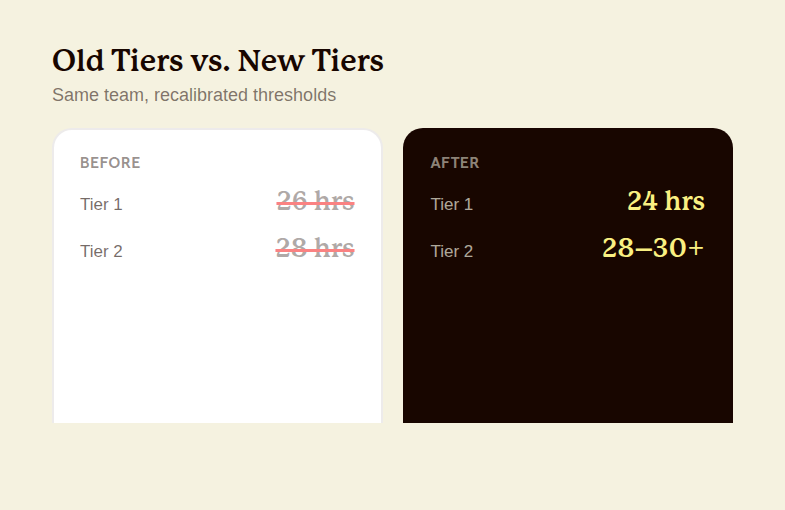
The plan required a technician to hit 26 sold-hours in a month just to unlock the first commission tier. Level two required 28 sold-hours. Those numbers sound close together, and they are, which was part of the problem. The gap between "earning nothing" and "earning something" was razor thin, and most techs simply never crossed it.
Month after month, solid technicians, guys putting in real hours and doing good work, ended up with a $0 commission line. There was technically a level-two rate of 1% sitting on the books, but it was effectively decorative. If you couldn't clear the hours bar, the rate under it didn't matter at all. A commission tier that nobody reaches isn't generous or conservative. It's just absent, dressed up to look like a plan.
A commission structure with unreachable thresholds isn't a cautious pay plan. It's an invisible one, and techs eventually stop believing the incentive is even real.
This is a more common problem than most owners realize, and it rarely gets caught because nobody is checking the math against reality. Someone sets thresholds based on a gut feeling of what "great performance" should look like, or copies numbers from a template, and then nobody goes back six months later to ask how many people actually cleared them. Thresholds drift out of sync with what a normal, hardworking month for a tech actually produces. We've written before about how tying pay to sold hours rather than raw job count tends to be a fairer way to structure HVAC commission, but the metric only works if the bar sitting on top of it is calibrated to something a real technician can actually clear.
The Wake-Up Call
What finally pushed the owner to act wasn't a complaint from a tech. It was a comparison. He benchmarked his own commission plan against what a competitor in his market was reportedly paying out for comparable revenue, and the gap was hard to ignore. His team was generating similar work and similar dollars, but earning noticeably less in commission because the thresholds were quietly filtering almost everyone out before a single dollar of bonus got paid.
That's the kind of finding that stings a little, because it means the problem wasn't a lack of ambition or a lack of good technicians. It was a spreadsheet detail nobody had revisited in a long time. A threshold set a year or two earlier, back when the business looked different, was still sitting there unchanged, silently deciding who got paid and who didn't.
It's worth saying plainly: this isn't unique to one HVAC shop. Trade businesses in general, and HVAC companies specifically, tend to build their first commission or incentive plan early, when the business is smaller and the owner is guessing at reasonable numbers. Then the business grows, crews change, workloads shift, and the plan just sits there, unexamined, quietly underpaying the very people the owner most wants to keep motivated and on staff. If you've never actually pulled the data on how many of your people clear your own tiers in a normal month, that's the first place to look before you assume your plan is working the way you think it is.
Rebuilding the Tiers Around Reality, Not Guesswork
The fix here wasn't a new incentive philosophy or a total overhaul of how the company thought about pay. It was recalibration. ShareWillow worked directly with the owner to rebuild the tiered plan live, using his actual ServiceTitan data on what technicians were realistically producing in a given month, rather than the round numbers someone had picked years earlier.
The first tier came down from 26 sold-hours to 24 sold-hours. That two-hour shift sounds small, but it made the difference between "most techs never get there" and "a solid, normal month gets you there." The second tier got a more meaningful redesign. Instead of a single hard cutoff at 28 hours with a token 1% sitting behind it, the structure now pays zero below 28 hours, 1% between 28 and 30 hours, and then scales up from there as a tech's sold hours climb higher. The incentive still rewards top performance, but it no longer requires a near-impossible bar just to get in the door.
Handling Real-World Attendance, Not Just Perfect Months
Sold-hours thresholds have a blind spot: they assume every technician works a full month. Techs take vacation, get sick, or start partway through a pay period, and a rigid hours bar punishes all of that equally, regardless of the reason. Part of the rebuild added attendance-adjusted payout logic, so a technician who worked three weeks of a month instead of four isn't judged against the same threshold as someone who was there the whole time. The plan now accounts for actual time available to work, which makes the thresholds feel fair instead of arbitrary to the people living under them.
This is the same pattern we've seen play out in other HVAC shops. In one case, a company's revenue threshold kept quietly moving on techs before anyone could hit it consistently, which we covered in a separate breakdown of a revenue threshold commission plan that had the same underlying issue: a number on a spreadsheet that stopped reflecting what was actually happening on trucks every day.
A Payout Workflow the Owner Actually Runs Himself
The other half of the fix wasn't about the math at all. It was about the process. Before, calculating commission meant someone doing manual math against ServiceTitan reports every month, a process that's slow, error-prone, and easy to quietly deprioritize when things get busy. A commission plan that requires heroic manual effort to run correctly tends to get run inconsistently, or not at all in the weeks the owner is slammed.
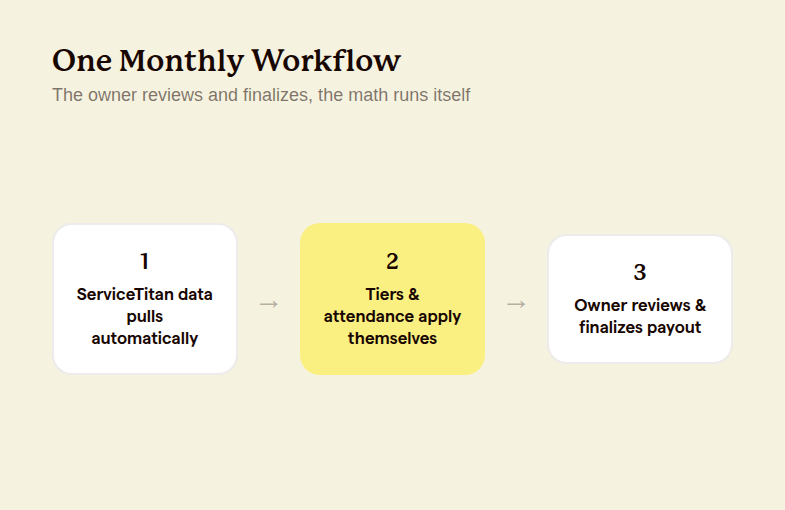
The rebuild included a simple monthly "review and finalize" workflow that the owner now runs himself. The numbers pull automatically from ServiceTitan, the tiers and attendance adjustments apply themselves based on the rules already built into the plan, and the owner's job each month is to review the output and confirm it, not to reconstruct it from scratch with a calculator and a spreadsheet. That's the kind of detail that sounds boring next to a $3,000 bonus number, but it's actually what makes the bonus number possible to sustain past month one. You can read more about how that kind of automated tier building and payout workflow works in practice, but the short version is: a plan only pays out consistently if running it doesn't require heroics every single month.
None of this required reinventing what "commission" means for the company. It required going back to the two numbers that mattered most, the tier thresholds, and testing them against what real technicians in a real month could actually achieve. Sometimes the biggest fix to a broken incentive plan isn't a new idea. It's arithmetic that finally matches reality.
Profit sharing
made simple.
Give your team a stake in the company’s success. ShareWillow helps you create and manage profit-sharing programs that motivate employees and drive business results.
The First Month Under the New Plan
Numbers tell this story better than adjectives do, so here they are. In the first full month running under the rebuilt plan, the top technician on the team generated roughly $100,000 in revenue. Under the new tier structure, that performance landed him in the 3% commission bracket, which worked out to a $3,000 bonus for the month.
Across the whole team, factoring in techs at different tiers and different production levels, the estimated total payout for the month came in around $4,000. That's real money going out the door that, under the old 26-hour and 28-hour thresholds, likely would have stayed in the business instead of landing in technicians' paychecks, not because the work wasn't happening, but because the bar to get paid for it was set somewhere nobody could actually reach.
The old thresholds weren't conservative. They were, in effect, punishing good, steady work by setting the bar just out of reach for the technicians doing it.
The owner was proud enough of the top technician's number that he asked for a printed, visual breakdown of that paycheck specifically so he could show it to the rest of the leadership team. Not to brag about the software behind it, but because a $3,000 bonus tied to a specific tech's real production is a far more persuasive argument for the plan than any explanation of tier percentages ever could be. Seeing one of your own guys hit a real number, in a real paycheck, tends to change how the rest of the team thinks about what's possible.
What Changed Wasn't the Team. It Was the Math.
It's worth being precise about what actually happened here, because it's easy to read a story like this and assume the company simply got lucky with a strong month or hired better technicians. That's not what happened. The technicians were the same people, doing largely the same work they'd been doing for months. What changed was whether the plan built around them was actually structured to pay for that work.
This is the pattern behind most "our incentive plan suddenly started working" stories, including one we've written about before where a company's total incentive payouts effectively doubled once the plan itself was fixed. The team wasn't twice as good the month after the change. The plan was just finally built to reflect what good work was already worth.
Is Your Own Plan Actually Reachable?
If you run a trade business with any kind of tiered commission or bonus structure, it's worth doing what this owner did before he ever talked to anyone about fixing it: pull the real data and ask how many of your people actually cross your thresholds in a typical month. Not your best month. A normal one. If the number is low, or if you honestly don't know because nobody's checked, that's not a small technical detail. It's the difference between a plan that motivates your best people and a plan that quietly tells them their extra effort doesn't count.
Thresholds and tiers aren't something you set once and forget. Crew composition changes, average job sizes shift, seasons come and go, and a number that made sense two years ago can quietly become the reason your best technician stops believing the bonus is real. Sometimes the fix isn't a bigger incentive budget or a fundamentally different pay philosophy. It's just going back and checking whether the bar you set is one your people can actually reach when they're doing the job well.
Related reading
- $638 On Three Jobs. Real Numbers On Five.
- 64 Hours On The Screen. 25 Were Real.
- HVAC Commission Pay: How to Design a Plan That Drives Profit (Not Problems)
- Companies with Profit Sharing: Who They Are & What They Offer
- Tiered Commission Structure for Technicians: How a Multi-Location HVAC Company Turned $15,316 in Weekly Sales Into a Real Payout
Conclusion
A commission tier nobody can reach isn't a conservative pay plan, it's an invisible one, and fixing the math can unlock real money for real work almost overnight.
Create incentives
that
drive results
You shouldn't need complex equity plans to align your team. ShareWillow makes it simple to create transparent profit-sharing programs that motivate employees and grow your business.

Incentive plans to help
small businesses thrive.
.png)
"I was able to leverage the knowledge of the ShareWillow team to learn how other companies were designing their bonus plans. The template was extremely helpful."

Brian Tustin
Owner, First Rate Movers