
A multi-trade HVAC and plumbing company was paying out 58.5% of HVAC revenue in technician labor before a redesign. A minimum incentive floor and a weekly department leaderboard brought that number back under 40%.
Ask most home services owners what percentage of revenue their labor should eat, and you will get a number somewhere in the mid-30s. Ask them what it actually is, and a surprising number go quiet, or guess, or pull up a spreadsheet they have not fully trusted in months. For one multi-trade company running separate HVAC, plumbing, and service technician teams, that gap between the target and the reality had grown wide enough to threaten the business: HVAC labor was consuming 58.5% of HVAC revenue, nearly 24 points above where leadership needed it to sit.
That is not a rounding error. On a department doing meaningful volume, 24 points of labor overage is the difference between a healthy trade and one quietly subsidizing itself out of existence. And the frustrating part, the part that made this such a hard problem to see clearly, was that no single decision had caused it. The plan had been built one good intention at a time, and every one of those intentions had a cost nobody had added up.
When "More Incentive" Actually Means Less Control
Here is how it happens almost everywhere: a technician does something worth rewarding, so a spiff gets created. A membership gets sold, so a bonus gets added. A five star review comes in, so another line item appears. None of these decisions is wrong on its own. The problem is that they rarely get reconciled against the base commission structure already in place, and over enough quarters, a shop ends up with spiffs stacked on top of full commission, paid out in parallel, with no one asking whether the total was still something the business could afford.
That is close to what had happened here. Technicians were earning commission on the job itself, plus a series of additional spiffs for behaviors the business wanted to encourage, and the two systems had never been designed to work together. A technician could hit a strong commission number on a job and then layer several more incentive payouts on top of it, each individually reasonable, collectively unsustainable. Multiply that across an HVAC department running real volume, and 58.5% stops being a mystery. It becomes math nobody had actually done.
The Real Problem Was Never the Percentage
It is tempting to respond to a number like 58.5% by cutting commission rates across the board. Most owners try this at some point, and most regret it, because slashing rates does not fix a stacking problem. It just makes every technician's paycheck smaller while leaving the underlying structure exactly as tangled as before. Worse, an across the board cut lands hardest on the technicians a shop can least afford to demoralize: the ones already producing well, who now watch their pay shrink for reasons that have nothing to do with their performance.
The real issue was structural, not numerical. Spiffs and commission were running on separate tracks with no shared ceiling and no shared logic. A technician's total pay for a given job depended on which combination of bonus programs happened to apply that week, which made the plan almost impossible to explain in one sentence, and a pay plan a technician cannot explain to a new hire in one sentence is a pay plan that has already started to lose the room. When people cannot see how their pay adds up, they stop trusting that it is fair, even when it is generous. And an incentive plan nobody trusts stops incentivizing anything.
There is a retention cost hiding inside a tangled plan too, and it rarely shows up until a technician has already given notice. A shop's strongest performers are usually the first to feel the confusion, because their pay swings the most from job to job depending on which bonuses happened to stack. Ambiguity does not read as generosity to a technician trying to plan a mortgage payment. It reads as risk. And in a labor market where a competing shop is one phone call away, a technician who cannot predict their own paycheck is a technician who has already started listening to offers, whether or not they have said so out loud.
Building A Plan With An Actual Floor
Instead of cutting rates, the redesign started from a different question: what is the minimum incentive every technician should be able to count on, and what is the ceiling the business can actually sustain around it? The answer was a guaranteed 3% minimum incentive threshold on every qualifying job, replacing the patchwork of stacked spiffs with a single, predictable floor.
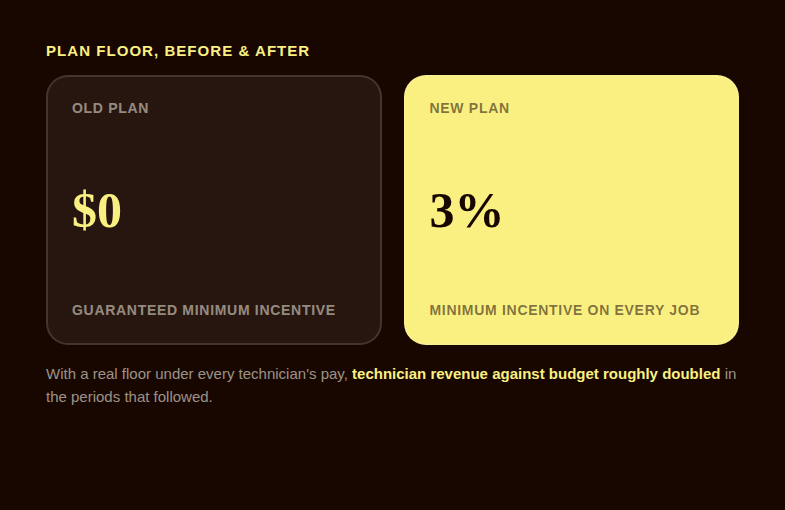
A floor sounds like a small change. In practice, it changes the psychology of the whole plan. Technicians no longer had to guess whether a job would trigger a spiff, or track which combination of programs applied to which job type. They knew, going in, what the minimum outcome looked like, and that certainty did more to stabilize behavior than any rate increase could have. It also gave leadership a single lever to pull. Instead of managing a dozen overlapping bonus rules, they had one number they could model against revenue and margin, the same discipline behind a tiered commission redesign that replaced a flat rate with structure a technician could actually plan around.
Recognition That's Visible, Weekly, By Department
A pay floor solves the fairness problem. It does not, on its own, solve the motivation problem, and this is where most incentive redesigns stop too early. Money that shows up quietly in a paycheck two weeks after the work was done does very little to reinforce the behavior that earned it. So alongside the new commission structure, the company rolled out a points based recognition system that runs in parallel with pay: memberships sold, five star reviews earned, and a category of manually awarded points for the kind of contribution that does not fit neatly into a spreadsheet line.
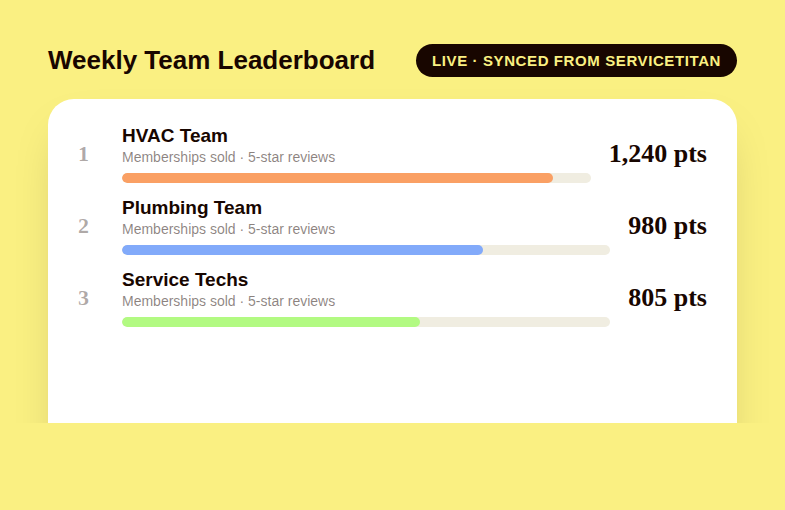
The points sync from ServiceTitan into a shared dashboard, broken out by department, updated at least weekly on a screen the whole team can see. That cadence matters more than it sounds like it should. A quarterly bonus is too far away to change Tuesday's behavior. A leaderboard that refreshes weekly, visible to HVAC, plumbing, and service technicians side by side, turns recognition into something closer to real time feedback, the same logic behind rebuilding a bonus structure so every role can actually explain how it is calculated. Technicians stopped asking the office to explain their bonus after the fact, because they could watch it accumulate all week.
There was a quieter benefit here too, one that mattered as much to the office as it did to the shop floor. Before the redesign, reconciling spiffs against commission at the end of a pay period meant someone in the back office manually cross-checking which bonuses applied to which jobs, a task that grew more error-prone every time a new spiff got added on top of the old ones. Once the points system and the commission floor were both wired directly into ServiceTitan, that reconciliation happened automatically, in the background, continuously. The office stopped spending pay-period afternoons untangling a plan nobody could fully explain, and started spending that time on work that actually grew the business.
Profit sharing
made simple.
Give your team a stake in the company’s success. ShareWillow helps you create and manage profit-sharing programs that motivate employees and drive business results.
From 58.5% To Under 40%, And a Target Still Ahead
Here is the part worth being honest about, because a real result is more useful than a tidy one. HVAC labor cost did not snap to the 35% target overnight. It moved from 58.5% of revenue down toward the high 30s, landing under 40%, with the company still working the last several points toward its actual goal. That is the shape most real turnarounds take: a large, fast improvement from fixing the structural problem, followed by a slower grind to close the remaining gap through better job costing, sharper scheduling, and continued tuning of the plan itself.
The other number that moved was less expected. Once the minimum incentive threshold gave every technician a floor to build from, and the leaderboard gave them a weekly reason to push past it, technician revenue against budget roughly doubled. That is not a coincidence of two unrelated changes. A technician who trusts the floor is willing to chase the upside on top of it, and a technician who can see their standing every week has a reason to chase it today instead of someday.
For a facility manager or business owner watching this from a budgeting seat, the more useful takeaway might not be the size of the drop at all. It is how much easier the number became to forecast. A labor cost built from a dozen overlapping, hand-tracked bonus rules is nearly impossible to model into next quarter's budget with any confidence. A labor cost built from one guaranteed floor and one automated points system is a line item you can actually plan around, which matters just as much to the person building next year's budget as it does to the technician earning the paycheck.
What This Means If Your Labor Percentage Feels Like a Mystery
If your own labor number has crept somewhere you cannot fully explain, the fix is rarely a rate cut. Start by listing every spiff, bonus, and commission rule currently active for a single role, then add them up the way a technician actually experiences them: stacked, on the same job, in the same week. Most owners are surprised by what they find. Layered incentives that each made sense in isolation almost always add up to more than anyone intended, and more than the business can sustain once volume climbs.
From there, the fix looks less like subtraction and more like consolidation. A short version of the audit that surfaced this company's stacking problem looks something like this:
- List every spiff, commission tier, and bonus rule active for one role today, including any that were added informally and never written down.
- Pull three recent paychecks for the same technician and confirm you can explain the full total from memory, without opening a spreadsheet.
- Check whether any of those rules can trigger on the same job at the same time, and whether that overlap was ever intentional.
- Decide on one guaranteed floor that replaces the patchwork, and confirm it is a number the business can sustain at your current volume, not just this month's volume.
- Put recognition on a cadence measured in days, not quarters, so technicians can see their own progress before the paycheck arrives.
Replace the patchwork with a single guaranteed floor everyone can explain in one sentence, and pair it with recognition that shows up on a timeline short enough to actually shape behavior, not just document it after the fact. A dashboard that updates weekly will do more for morale than a bonus that lands quarterly, even when the quarterly number is larger.
For HVAC and plumbing operators running multiple departments under one roof, the hardest part is rarely designing the right percentage. It is untangling the incentives that already exist so the new plan has a clean foundation to stand on. ShareWillow's plan design and reporting tools can model a guaranteed floor and a live leaderboard against your own technicians' actual production before a single paycheck changes.
Related reading
Conclusion
A runaway labor percentage is rarely a wage problem. Usually it is an incentive design problem wearing a wage problem's clothes.
Create incentives
that
drive results
You shouldn't need complex equity plans to align your team. ShareWillow makes it simple to create transparent profit-sharing programs that motivate employees and grow your business.

Incentive plans to help
small businesses thrive.
.png)
"I was able to leverage the knowledge of the ShareWillow team to learn how other companies were designing their bonus plans. The template was extremely helpful."

Brian Tustin
Owner, First Rate Movers
